
The Prime Directive, also known as Starfleet Command General Order 1, the Non-Interference Directive, or the principle of non-interference, was the embodiment of one of Starfleet's most important ethical principles: noninterference with other cultures and civilizations. At its core was the philosophical concept that covered personnel should refrain from interfering in the natural, unassisted, development of societies, even if such interference was well-intentioned.
The Prime Directive was viewed as so fundamental to Starfleet that officers swore to uphold the Prime Directive, even at the cost of their own life or the lives of their crew, though the literal application of this oath rarely if ever applied. Instead, the use and interpretation of the Prime Directive was flexible and varied considerably, depending on the discretion of the captain or commanding officer. (TOS: "Bread and Circuses", "A Piece of the Action"; DIS: "The Vulcan Hello"; TAS: "The Magicks of Megas-Tu", "Bem"; TNG: "Justice", "Symbiosis", "Who Watches The Watchers", "Redemption", "Homeward"; VOY: "Course: Oblivion"; Star Trek Into Darkness)
Text and structure
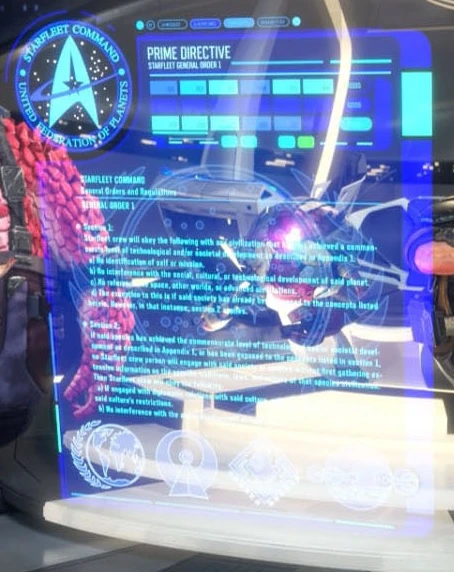

The text of General Order 1
In 2383, the text of General Order 1 included:
- Section 1:
- Starfleet crew will obey the following with any civilization that has not achieved a commensurate level of technological and/or societal development as described in Appendix 1.
- a) No identification of self or mission.
- b) No interference with the social, cultural, or technological development of said planet.
- c) No reference to space, other worlds, or advanced civilizations.
- d) The exception to this is if said society has already been exposed to the concepts listed herein. However, in that instance, section 2 applies.
- Section 2:
- If said species has achieved the commensurate level of technological and/or societal development as described in Appendix 1, or has been exposed to the concepts listed in section 1, no Starfleet crew person will engage with said society or species without first gathering extensive information on the specific traditions, laws, and culture of that species civilization. Then Starfleet crew will obey the following.
- a) If engaged with diplomatic relations with said culture, will stay within the confines of said culture's restrictions.
- b) No interference with the social development of said planet. (PRO: "First Con-tact")
In summation, Section 1 deals with pre-warp civilization, specifically on contact; section 2 deals with warp civilization in a diplomatic manner.
A complicated order, the Prime Directive had 47 sub-orders by the latter part of the 24th century. (VOY: "Infinite Regress")
The directive provided guidance on what constituted prohibited "interference" with a society, covering such matters as:
- Providing knowledge of other inhabited worlds (even if individuals or governments in the society were already aware of such) to peoples who had not started using warp technology (TOS: "Bread and Circuses"; TNG: "First Contact")
- Providing knowledge of technologies or science (TOS: "A Private Little War"; VOY: "Caretaker")
- Taking actions to generally affect a society's overall development (TOS: "Patterns of Force"; TNG: "Who Watches The Watchers")
- Taking actions which supported one faction within a society over another (TOS: "Patterns of Force", "The Omega Glory"; TNG: "Too Short A Season")
- Helping a society escape the negative consequences of its own actions (VOY: "Time and Again", "Thirty Days")
- Helping a society escape a natural disaster known to the society, even if inaction would result in a society's extinction, unless the society had warp technology and had formally requested aid (TNG: "Pen Pals", "Homeward", "The Masterpiece Society"; Star Trek Into Darkness)
- Subverting or avoiding the application of a society's laws (TOS: "Wolf in the Fold"; TNG: "Justice")
- Interfering in the internal affairs of a society (TOS: "Patterns of Force"; TNG: "Symbiosis", "Reunion", "Redemption", "Redemption II", "The Price"; DS9: "The Circle", "Inter Arma Enim Silent Leges"; VOY: "Thirty Days")
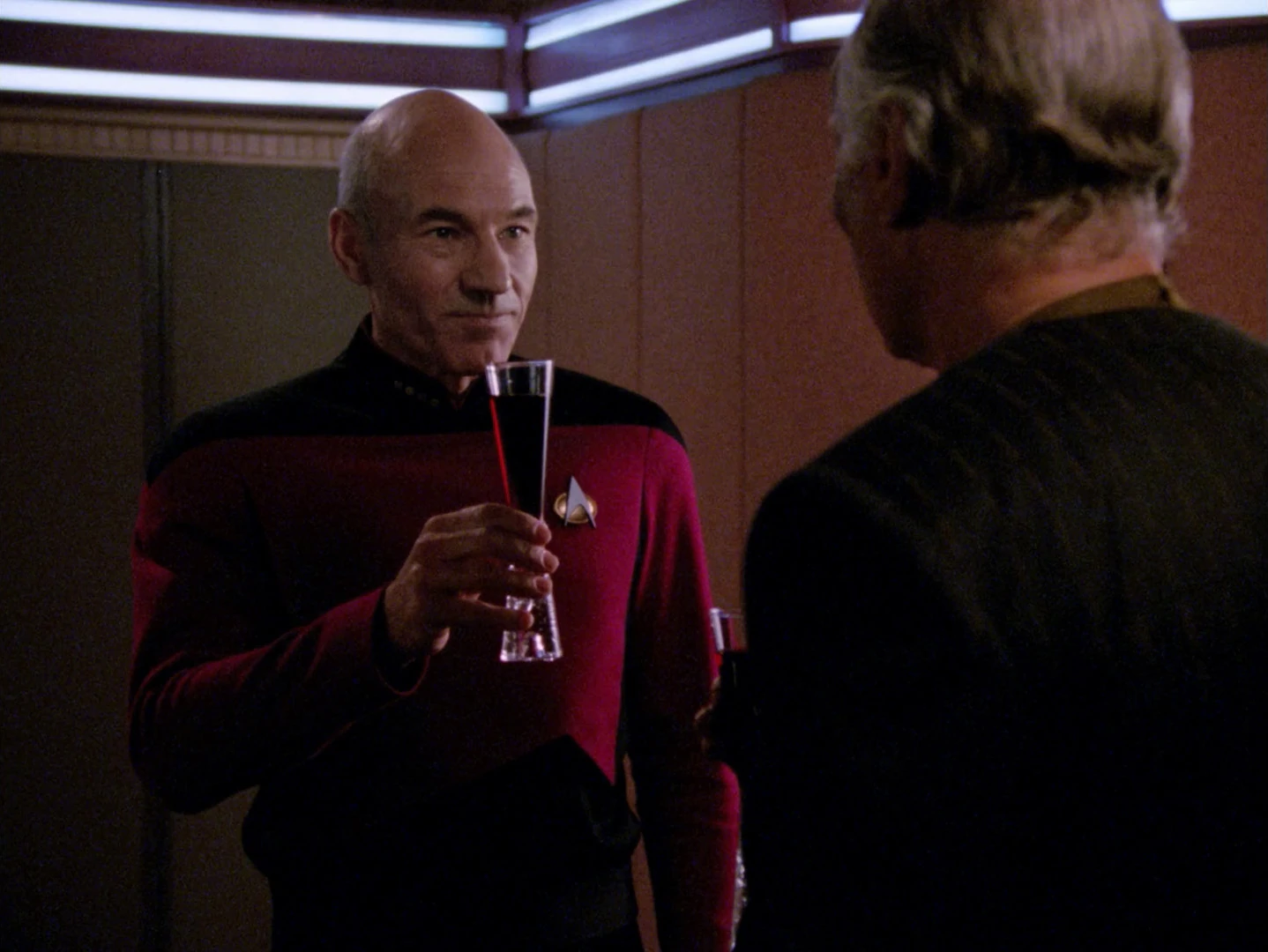

Captain Picard performs first contact diplomacy with the Malcorians (2367)
The Prime Directive also applied when Starfleet vessels made first contact with new species to establish formal diplomatic relations. Although introducing the concept of alien life would alter the trajectory of any civilization, the Prime Directive permitted initial contact with a species to occur if the civilization was advanced enough technologically, even if they had not yet developed warp drive. Sometimes, this would involve a small scouting mission with Starfleet representatives sent ahead to establish peaceful diplomatic relations with a few delegates or scientists of that planet, before formally revealing the existence of the Federation to the planet's greater society. In those circumstances, the Prime Directive required Starfleet members to take delicate care not to disrupt local culture or customs as they decided whether to join the galactic community. However, diplomatic gift exchanges were common and permitted within limits. (TNG: "First Contact")
History
By 1957, Vulcan High Command protocol reflected the principle of non-interference, prioritizing the avoidance of contaminating an alien culture over the lives of a crew. (ENT: "Carbon Creek")
In encountering the Akaali in 2151, Sub-Commander T'Pol reminded Captain Jonathan Archer that Vulcan protocol was to wait until a society had developed warp drive before initiating first contact, and that it would be wise for Starfleet to adopt the same. (ENT: "Civilization")
Later that year, Captain Archer and Doctor Phlox faced an ethical dilemma when Enterprise NX-01 encountered Valakis, and whether or not to interfere in the natural evolution of the Valakians over the Menk to cure an epidemic. In foreshadowing the Prime Directive, Archer commented that eventually Starfleet would have to "come up with some sort of a doctrine" establishing what Humans should and should not do while exploring space and interacting with other lifeforms. In the end, they decided that interfering with the natural evolutionary course of these two species would go against the "directive" upon which they based their entire mission: to meet new species and attempt peaceful communications, not to "play God". (ENT: "Dear Doctor")
Captain Archer further wrestled with "the fine line between doing what I think is right and interfering with other species" in dealings with the Vissians and the Gosis' species. (ENT: "The Communicator", "Cogenitor")
Starfleet's non-interference directive had not yet been established in 2168, when the Horizon encountered and contaminated Sigma Iotia II. (TOS: "A Piece of the Action")
In 2259, the Federation Council doubled down on enforcing General Order 1 after an incident on Kiley 279, labeling it the "Prime Directive." (SNW: "Strange New Worlds")
The directive remained in effect well into the 24th century and applied to at least Starfleet and Merchant Marine personnel, but specifically did not apply to ordinary Federation citizens. (TOS: "Bread and Circuses"; TNG: "Angel One") Despite this, it was occasionally described as a principle of the Federation or its people, and also space exploration. (TNG: "Symbiosis"; Star Trek: Insurrection; VOY: "Time and Again", "Prime Factors", "False Profits")
In 2371, the Sikarians had a similar policy preventing the sharing of certain technologies with the USS Voyager. (VOY: "Prime Factors")
In the 32nd century, following The Burn in 3069, the Emerald Chain flouted the Prime Directive when it made reckless first contact with species. (DIS: "The Sanctuary", "There Is A Tide...")
Reach and application
The Prime Directive primarily applied to societies that had little to no knowledge of other worlds and space-faring civilizations (as with certain pre-warp civilizations). (TOS: "Bread and Circuses"; TNG: "First Contact", "Who Watches The Watchers") But it also applied to the internal affairs of societies which knew extensively of other worlds (for example, interference in purely internal affairs by Starfleet was not permitted in the Klingon Civil War). Most Human colonies were excluded from its coverage altogether; but Human settlements established by aliens prior to official Human first contact were still covered, as they were regarded as pre-warp civilizations. (TNG: "The Masterpiece Society"; TOS: "The Paradise Syndrome"; DIS: "New Eden")
Some actions were clearly forbidden by the Prime Directive when it did apply to a society. Others were subject to interpretation, with commanding officers in Starfleet being given great discretionary powers regarding how and whether the Prime Directive would apply to specific situations. This promoted debate among command crews about whether the Prime Directive would (or should) apply, and how best to balance competing ethical priorities. (TOS: "The Return of the Archons", "The Apple", "For the World is Hollow and I Have Touched the Sky", "A Private Little War"; TNG: "Conspiracy", "Justice", "Pen Pals", "Who Watches The Watchers"; DS9: "Captive Pursuit"; VOY: "Time and Again", "Prototype")
If a decision was made by the commanding officer that could potentially be a violation of the Prime Directive, the conclusions and rationale would need to be recorded and justified to Starfleet through the ship's or station's logs. (TNG: "Coming of Age")
Any action deemed to have violated the Prime Directive (including through claiming an unjustified exception or having a weak rationale regarding actions otherwise constituting a violation) could result in punishment ranging from a formal reprimand, a possible demotion of rank, or possible arrest and court martial. However, many violations by prominent Starfleet personnel were never formally punished, and discretion was left to commanding officers on the strictness of the Prime Directive's enforcement. (DS9: "Captive Pursuit"; VOY: "Thirty Days"; TOS: "Errand of Mercy", "The Omega Glory")
Inconsistencies, exceptions and violations
The Prime Directive, especially of Section 1, had exceptions and allowed for violations if satisfactory reasons were given. (TOS: "The Omega Glory")
Some examples of exception to Section 1 included:
- The Prime Directive in 23rd century is seen to apply only to "a living, growing culture"; therefore a society that was kept stagnant by a sentinent individual can be intepreted to allow interference. (TOS: "The Return of the Archons", "The Apple")
- Cultures already contaminated could be "repaired" (TOS: "A Piece of the Action", "Patterns of Force"; TNG: "Who Watches The Watchers", "Homeward"; VOY: "Thirty Days")
- Likewise, cultures already contaminated that could be "repaired", but the repairs do not interfere with the natural pre-contact growth of the society (TOS: "Bread and Circuses", "Assignment: Earth", "The Paradise Syndrome"; TNG: "Pen Pals", "Thine Own Self", "First Contact")
- A pre-warp culture, if openly or officially contacted/contaiminated by a member world prior to that member world's joining, can still be contacted by only those of that member world, and they cannot reference anything regarding the Federation or its members. In turn, Federation can send those of the member (or disguised sufficently) on missions on those worlds. This is considered the "Prime loophole" (SNW: "Four-and-a-Half Vulcans")
- A society that sent a general distress call to any space-faring culture could have been exempt (TOS: "Miri"; TNG: "Pen Pals").
- If a material injustice involving a Federation citizen would occur absent the interference, the situation could qualify. (TNG: "Justice")
- If the quadrant in which the culture resided had lost a large number of lives, an exemption could be made (TOS: "A Taste of Armageddon")
- The society was previously interfered with by non-Federation citizens (e.g., Klingons) in a manner that would have violated the Prime Directive had it been done by Starfleet personnel (TOS: "A Private Little War"; VOY: "False Profits")
Society that either had developed warp, or soon-to-warp, are exempted from Section 1 as per part D. Examples include:
- Pre-warp or soon-to-warp societies that had been contacted by Starfleet, but upon recommendation by the contact/survey team, the planet was nonetheless subject to the Prime Directive as though such contact had not occurred. After such judgement, Section 1 applies. (TOS: "A Private Little War"; TNG: "First Contact")
- The society was in diplomatic discussions with the Federation (TNG: "Encounter at Farpoint")
- If a society already knew of and had contacted the Federation (e.g., seeking assistance; treaty matters) (TNG: "Datalore", "Deja Q")
- The society hails or attacks a Federation vessel (TOS: "The Corbomite Maneuver"; VOY: "Thirty Days")
- Rescue missions (TNG: "Transfigurations")
- Compliance with specific orders that could not be followed if the Prime Directive fully applied (e.g., ancillary to a war with the Federation; first contact missions; diplomatic missions; trade negotiations) (TOS: "Errand of Mercy", "Spectre of the Gun", "A Taste of Armageddon", "Friday's Child"; TNG: "First Contact"; DS9: "In the Pale Moonlight")
Nonetheless, Section 2 applies, even if they are consider as Enemy of Federation.
The Omega Directive was a classified Starfleet general order concerning the destruction of Omega molecules that was considered so important that it superceded the Prime Directive, and could result in its temporary suspension. (VOY: "The Omega Directive")
Federation citizens did not need an exception as the Prime Directive did not apply to them. In fact, under the rules as defined in the Directive in the 24th century, a Starfleet crew was forbidden from forcibly removing Federation citizens from a world, even if they had intentionally and materially interfered with the culture of a world in a way that would otherwise have been prohibited by the Prime Directive. (TNG: "Angel One")
A Red Directive mission, which was a mission of utmost urgency and a level of secrecy that could supersede even the authority of Starfleet's commander in chief, may also supersede the Prime Directive as the USS Discovery didn't get into trouble for violating the Prime Directive while on a Red Directive mission. (DIS: "Whistlespeak")
Interference with societies unaware of other worlds
- In 2259 of the alternate reality, Captain Kirk learned a volcano on the planet Nibiru was going to erupt and render the Nibirans extinct. He and Leonard McCoy went to great lengths to relocate them from their settlement before the eruption. However, Kirk chose to violate the Prime Directive anyway when he moved the USS Enterprise into position over the volcano to transport the stranded Spock before the cold fusion device he placed inside detonated, prompting the Nibirans to draw a picture of the starship in the soil and accept it as a deity. (Star Trek Into Darkness)
- In 2246, Captain Robert April warned the Perricans, a pre-warp civilization, of an apocalyptic meteor shower about to impact their planet. (SNW: "Ad Astra per Aspera")
- In 2248, Captain April sent his science officer to share Federation technology to halt an extinction-level drought on the pre-warp planet Na'rel. (SNW: "Ad Astra per Aspera")
- At unknown date before 2259, Captain April beamed down to the planet Man-us II without his security officer and revealing his starship to the pre-warp Ohawk civilization. (SNW: "Ad Astra per Aspera")
- In 2259, Captain Christopher Pike took the Enterprise to the planet Kiley 279 to investigate the disappearance of the crew of the USS Archer during a first contact mission. Upon investigation, it was discovered the Kiley people had reverse-engineered matter-antimatter reaction into a devastating weapon due to discovering the events of the Battle near Xahea the previous year by accident. To prevent the planet's inhabitants from destroying each other, Pike revealed the Enterprise to the Kiley and urged them to work for something better, reasoning beforehand that General Order 1 had already been violated and their only option was to change the destructive violation to a constructive one. The Federation Council was upset at this, but couldn't punish Pike and his crew due to the battle being classified information. They did, however, start pushing for a greater importance for General Order 1, intending on renaming it the "Prime Directive". (SNW: "Strange New Worlds")
- Later that same year, the Enterprise was tasked to return to Rigel VII, the site of a disastrous investigation five years prior, after the Starfleet Delta was discovered on photographs of the planet. It was discovered that the Enterprise's former yeoman, Zac Nguyen had become leader of the planet and outfitted the guards with Starfleet-issued weaponry to suppress the Kalar who were stripped of their memories outside the castle due to radiation that permeated the planet due to an asteroid that landed. Upon arresting Zac, Pike ordered the asteroid pulled out and launched into space, noting that its presence was stunting the civilization's growth and arguing that the ship was merely correcting the course of natural development on the planet rather than interfering with it. (SNW: "Among the Lotus Eaters")
- In 2266, Captain Kirk took a landing party down to Miri in response to a general distress call. Once there, he and the rest of the landing party became infected with a virus that killed adults, but significantly slowed the aging process of those who had not yet entered puberty. Dr. Leonard McCoy discovered a cure for the virus, which was also given to the few children who remained alive on the planet and with whom the landing party had interacted. (TOS: "Miri")
- On stardate 3156.2, the USS Enterprise was trying to determine the fate of the starship Archon. After his entire crew was threatened with death by the Landru computer, Captain Kirk caused the computer to self-destruct by convincing it that it was harming the society that it was designed to protect. Kirk justified the interference by claiming that the society was not "a living, growing culture" and that as an arrested culture the Prime Directive did not apply to it. Following the destruction of the computer Kirk left behind a team of specialists to assist the planet with societal development in the absence of Landru. (TOS: "The Return of the Archons")
- On stardate 3715.3, Kirk ordered the Enterprise to destroy the Vaal computer that was caring for the inhabitants of Gamma Trianguli VI. Doing so saved his ship from destruction after the Vaal computer attacked the vessel. Kirk justified his action on the grounds that the people on the planet were essentially enslaved by a computer. As Kirk said at the time, "These people aren't living. They're existing. They don't create, produce, even think. They exist to service a machine... we owe it to them to interfere." Despite serious misgivings from his First Officer Spock about his rationale, Kirk decided that the society was – as were the followers of Landru – an arrested culture and therefore not subject to the Prime Directive's prohibitions. (TOS: "The Apple")
- On stardate 2534.0, the crew of the Enterprise investigated the loss of contact with historian and cultural observer John Gill, who had been assigned to the planet Ekos. They discovered that Gill deliberately violated the Prime Directive in an attempt to reorder the planet's society into a version of Nazi Germany. Captain Kirk acted to reduce the effects of Gill's interference in the hopes of restoring the peace that had existed before Gill's arrival. Kirk's corrective interference resulted in the overthrow of the planetary government Gill had installed and allowed for a return to such peace. (TOS: "Patterns of Force")
- In an attempt to gain diplomatic alliances and hide their activities, the Klingons surreptitiously introduced advanced (for the planet) weapons to enemies of the Hill People on the planet Neural. Their belief was that once the Hill People were obliterated the planet would ally itself with the Klingon Empire. Discovering the interference on stardate 4211.4, Kirk felt that it was justified to "even the odds." Through corrective interference intended to eliminate the advantages introduced by the Klingons, Kirk decided to provide the Hill People similar weapons. (TOS: "A Private Little War")
- In 2268, Captain Ronald Tracey of the USS Exeter provided material support to one faction (the Kohms) on the planet Omega IV in their ongoing war with a rival faction (the Yangs). He did so primarily through strategic advice and extensively using his phaser during at least one battle otherwise fought with bladed weapons, spears, and arrows. Tracey's rationale for violating the Prime Directive was that he believed the planet was the source of a means for Humans to significantly extend their lifetimes; he saw protection of the Kohms as the best way to allow scientific study of that means. His conclusion was that the benefits of general life extension throughout Humankind outweighed his significant interference in the planet's society. (This was echoed a century later by a similar rationale used by Admiral Dougherty in his dealings with the Ba'ku.) Tracey was subsequently arrested by Captain Kirk for his violation. (TOS: "The Omega Glory"; Star Trek: Insurrection)
- On stardate 4842.6, Captain Kirk inadvertently became entangled with the native population of the planet Amerind after his memories were damaged by an alien device. He was proclaimed a god by the indigenous population of Native Americans, married the daughter of the chief, and fathered a child with her before having his memory restored. He was later rescued by Commander Spock and Dr. McCoy, who were also inadvertently seen in full uniform by the indigenous people. (TOS: "The Paradise Syndrome")
- Also in 2268, the USS Enterprise discovered the wreckage of the SS Beagle near the planet 892-IV. A merchant service vessel, the ship and its captain, R.M. Merik had been missing for six years at that time. Upon finding the planet Merik had been convinced that carrying knowledge of the planet elsewhere would damage the highly traditional society there; he and his crew therefore beamed down to live within the society. By the time the Enterprise arrived, Merik had been elevated to First Citizen, an influential leader within the society. Captain Kirk considered Merik's interference to have violated the Prime Directive, but Merik died before he could be charged or exonerated. During this mission Kirk provided a special commendation to Montgomery Scott as "Despite enormous temptation and strong personal feelings, he obeyed the Prime Directive. His temporary blackout of the city below resulted in no interference with the society and yet saved the lives of myself and the landing party." (TOS: "Bread and Circuses")
- In the late 2260s, the Enterprise detected a danger on Planet 0042692, but were unable to intervene directly because of the Prime Directive. Ensign David Garrovick undertook a solo mission to deal with the problem, but the shuttle Galileo crashed, resulting in first contact and extensive cultural contamination. The natives subsequently dubbed themselves Enderprizians, named their settlement New Enda-Prize, adopted Starfleet technology salvaged by Garrovick from the wreckage, and named themselves after various Enterprise crewmembers. When the USS Protostar made second contact in 2384, Doctor Boons (named after Doctor Leonard McCoy's nickname of "Bones") admitted to Dal R'El and Zero that Garrovick had told the Enderprizians of the Prime Directive and how they weren't ready for the Federation's technology or ideas. However, they had decided to adopt the Federation's ideals as something to believe in nonetheless. (PRO: "All the World's a Stage")
- In 2365, Lieutenant Commander Data answered a call for help from Sarjenka of Drema IV and maintained communication with her for eight weeks. Her planet was undergoing extreme seismic disturbances that the USS Enterprise-D could potentially correct. A highly emotive discussion took place among the senior staff on whether or not to interfere by resolving the problems on the planet, with mixed views on the application of the Prime Directive. The matter was settled after Captain Picard declared that the request for help allowed for an exception. Data later transported Sarjenka to the Enterprise to save her life, but her knowledge of the ship and of Data was erased from her memory. The Enterprise neutralized the seismic activity of the planet without the inhabitants being aware of it, thereby answering the call for aid while minimally interfering with the society. (TNG: "Pen Pals")
- A malfunction in an observation team's duck blind (a holographic projection to hide a Federation cultural observation post) in 2366 caused an explosion which was viewed by the people of Mintaka III. Despite multiple attempts by the crew of the Enterprise to eliminate the societal interference (including memory wipes and secret infiltration into the society), the result of this caused the Mintakans to revert into a religious belief in an Overseer (a god). The Mintakans had previously been on a social trajectory that included a rejection of religion, so in a final attempt to correct the inadvertent interference Captain Picard purposefully revealed aspects of the Federation to the leader of the Mintakans. This revelation showed that none of the crew were supernatural, and – while some limited knowledge of other worlds and societies remained – the corrective interference by Picard was intended to cause the Mintakans to return to their societal development as before. (TNG: "Who Watches The Watchers")
- In 2370 Nikolai Rozhenko was acting as an assigned cultural observer for a pre-warp society on Boraal II. During and after his assignment he committed at least three actions which had Prime Directive implications. First, he intervened to save a village of people on Boraal II from the destruction of their planet from natural causes (in direct contravention of Captain Picard's orders regarding the use of his ship for such purposes). Second, he fathered a child with a native of Boraal II. Third, he elected to remain with the village following its resettlement to Vacca VI. Rozhenko's plan to save the village was to transport the entire population to a holodeck on the Enterprise. He then intended to mask their relocation and knowledge of the Federation by using holodeck technology, thereby (in his opinion) acceptably minimizing the interference in their society while they were relocated to a different planet. Captain Picard disagreed with taking any action as saving the village from a natural disaster was in his opinion a Prime Directive violation. When presented with Rozhenko's fait accompli of having already transported the village to the Enterprise as Boraal II was dying, Picard chose to resettle the village on Vacca VI while simultaneously trying to minimize the societal interference (although one native of Boraal II committed suicide after he inadvertently discovered what was happening to his people). Rozhenko was later permitted to remain on Vacca VI following the successful resettlement of the village by the Enterprise. (TNG: "Homeward")
- In 2371, Captain Janeway and Lieutenant Paris both inadvertently interfered in a society on a class M planet in the Delta Quadrant and acted to repair that interference. While investigating a massive, planet-wide explosion that caused subspace to be ripped into many fractures, Janeway and Paris were transported a day back in time through one such fracture. One day later, the subsequent efforts by the crew of the starship USS Voyager to rescue them caused the explosion that destroyed the surface of the planet. After the loop was completed at least once, Janeway recognized the danger presented by the rescue attempt and prevented the crew's inadvertent interference from triggering the explosion. The timeline in which the explosion never happened became the primary one such that the society was not interfered with in any respect. (VOY: "Time and Again")
- When two Ferengi attempted to exploit the people of Takar by posing as the Holy Sages of Takarian myth after they were trapped there following the disruption of the Barzan wormhole, the crew of the USS Voyager decided to take them away from Takar, Captain Janeway reasoning that, even if the Ferengi were not part of the Federation, they were only present because of the Federations' actions, although she was forced to find some way to take them away from Takar without compromising the Takarians' religious beliefs and making the cultural situation on the planet even worse (VOY: "False Profits").
- Following a battle with a D-12 Bird-of-Prey commanded by Lursa and B'Etor, the Enterprise-D's primary hull was forced to crash-land on Veridian III. Following the rescue of the ship's crew, despite initially deeming the Enterprise-D unsalvageable, Starfleet retrieved the saucer section from the planet to avoid contaminating the pre-warp civilization on Veridian IV, with the saucer section being sent to the Fleet Museum for storage. Section 31 also recovered Kirk's body and transported it to Daystrom Station to be used in Project Phoenix. (Star Trek Generations; PIC: "Vox", "The Bounty")
- In 2376, USS Voyager became trapped in orbit around a planet with a unique tachyon core and subject to intense gravimetric forces, which resulted in time on the planet flowing at an accelerated rate of a day passing on the planet for every second that passed on Voyager. Due to the intense gravity forces, Voyager became trapped in the planet's orbit, where it essentially became a third pole, triggering various seismic events down on the planet, as well as serving as an inspiration of various myths and legends as it was visible as an apparent star from the surface. Although the presence of Voyager influenced the planet's culture to the point that they developed space travel just to make contact with the ship, and the issues of the Prime Directive were acknowledged when pre-spaceflight civilizations tried to make contact with the crew, it could be argued that Voyager did everything possible to leave orbit, and only had such an extreme impact on the planet's civilization due to their inability to move on and the unique temporal conditions of the encounter. (VOY: "Blink of an Eye")
- In 2378, Seven of Nine and Commander Chakotay crashed through an energy barrier protecting the Ventu on Ledos, a pre-Bronze Age civilization that were considered by the Ledosians to be their evolutionary ancestors. Although inadvertent, the two's mere presence amongst the Vendu resulted in some cultural contamination as the Ventu were exposed to the two's advanced technology, took some of their shuttle debris as jewelry to match Seven's facial implant, and painted symbols on their foreheads similar to Chakotay's. Seven managed to modify the shuttle's deflector to take down the barrier, and Voyager beamed out all of the loose pieces of technology that were left behind to help limit the impact that they had had. However, the Delta Flyer was forced to destroy the deflector to keep the Ledosians from using it to interfere with the Ventu, a separate Prime Directive issue. (VOY: "Natural Law")
- In 2379 the inhabitants of Kolarus III lived in isolated pockets in a pre-warp civilization at an early stage of industrial development. Captain Picard, Data, and Worf were investigating positronic signatures on the planet's surface when they were unexpectedly attacked by a group of inhabitants. An ion storm had previously prevented them using the ship's transporters, and so the away team had landed in the shuttlecraft Argo and were using its all-terrain vehicle to collect what turned out to be scattered portions of B4. The away team responded to the attack with suppressing phaser fire and a rapid escape. This display of weaponry, the vehicle, the crew (in uniform), and the Argo itself were all observed by the inhabitants, whose memories were left intact. (Star Trek Nemesis)
- In 2380, Ensign Beckett Mariner single-handedly overthrew a regime with an oppressive rat creature society eating the lizard folk. Captain Carol Freeman beamed down to immediately correct Mariner's actions. Despite Mariner proclaiming "Screw the Prime Directive!" and trying to justify saving a race, Freeman revealed that, despite it, they were quite peaceful and she had to explain why there was now an inter-species war. (LD: "Crisis Point")
- Later that same year, the USS Cerritos returned to Beta III, learning that the Landru computer had been reactivated. Captain Freeman and Commander Jack Ransom beamed to the surface to force the Betans back on their corrective path as it seemed that no one of the previous generation had warned them of its dangers. Freeman later complained about how someone should have kept an eye on them, but Ransom pointed out the Prime Directive forbade such an action unless Starfleet ordered them. (LD: "No Small Parts")
- Sometime before 2381, former Ensign Peanut Hamper, who had deserted the Cerritos when it was under attack by the Pakleds, crash-landed on Areolus, a pre-warp civilization that had initially been space-faring. Despite holding the affections of the Areore Rawda, Peanut Hamper conspired to engineer a set of heroics to get her off the planet and back into Starfleet. She lured the Drookmani to the planet and set out a distress call to the Cerritos, which upset Freeman as she had now added breaking the Prime Directive to her list of misdeeds. Though the captain was initially willing to look past this and welcome the Exocomp back after she stopped the Drookmani, the resulting revelation of her duplicity and her indignant attempt to call the Borg landed her in Daystrom Institute's Self-Aware Megalomaniacal Computer Storage. (LD: "A Mathematically Perfect Redemption")
- Later that same year, the Cerritos participated in a Second Contact Race against the Texas-class USS Aledo. On the planet LT-358, Ensign D'Vana Tendi forced the stoppage of building an outpost upon discovering microbial life forms that may be sentient, allowing the Aledo to win the race. When Tendi lamented her actions cost them the race, she realized the Aledo did no such action. Captain Freeman, overhearing this, immediately contacted Vice Admiral Les Buenamigo–who had championed the class and, unknown to her, was sabotaging her career to do so–to declare victory by disqualification on the basis that the vessels were incapable of reacting to unexpected Prime Directive concerns and thus fundamentally unfit for duty. She planned to give a report to the Federation Council stating as such, but the argument was superseded by Ensign Sam Rutherford's realization that the class' artificial intelligence was dangerously emotionally unstable. (LD: "The Stars At Night")
- In 2382, the Enterprise-D from an alternate reality left behind a shuttle containing Lieutenant Commander Data which crashed on Dilmer III which had a pre-industrial civilization. An away team from the Cerritos, disguised as Dilmerians, found the shuttle wreckage and vaporized the debris using phasers in order to avoid it being found and recovered Data's head. However, a transporter mishap and time dilation left the team stranded for a year of relative time during which they had to be careful not to violate the Prime Directive. T'Lyn grew giant produce and created beauty products from a natural filament enhancer (hair enhancer) that she discovered by boiling the skin of the shnoop fruit which improved the lives of the Dilmerians. She considered neither action to have violated the Prime Directive as despite using her scientific knowledge, she utilized local resources to provide at-era products, thus accomplishing everything without utilizing advanced technology. Purple-Data also noted that "adding bounce to curls" wasn't exactly going to change the course of a civilization.
- One of the locals, Snell, saw Purple-Data's head powered up and talking to Tendi. In order to make things right, Tendi drew Data's face on a giant grape and fooled the locals into thinking that Snell was just a loser who was seeing things and making things up. Although Lieutenant junior grade Beckett Mariner asked about the solution potentially also breaking the Prime Directive, Purple-Data noted that it wouldn't be a problem as Snell had been exhibiting the traits of a loser well before he saw Purple-Data's head. After receiving Boimler's signal from a disguised return beacon, the away team moved to a location where the locals wouldn't see them beaming out. (LD: "Fully Dilated")
- In 2384, the USS Protostar crew rescued an aquathawn from poachers with Dal R'El noting that they had to be careful not to violate the Prime Directive in the process. Although Zero ultimately beamed the creature aboard the ship, the poachers did not appear to notice the beam out and just missed seeing the Protostar flying away. The crew's original intention had simply been to use an aquashuttle to lead the aquathawn safely away, but Gwyn became distracted by memories of her father suddenly resurfacing, causing the aquashuttle to get swallowed and the plan to change. Hologram Janeway noted that they had only almost broken the Prime Directive. (PRO: "Asylum")
- In 3191, while searching for the Progenitors' technology, Captain Michael Burnham and Lieutenant Sylvia Tilly encountered the pre-warp, pre-industrial Halem'nites who were protected by Denobulan technology, albeit disguised centuries earlier to avoid breaking the Prime Directive. Although the two were at first able to blend in, after Tilly's life fell into danger, Burnham decided to break the Prime Directive by directly revealing herself to Ohvahz and telling him the truth, something that her first officer Commander Rayner noted they'd have to answer for. However, Burnham insisted upon pressing forward, both to save Tilly and because the Halem'nites would face eventual extinction without someone to teach them how to maintain the weather modification tower. After saving Tilly and Ravah, Burnham filled Ohvahz in on the truth of other life in the galaxy, something that would change the entire Halem'nite belief system, albeit likely for the better as it would mean the end of pointless ritual sacrifices to their "gods," in reality the Denobulans who had originally planted the towers on the planet in secret. Burnham faced no known repercussions for this Prime Directive violation, possibly given the Red Directive mission that Discovery was on at the time. (DIS: "Whistlespeak")
Interference with societies aware of other worlds
- In 2261, the Vulcans requested that the USS Enterprise intervene in a dangerous situation on Tezaar, a pre-warp planet. This put the Federation on the other side of the Prime Directive: they were unable to help the Tezaarians directly as they weren't yet aware of the Federation. However, the Vulcans had what Pelia referred to as a "Prime loophole" as they had made contact with the Tezaarians before the founding of the United Federation of Planets. With the nuclear-based method provided by the Vulcans to power Tezaar in danger of overloading and destroying the planet, the Vulcans requested Starfleet fix it as they were too far away to help. Using the Kerkhovian serum to transform into Vulcans, Spock and four Enterprise crewmembers were able to fix the system without violating the Prime Directive. (SNW: "Four-and-a-Half Vulcans")
- In 2267, Captain Kirk severely damaged a computer system on Eminiar VII. The system was used in conjunction with a Vendikar computer system to simulate war between them (rather than truly wage it). Damaging the system abrogated a treaty between the two worlds and gave the planets the choice of either waging real war or agreeing to cease hostilities. Eminiar VII, for its part, attempted to choose the latter course with the help of a Federation ambassador. The interference occurred during diplomatic discussions with the Federation, and was ancillary to Kirk's invoking General Order 24. (TOS: "A Taste of Armageddon")
- Later in 2267, Kirk persuaded Spock's mirror double to work for significant cultural change in the Terran Empire. Had the actions occurred in the Federation's universe they would undoubted have constituted interference in the internal affairs of other societies. However, applicability of the Prime Directive to another universe had not previously been required to be contemplated as knowledge of such universes was a closely-held secret, and apparently not known to Kirk and his crew. (TOS: "Mirror, Mirror")
- During a Starfleet-ordered contact to open negotiations with the Capellans for mineral resources on stardate 3156.2, Captain Kirk prevented the Teer (leader) of certain tribes from killing the wife and unborn child of the former leader. This delay resulted in her giving birth to a child who was, by lineage, to be a future leader of the tribes. The actions were a counter-response to the overthrow and death of the legitimate leader due to Klingon influence. Since the deposed leader would otherwise have remained in power absent the Klingons, actions to preserve his lineage were an attempt to "repair" the society. (TOS: "Friday's Child")
- On stardate 2314, the Federation starship USS Origin saved the Lynd from extinction via non-consensual relocation. This incident established a legal precedent that amended Book 12, Section 2386, Subsection 89 of the Starfleet Command General Orders and Regulations, in that Starfleet officers were permitted to "contradict alien morality" when engaging with non-ally species if the race in question was in "mortal danger as established by Case Coth v Farah of stardate 2289. (SA: "Vox In Excelso")
- In 2319, then-Captain Mark Jameson of the USS Gettysburg supplied weapons to the leader of one faction, Karnas, on Mordan IV in exchange for the release of Federation hostages. However, he also supplied Karnas' rival factions with equivalent weaponry. The net result was the affected society was plunged into decades of civil war. His rationale, later given to Captain Jean-Luc Picard, was that arming both sides was intended to maintain a balance of power, save the hostages, and negate his interference. (Jameson, however, also mentioned that he falsified records of this event to Starfleet indicating his confidence in the validity of his excuse was not as high as he later claimed.) Jameson died prior to any action being taken as a result of his interference becoming known, although Picard had previously expressed sympathy for the result of his actions, arguing that Karnas could have chosen to work for peace rather than continue his vendetta. (TNG: "Too Short A Season")
- Captain Picard interfered with the Edo society of Rubicun III on stardate 41255. First, he prevented the lawful execution of a Federation citizen (Wesley Crusher) for having inadvertently disturbed some new plantings. Second, while questioning a representative of the Edo regarding an investigation into what a powerful alien ship might do should he prevent the execution, Picard revealed that the Edo's god was an orbiting installation. Picard justified his actions to Starfleet by claiming that the execution – the sole punishment of the Edo for unlawful activity – would result in such a material injustice to Wesley that the interference in the internal affairs of the Edo was justified. (TNG: "Justice", "Coming of Age")
- When participating in a rescue mission of a J'naii ship, Commander Riker developed a relationship with Soren, who self-identified as female despite the J'naii being a genderless race and such an attitude being considered a sign of illness. When Soren's self-identification as female was discovered, she was forced to undergo psychotectic treatment to "cure" her of this; Riker appealed to Picard to rescue Soren, but Picard declined despite his sympathies for his first officer as such an action would violate the Prime Directive (Riker and Worf attempted to rescue Soren anyway, but arrived too late to prevent the treatment) (TNG: "The Outcast").
- In 2369, Chief Miles O'Brien took actions on the space station Deep Space 9 which interfered in the progression of a "hunt" between a group of Hunters and their quarry, a Tosk. The hunt was culturally significant to their society, and interference in the hunt was deemed by the station's commanding officer, Commander Sisko, to represent a violation of the Prime Directive. Sisko remarked that an exception permitting the interference would have existed had the Tosk affirmatively requested asylum from the Federation, but the Tosk considered such a request shameful. O'Brien's actions to nevertheless help the Tosk escape from the Hunters earned him a reprimand in his Starfleet record – although he justified his actions as restoring the hunt to its original level by allowing Tosk and the Hunters to continue as though they'd never come to DS9 – even though Sisko privately sympathized with his motives and was unofficially complicit in O'Brien's aid, ordering O'Brien to be stopped by Constable Odo ... at a leisurely pace. (DS9: "Captive Pursuit")
- Also in 2369, Commander Sisko offered to remove the Ennis and the Nol-Ennis from their moon prison. Dr. Julian Bashir suggested that doing so might amount to a "jail break," thereby interfering with their society's administration of justice. Sisko replied that as the commanding officer he believed the Federation would consider the artificial microbes infused into the prisoners' systems sufficient for them to be seen as "separate and unique" from their original society, while the prisoners themselves had clearly suffered more than enough for their original crime after spending so long dying and being reborn. This would make the Prime Directive inapplicable. It remained a theoretical discussion, as no one was removed from the prison due to the microbes rendering it impossible for anyone infected by them to leave the moon. (DS9: "Battle Lines")
- In 2371 (stardate 48315.6), Captain Kathryn Janeway destroyed the Caretaker's array. This was done after the Caretaker had, as he was dying, initiated a self-destruct program. The Caretaker's reason for destroying the array was to prevent the Kazon from using it against the Ocampa – a race the Caretaker was nurturing and protecting. That program malfunctioned due to a Kazon ship colliding with the array following a battle with the Val Jean. Lt. Tuvok advised Janeway of the potential Prime Directive issues of becoming involved in internal societal matters when he said that destroying the array "would affect the balance of power in this system. The Prime Directive would seem to apply." However, because the Kazon ship would not have collided with the array but for the unintended arrival in the system of Voyager and the Val Jean, Janeway's destruction of the array was a corrective action that reinstated the Caretaker's self-destruct plan. Her actions therefore reinstated events that would have occurred absent Voyager's forcibly becoming involved. (VOY: "Caretaker")
- In 2372, Lieutenant Torres assisted the Pralor Automated Personnel Units (APU) in developing a way to reproduce themselves. When first encountered by Voyager the Pralor APUs were found to be designed such that they could not create additional APUs. Torres had argued to Captain Janeway that helping the APUs to work around that design would "save them from extinction" since over time the APUs were becoming non-functional (either through age, accident, or war). Janeway refused, likening the modified design under consideration to being the "equivalent of altering their genetic structure," and therefore a Prime Directive violation. Saying that "extinction is often the natural end of evolution," Janeway refused to permit Torres to continue. The APU later kidnapped Torres and forced her, under duress, to develop a prototype that could serve as the new design standard and permit reproduction. Prior to her rescue Torres destroyed her work (in part because of revelations that the new design would be used primarily to gain advantage in a war). This action denied the APUs access to her design changes and eliminated the interference. (VOY: "Prototype")
- In the early to mid 2370s, Captain Rudolph Ransom and the crew of the USS Equinox killed multiple nucleogenic lifeforms and used their bodies for fuel to greatly enhance their warp drive. Ransom felt that he was justified under Starfleet Regulation 3, which provided that "in the event of imminent destruction, a captain is authorized to preserve the lives of his crew by any justifiable means." Captain Janeway rejected this reasoning, and declared his systematic murder of members of an alien society to be a direct violation of the Prime Directive. Ransom, preferring to fight both Voyager and the nucleogenic lifeforms rather than spend "thirty years in [the] brig," was eventually killed himself when the Equinox was destroyed by the aliens he had been killing. (VOY: "Equinox", "Equinox, Part II")
- In 2373, the USS Voyager was crossing the Void, an area of space that was completely black, inhabited only by a race that had evolved to cope without light. This area was being used by a Malon freighter to dispose of their toxic waste via a Spatial vortex that led from the edge of the Void to the heart of it. When Voyager found out what was going on, the crew initially proposed giving the Malon access to Starfleet's own recycling technology, but when this offer was rejected, they instead destroyed the spatial vortex after taking a final trip through it to the other end of the void. Although the Malon had not developed the offered recycling technology themselves, Chakotay noted that their technology showed signs of the essential framework already, with Voyager thus just offering to give the Malon a slight 'nudge' rather than offering them anything explicitly advanced, and their actions to aid the Night Aliens restoring their natural way of life, particularly since only a small portion of the Malon knew about the vortex rather than it being in mass use. (VOY: "Night")
- In 2374, Captain Benjamin Sisko worked with Elim Garak to force the Romulan Empire to enter into Dominion War under false pretenses. The Romulans up to that point had remained neutral in the conflict. Sisko and Starfleet felt that Federation and Klingon Empire would lose the war with the Dominion if they did not gain another ally. Both Sisko and Garak, with the knowledge and approval of Starfleet Command, created false evidence that ultimately convinced the Romulans that the Dominion was planning to renege on the Peace Treaty between the two governments and mount a full scale invasion. Participation in the war by the Romulans resulted in massive military and civilian casualties within Romulan society. (DS9: "In the Pale Moonlight")
- Captain Sisko used his superior knowledge regarding the engineering systems of the USS Defiant as well as his Starfleet tactical training and experience to help the Terran Resistance Forces in the mirror universe win a major victory against the Klingon-Cardassian Alliance under the command of Worf.
- Worf challenged and killed Gowron, Chancellor of the Klingon Empire, in 2375. Worf's motive was he believed that Gowron was deliberately mishandling Klingon forces in an attempt to destroy the reputation of General Martok, thereby risking the entire war effort against the Dominion for personal political gain. Due to this Worf had previously been authorized by Captain Sisko to use whatever means were necessary to resolve the issue. Worf defeated Gowron in single combat, and for a few moments was hailed by the assembled Klingons as Chancellor of the Klingon Empire. However, he immediately abdicated in favor of Martok, who assumed the mantle. Prior to the duel Worf removed his combadge and indicated that he was not acting as a Starfleet officer but rather simply as a Klingon. (DS9: "Tacking Into the Wind")
- Also in 2375, Tom Paris attempted to influence the government of the Monean World Ocean to take more aggressive action to save their water-world from dissipation into space. When Paris proposed that some kind of direct interference take place to cause an otherwise recalcitrant Monean government to act, Captain Janeway declared that such interference with the internal workings of a government to be a violation of the Prime Directive. She thereafter forbade Paris from taking any such actions. Paris nonetheless attempted to destroy an oxygen refinery to demonstrate the dangers of continuing to operate them as the Moneans had been doing. His attempt was thwarted by Voyager, though. As a result Paris was demoted to the rank of ensign and incarcerated in Voyager's brig for thirty days for insubordination, unauthorized use of a spacecraft, reckless endangerment, and conduct unbecoming an officer. (VOY: "Thirty Days")
- In 2375, Admiral Dougherty, acting on orders from the Federation Council, formed an alliance with the Son'a to forcibly relocate the entire Ba'ku population (approximately six hundred individuals) from their planet. This was intended to permit Son'a technology to collect metaphasic particles from the planet's rings and was required as the planet would become uninhabitable for decades after the life-extending particles were collected. Dougherty's rationale for interfering with the Ba'ku was that the Prime Directive simply did not apply. He stated that since the Ba'ku were not indigenous to the planet and that they "were never meant to be immortal," that removing them would simply be restoring their natural evolution. Dougherty's true motivation, however, was that collection of the particles could double lifespans throughout the Federation and that an entire new medical science would evolve as a result. Captain Picard did not accept this reason for an exception to the Prime Directive. He instead believed that Starfleet's participation in a forced relocation of a society would be "an attack on the very soul of the Federation." Picard therefore disobeyed Dougherty's direct orders, conspired with fellow crew members to commit an armed insurrection against the admiral and his allies, and was threatened with a court martial when captured. Picard believed his refusal to accept orders that voided the Prime Directive was justified and that if "a court martial is the only way to tell the people of the Federation what happened here, then I welcome it." Picard's actions ultimately prevented the relocation of the Ba'ku and did not result in either his loss of rank or command. (Star Trek: Insurrection)
- In 2378, a shuttlecraft from Voyager crashed through an energy barrier set up by Species 312 to protect the Ventu from the Ledosians. In order to return to the ship, Seven of Nine modified the shuttle's deflector to take down the barrier, which allowed the Ledosians the ability to send explorers and to interfere with the protected culture of the Ventu. Although the crew had some debate about whether or not to allow it, Captain Janeway decided not to and to have Voyager reclaim the deflector once the Ledosian explorers were evacuated, telling the Ledosian ambassador that the Federation had a strict policy against leaving their technology in the hands of other cultures as doing so often had damaging consequences. In response, a Ledosian patrol ship disabled Voyager's transporters in a targeted strike and attempted to force the ship to leave the deflector behind. When the Delta Flyer tried to retrieve the deflector after beaming up the Ledosian team, the Ledosians similarly disabled that ship's transporters. Finally, with no other choice, Paris used the Delta Flyer's phasers to destroy the deflector, restoring the barrier protecting the Ventu. However, Seven expressed a concern that having gotten a scan of her modifications to the deflector, the Ledosians might eventually be able to duplicate it and take down the barrier themselves in time. (VOY: "Natural Law")
- Later that year, Voyager was unable to help the Talaxian asteroid colony against Commander Nocona due to the Prime Directive, causing Neelix, who was not a member of Starfleet and thus not bound by the directive, to help on his own. Nevertheless, the Delta Flyer aided the Talaxians in laying down a shield grid over the asteroid by coming to Neelix's rescue when he made a suicide run to intercept a thermolytic charge. When Neelix brought up the Prime Directive violation, Janeway stated that they were just helping a friend in distress rather than aiding the Talaxians directly. (VOY: "Homestead")
- In 2382, Lieutenant junior grade Brad Boimler and Beckett Mariner's attempts to help Ma'ah regain his captaincy resulted in something of a political shakeup, potentially meaning that they violated the Prime Directive. The Starfleet officers helped Ma'ah challenge Bargh, the leader of the Klingon Oversight Council and the commander of a Klingon fleet. Bargh had strong anti-Federation beliefs and refused to allow Starfleet to investigate a quantum fissure in Klingon space, so Boimler and Mariner turned to Ma'ah who was an old friend of Mariner's for help. Requiring Ma'ah's help for the mission, along with their personal sympathies for the disgraced Klingon officer, necessitated them helping Ma'ah to regain his captaincy. It was Mariner's idea to use the Rite of Forced Conscription against Bargh, ultimately leading to Ma'ah killing him in a duel, although that wasn't Mariner's intention. As a result of the intervention of the two Starfleet officers in Klingon internal matters, a highly ranked strongly anti-Federation Klingon officer met his end, one who led the Klingon Oversight Council and had enormous political power to the point of blocking all of Ma'ah's appeals due to his hatred for the former captain over Ma'ah killing his brother Dorg. (LD: "A Farewell To Farms")
- In 2385, The Doctor noted that Gwyn taking her crew behind enemy lines on Solum would technically not violate either Admiral Edward Jellico's direct orders or the Prime Directive as Gwyn's team was not Starfleet and Gwyn, as a native of Solum, had the right to return to help. In addition, while the Prime Directive prevented Starfleet from taking sides in the civil war, Janeway could offer Ilthuran political asylum. Wishing to join the mission, Maj'el resigned from Nova Squadron so that she would be considered non-Starfleet personnel. Janeway warned the team that, if they were caught, their actions would be disavowed by Starfleet, meaning that they were on their own for better or worse. However, after the team was captured, Janeway led a rescue mission and then agreed to help Gwyn stop Asencia, the tyrannical leader of the planet despite the fact that it violated the Prime Directive. The USS Voyager-A engaged Asencia's launching fleet to buy time for the plan to send the USS Protostar back in time using Asencia's technology to be completed, although the fleet was in the middle of launching to attack the Federation at the time. Ultimately though, Starfleet's intervention in the civil war was minimal with Gwyn and the Vau N'Akat rallying to overthrow their tyrannical ruler without any official Starfleet personnel being involved in Asencia's ultimate defeat and capture. Starfleet's direct involvement mainly consisted of transporting Gwyn's team to the planet and dealing with the ships in orbit that were in the middle of launching for an attack on every major Federation base across three quadrants. (PRO: "Brink", "Touch of Grey", "Ouroboros, Part I") Although Gwyn's team acted as the Protostar's crew and served on Voyager, they were technically not Starfleet yet as they had not yet entered Starfleet Academy at the time of Voyager's maiden voyage. (PRO: "Into the Breach, Part I")
Other notable matters
- The Prime Directive did not go into effect as a general order until sometime after the 2160s (which is when the crew of the starship Horizon left behind books on technology and culture that radically altered the course of civilization on the planet Sigma Iotia II). (TOS: "A Piece of the Action")
- While the Prime Directive was not officially formulated until after the 2160s, the fundamental principles were an important part of Earth Starfleet procedures as early as 2152, with the crew of the Enterprise going to great lengths to recover a communicator that had accidentally fallen out of Lieutenant Malcolm Reed's pocket during a survey mission on a pre-warp planet. (ENT: "The Communicator")
- On stardate 43775.5, the USS Enterprise-D received a mission order from an admiral at Starfleet Command. According to the mission specifications, contact with the living spacecraft code named "Tin Man" were to include considerations for the Prime Directive. (TNG: "Tin Man")
- Benjamin Sisko and his crew on Deep Space 9's orders were "to do everything short of violating the Prime Directive" to make Bajor and the Bajoran people ready for Federation membership. (DS9: "Emissary")
- A related order, known as the Temporal Prime Directive, was also created, mainly applicable to Starfleet officers time-traveling to the past. It prohibited them from interfering with past events, thereby altering the course of history; this included giving information about future events to individuals in the past, or taking action that would have been impossible with contemporary technology. (VOY: "Future's End, Part II", "Endgame")
- According to Rear Admiral Norah Satie on stardate 44769.2, Jean-Luc Picard had violated the Prime Directive a total of nine times since taking command of the USS Enterprise-D three and a half years prior, with Picard countering the argument by stating that, every time he had taken action to violate the Prime Directive, it had been done with careful thought and certainty that this was the right thing for him to do, also noting that he had provided Starfleet with full reports on his reasoning for taking that action after the fact. (TNG: "The Drumhead")
- In 2368, Picard lamented the impact of the Enterprise-D on the Genome colony of Moab IV, calling it a reminder of the importance of the Prime Directive. Commander William T. Riker stated that as the colonists were Human, the Prime Directive didn't apply, but Picard felt that it did as the Enterprise's very presence may have damaged or even destroyed the colony's way of life. (TNG: "The Masterpiece Society")
- In the 24th century, the Denobulans acted to save a pre-warp, pre-industrial civilization called the Halem'nites from extinction as the worsening dust storms threatened their very existence. The Denobulans placed five weather modification towers on the planet, but disguised them as mountains so as to not break the Prime Directive. However, the Halem'nites came to believe that the gods had saved them and began worshipping the beings who had planted the towers. (DIS: "Whistlespeak")
- In 2382, the Lily Sloane of an alternate quantum reality revealed that her universe had its own version of the Prime Directive where they were not yet allowed to contact other civilizations who had not developed the ability to cross realities while they were exploring. This prevented her from realizing that the USS Beagle was creating unexpected quantum fissures in addition to her intentionally-created ones because she was barred from talking to the people affected. (LD: "Fissure Quest")
- Technically, Wesley Crusher violated the Prime Directive by allowing himself to be captured and tortured so that Asencia would build the temporal technology needed to send the USS Protostar back in time, thus affecting the development of Solum's technology. However, Wesley was acting as a member of the Travelers at the time, not on behalf of the Federation. (PRO: "Brink") The temporal technology was later removed by the crew of the USS Voyager-A after first contact was made. (PRO: "Ouroboros, Part II")
- In the alternate timeline that the Diviner and the Vindicator came from, Starfleet refused to get involved in the Vau N'Akat's civil war because of the Prime Directive, causing the survivors to blame the Federation for their planet and species being decimated in the war which was caused by differing opinions on what to do after Starfleet initiated first contact. (PRO: "A Moral Star, Part 2", "Preludes")
- In 3195, during the Aaron Satie Debate Competiton, Cadet Caleb Mir argued that a core responsibility of Starfleet and its personnel was to provide aid to any sentient being in aid of assistance unless that assistance violated the Prime Directive. Providing and enforcing asylum for the surviving Klingons on Faan Alpha, the solution that Caleb was arguing for, did not violate the Prime Directive. (SA: "Vox In Excelso")
Attitudes toward the Prime Directive
"Oh, stop. This is a rounding error!"
"One that proves the Texas-class isn't fit for duty."
Starfleet as an organization had the greatest respect for and required compliance with the Prime Directive. (TOS: "The Omega Glory", "Bread and Circuses") But not all Federation citizens, or even all Starfleet personnel, believed that strict adherence to the Prime Directive under every circumstance was in the best interests of the civilizations it was designed to protect. Starfleet captains themselves had very different personal tolerances for the degree of flexibility to be applied to the Prime Directive. Captain James T. Kirk noted that the Prime Directive was intended to apply only to living, growing civilizations and felt it was appropriate to interfere where societies had been enslaved, were in a state of total stagnation (also known as an arrested culture), or even in mortal danger. (Star Trek Into Darkness; TOS: "Errand of Mercy", "The Return of the Archons", "The Apple") Captain Kirk also at least twice attempted to interfere in the internal affairs of a civilization when he believed that higher ethics compelled or justified such actions. (TOS: "Mirror, Mirror", "For the World is Hollow and I Have Touched the Sky")
Kirk's predecessor Captain Christopher Pike occasionally interfered in a civilization's development if he felt the circumstances were extreme enough. Examples of him doing so include the Kiley, a civilization which was in danger of destroying itself as a result of accidental prior interference, and the Kalar, a civilization which he realized had completely stagnated due to generations of widespread amnesia caused by radiation from a crashed asteroid. In the former case, he felt so duty-bound to save the Kiley from themselves that he openly stated "Screw General Order 1". In the latter case, Pike was able to justify his actions as fixing their evolutionary process which had been stagnated through other outside interference, something that Spock conceded was a logical argument for intervention that did not violate the Prime Directive. (SNW: "Strange New Worlds", "Among the Lotus Eaters")
Both Captains Picard and Janeway were prepared to watch whole societies perish from natural causes rather than interfere – even when others were seeking to prevail upon them that Starfleet's role should permit actively saving societies rather than passively watching them die. (TNG: "Homeward", "Pen Pals"; VOY: "Time and Again") This range of conduct could even be found within a single individual: Captain Janeway once opined that 23rd century Starfleet officers such as Kirk were "a little slower to invoke the Prime Directive," but she herself admitted to having "bent it on occasion" during her travels in the Delta Quadrant. (VOY: "Flashback", "Equinox") However, Janeway was a bit more lenient in later years, refusing to intervene directly in the Vau N'Akat Civil War, but agreeing to give Ilthuran political asylum and sending a team made up of non-Starfleet personnel to Solum, although she made it clear that Starfleet would disavow their actions if the team were to be caught. After the team was caught, Janeway instead personally led a rescue mission for them and, having been reminded that "boldness isn't only for the young," agreed to help stop the planet's tyrannical ruler, an act that directly violated the Prime Directive as Solum wasn't a Federation world nor had the Federation made official first contact yet. (PRO: "Brink", "Touch of Grey", "Ouroboros, Part I")
Shortly after coming aboard the Enterprise, Spock asked Number One if she had ever considered that the Prime Directive was not only unethical, but also illogical and perhaps morally indefensible. Chin-Riley quickly shut down this line of questioning by saying she had not, and for the sake of his sanity nor should Spock. (ST: "Q&A")
Appendices
Background information
The Star Trek Encyclopedia, 4th ed., vol. 2, p. 180 has a picture of a prop made for Admiral Christopher Pike's office in Star Trek Into Darkness. This prop has text for the first three Starfleet General Orders. General Order #1's text is as follows:
- As the rights of each sentient species to live in accordance with the normal cultural evolution is considered sacred, no Starfleet personnel may interfere with the normal and healthy development of alien life and culture.
- Such interference includes introducing superior knowledge, strength, or technology to a world whose society is incapable of handling such advantages wisely.
- Starfleet personnel may not violate the Prime Directive even to save their lives and/or their ship, unless they are acting to right an earlier violation or an accidental contamination of said culture. This directive takes precedence over any and all other considerations, and carries with it the highest moral obligation.
This phrasing of General Order One has its origins in the FASA Star Trek Role-Playing Game (The Federation sourcebook, p. 5). The text was slightly edited by the individual who made the prop for the film.
One of the TNG writers commented "who cares about Prime Directive issues?" (Cinefantastique, volume 24, issue 1, page 30)
Apocrypha


Kirk denies having ever violated the Prime Directive (DC Comics)
- In the TOS novel Strangers from the Sky, Vulcans had developed their own set of non-interference canon of laws in the 1870s. However, they did not hold Humans – with whom they made first contact – bound to these restrictions.
- In the ENT novel By the Book, Captain Archer had to decide whether to supply one of the two cultures he met with technology to bring them on the level of the more advanced society.
- In the TNG novel Double Helix: Double or Nothing the "Resolution of Non-Interference" was drafted and signed by all Federation members in 2175. By the 2190s the Prime Directive was in full force.
- In the TOS novel Prime Directive, a "Scale of Culture" was developed in the early 2200s in order to measure cultural development of a civilization and monitor its development.
- In the Department of Temporal Investigations novel Forgotten History, it is revealed that Kirk's last mission during the Enterprise's five-year mission involved him saving a planet from an environmental crisis where the nobles were willing to allow the general population to die as a test of faith. Recognizing that this policy would result in the planet's population dying out once the crisis was over, Kirk secretly supplied the natives with the medical supplies necessary for them to survive the attack, claiming to the locals that the medicine actually came from a part of the planet that had been destroyed by earlier disasters without admitting alien interference. He was subsequently sentenced to a court-martial for violating the Prime Directive, but Kirk's argument in defense of his actions (combined with an agent of the newly-formed Department of Temporal Investigations, who wanted access to the Enterprise's slingshot-capable engines) resulted in him being promoted to admiral, the court-martial board reasoning that this would be a reward to Kirk from the perspective of the public while it would privately be a punishment as Kirk wouldn't be a good fit for an admiralty position.
- According to the CD-ROM game Star Trek: 25th Anniversary, one of the most serious violations of the Prime Directive was an event known as "The Galahad Incident" caused by an unauthorized entry of the USS Galahad into the civil war on Shiva Omicron IV in 2208. The Galahad used its phasers to stun an army of the Jerion faction during an attempted massacre, causing the unconscious Jerions to be themselves massacred. This eventually led to the destruction of the Jerion culture. This event became a test case for measuring the competency of a starship captain. Captain Joshua Mulrone Grant was court-martialed and imprisoned for his part in the genocide. At his court martial, he stated, "the Human Directive is the real Prime Directive."
- The Temporal Prime Directive is referenced in the novel Federation by Judith Reeves-Stevens. In this novel, the Temporal Prime Directive existed in both the time of TOS and in the time of TNG. There, both Kirk and Picard knew how to follow the Temporal Prime Directive, even though neither was capable of time travel (or at least not willful time travel).
- In the alternate future seen in the Deep Space Nine Millennium book trilogy, the Federation, in the middle of fighting a fierce war with the Bajoran Ascendancy, suspended the Prime Directive. The timeline was later reset thanks to the efforts of the crew of Deep Space 9.
- According to the FASA role-playing sourcebook The Federation, the first captain being court-martialed for violating the Prime Directive was Captain James Gunther Smithson. On stardate 1/2803 he disabled the nuclear weapons of two governments on Vega Proxima preventing nuclear war. Smithson was relieved of command and dishonorably discharged from service.
- In Star Trek Online, Admiral T'Nae invokes the Prime Directive in the matter between the Remans and the Tal Shiar due to the fact that there was no direct evidence that the Iconians were involved in the Remans' plight or were allied with the Tal Shiar, though gives the player clearance to pursue the matter more and take action where needed.
- In Star Trek: Lower Decks #2, Freeman, T'Ana and Shaxs are accused of breaking the Qvanti's Prime Directive when they accidentally land on part of the planet housing the Qvanti's neighboring, Dark Ages-trapped race the Yentoa, with both them and the Cerritos marked for death. In the following issue, the hologram Dracula revealed the truth between the Qvanti and Yentoa – that the more peaceful Yentoa had been forced into their state by the Qvanti, stealing their equipment and kidnapping their children – making Freeman realize the Qvanti just created their Prime Directive on the fly as justification for trying to kill them to hide that truth.
External links
- Prime Directive at Memory Beta, the wiki for licensed Star Trek works
- Prime Directive at Wikipedia