
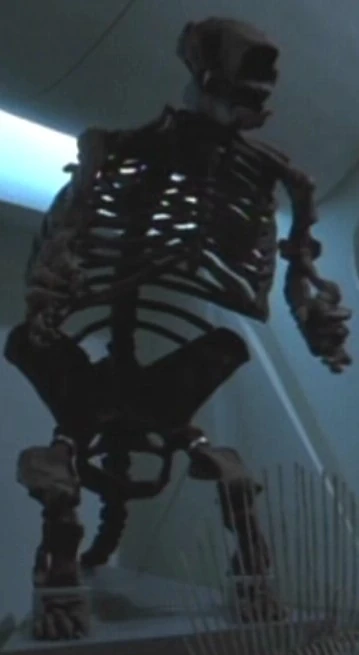

The skeleton of a prehistoric animal
Extinction was a term for the condition of a species of which there were no currently living members. Extinctions have occurred naturally on many worlds through the course of evolution, or through extinction-level events. Some species have become extinct through unnatural means.
In 2258 of the alternate reality, Spock initially planned to resign his commission, given what he perceived as the pending extinction of the Vulcan people, and help rebuild his species. Spock Prime urged him to continue to serve in Starfleet, saying he would fulfill this while young Spock remained where he belonged. (Star Trek)
Extinctions
Distant past
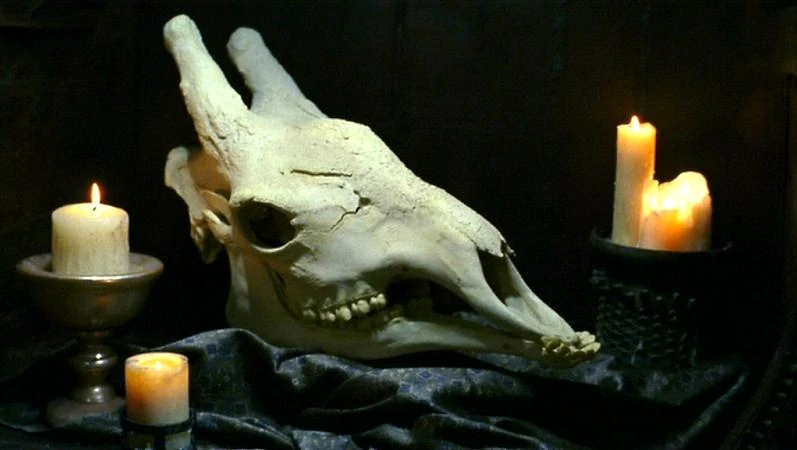

The skull of a Xindi-Avian, which went extinct in the mid-21st century
- The Progenitors, possibly the first humanoid race and one of the first sentient lifeforms in the Milky Way Galaxy, which flourished some 4.5 billion years ago, was believed to be extinct. A recording left by an individual of this race suggested they seeded the primordial environments of many planets with a DNA code that would direct the evolution of life on that planet towards a form similar to their own, possibly giving rise to many humanoid species that exist today and allowing their legacy to live on. (TNG: "The Chase"). In 3191, while using the Progenitors' life-creation technology, Captain Michael Burnham encountered a Progenitor who confirmed that her race had been extinct for billions of years. The nature of the technology -- which had actually been created by another unknown race in the past, possibly as part of a cycle of creators and creations -- allowed the minds of Burnham and the Progenitor to meet in a liminal space-time adjacent to the Progenitor's own. (DIS: "Life, Itself")
- The D'Arsay race existed 87 million years ago and were presumed extinct. (TNG: "Masks")
- Dinosaurs such as velociraptors and hadrosaurs became extinct at the end of Earth's Cretaceous Period. (VOY: "Distant Origin"; ENT: "Azati Prime", "In A Mirror, Darkly, Part II")
- As a result of Barclay's Protomorphosis Syndrome, Deanna Troi was transformed into an amphibious lifeform which became extinct over fifty million years before the 24th century. (TNG: "Genesis")
- The Tkon Empire was a massive and incredibly advanced empire that existed over 600,000 years ago. The empire collapsed not long after the Age of Makto when the central star of its home system went supernova. Little is known of the Tkon and they were believed to be extinct. (TNG: "The Last Outpost")
- Iconia was devastated by a massive orbital bombardment approximately 200,000 years ago. The Iconians were believed to be extinct, although a part of the population may have escaped through their gateways. (TNG: "Contagion")
- The Verathans were a now-extinct civilization native to the Verath system in the Gamma Quadrant, which reached their height approximately 30,000 years ago. (DS9: "Q-Less")
- An ancient humanoid race from the Andromeda Galaxy became extinct following the destruction of their homeworld when their sun went supernova. Remnants of the species survived for a time on scattered outposts but eventually died out. (TOS: "I, Mudd")
- The Kurlan died out several millennia before the 24th century. (TNG: "The Chase")
- The Kalandans, a spacefaring and technologically advanced species that flourished around the 1st millennium BC was thought to be extinct after they inadvertently created an deadly organism on an artificial planet, which supply ships then brought back to the Kalandan homeworld. (TOS: "That Which Survives")
Pre-Federation
- Before the 4th century, Golana was inhabited by a now-extinct, technologically-advanced civilization. (DS9: "Time's Orphan")
- The Promellians and Menthars were two spacefaring races who fought to their mutual extinction in the 14th century. (TNG: "Booby Trap")
- All life on the planet Kataan in the Silarian sector became extinct in the late 14th century due to the effect of increased solar radiation. (TNG: "The Inner Light")
- The Koinonians as a result of the Koinonian Wars. (TNG: "The Bonding")
- The Xindi-Avians once flourished on the planet Xindus with the other five Xindi races. They were apparently the only race that did not survive the destruction of their homeworld in the mid-21st century. The skull of an Avian adorned the Xindi Council in 2154. (ENT: "The Council", "The Shipment")
- According to Trip Tucker, the Novans were one or two years away from extinction. The crew of Enterprise NX-01 didn't just find them, they saved their lives. (ENT: "Terra Nova")
- The Loque'eque were an intelligent race native to the Delphic Expanse who began to die out when they lost the ability to reproduce. They attempted to preserve their race by engineering a mutagenic virus which transformed the DNA of other species into their own. By 2153, the virus was all that remained of them. (ENT: "Extinction")
Recent past
- The spacefaring race referred to by the Klingons as the Hur'q were believed to be extinct. (DS9: "The Sword of Kahless")
- The Draco lizard was a small Earth reptile that went extinct in the early 21st century. (TNG: "New Ground")
- Due to hunting, humpback whales became extinct in the 21st century. This almost caused the destruction of Earth in the 23rd century when an alien probe attempted to contact the planet's humpback whales. (Star Trek IV: The Voyage Home)
- The buffalo, also called the bison, another large Earth mammal, was wiped out by the 23rd century, by Human over-hunting and habitat degradation. (TOS: "The Man Trap")
- By the 22nd century, the Valakian's genomes had been deteriorating for millennia, manifesting itself as a plague that was expected to render the species extinct by the 24th century. (ENT: "Dear Doctor")
- The "wisps" were apparently rendered extinct in 2152 after Enterprise NX-01 was forced to destroy their vessel in self-defense. (ENT: "The Crossing")
- The white rhinoceros, a large Earth mammal, went extinct about two centuries before 2368 due to Human hunting. (TNG: "New Ground")
- In 2267, James T. Kirk and his crew made contact with Apollo, the last survivor of his kind. Humanity learned that the ancient Greek gods were in fact extraterrestrial beings. The encounter resulted in the death of Apollo and possibly the extinction of his species. (TOS: "Who Mourns for Adonais?")
- Additionally, in 2267, nearly all life on Ceti Alpha V was wiped out after its orbit was disrupted by the explosion of Ceti Alpha VI. According to Khan Noonien Singh, Ceti eels were the only indigenous life form to survive. (Star Trek II: The Wrath of Khan)
- Later in 2267, the Malurian civilization was wiped out by the malfunctioning Earth space probe Nomad. (TOS: "The Changeling")
- In 2268, James T. Kirk and his crew encounter the last three survivors of a race that died half a million years ago. One of the survivors, Henoch, was killed and the two remaining, Sargon and Thalassa, chose "oblivion" and possibly the extinction of their species. (TOS: "Return to Tomorrow")
- Later in 2268, James T. Kirk and his crew encounter the non-corporeal lifeform Gorgan, last survivor of his race. Gorgan caused the death of many in the Starnes Exploration Party. The encounter resulted in the death of Gorgan and the extinction of his species. (TOS: "And the Children Shall Lead")
- By 2268, the humanoid civilization native to the planet Cheron had destroyed themselves in a racially-motivated civil war. Though there were two survivors, who had been off-world at the time, the race is effectively extinct. (TOS: "Let That Be Your Last Battlefield")
- The Keeper of the Shore Leave Planet, who "ceased to function" some time between 2267 and 2269, was described as the last of his kind. (TAS: "Once Upon a Planet")
- The Pralor and the Cravic were two species native to the Delta Quadrant who had waged war with one another since at least the early 23rd century. Ironically, when both races decided to make peace, they were destroyed by the Automated Personnel Units they had constructed to fight for them. (VOY: "Prototype")
- In 2366, the Husnock, an intelligent but aggressive spacefaring race, was completely exterminated by a Douwd using the name Kevin Uxbridge after his wife Rishon was killed when the Husnock destroyed the Federation colony on Rana IV. (TNG: "The Survivors")
- By 2366, as far as the Federation and Romulans knew, the possibly extra-galactic living bio-ship Gomtuu, also known as "Tin Man", was the last of its species. It narrowly escaped suicide and thus extinction – at least in the Milky Way galaxy – thanks to the efforts of Tam Elbrun. With its crew dead and no known methods of reproduction, Gomtuu was at least in grave danger of being the last of its "species". (TNG: "Tin Man").
- The Minosians of Minos were destroyed by their own weapons systems at some point prior to 2364. (TNG: "The Arsenal of Freedom")
- The deciduous vegetation on Indri VIII was wiped out in 2369 when the Klingon vessel IKS Maht-H'a destroyed the planet's biosphere with a plasma reaction. (TNG: "The Chase")
- The Borg were decimated in 2378 when Admiral Janeway infected the Borg Queen with neurolytic pathogen, the effects of which spread across the entire collective. (VOY: "Endgame") By 2401, the Borg had been reduced to a single borg cube operating at 38% power, which was ultimately destroyed by the USS Enterprise-D during the Battle of Frontier Day, rendering the primary collective extinct. (PIC: "The Last Generation")
- The Burn left the Klingons reduced to refugees facing extinction by the late 32nd century. Despite this, the Klingons refused help from the Federation, seeing it as charity. This danger was alleviated with the conquest of a new Klingon homeworld, Faan Alpha. (SA: "Vox In Excelso")
- The Kwejian were rendered nearly extinct with the destruction of their homeworld by the Dark Matter Anomaly in 3190. The only confirmed surviving member of the species was Cleveland Booker. (DIS: "Kobayashi Maru", "Anomaly (DIS)")
Previously believed extinct
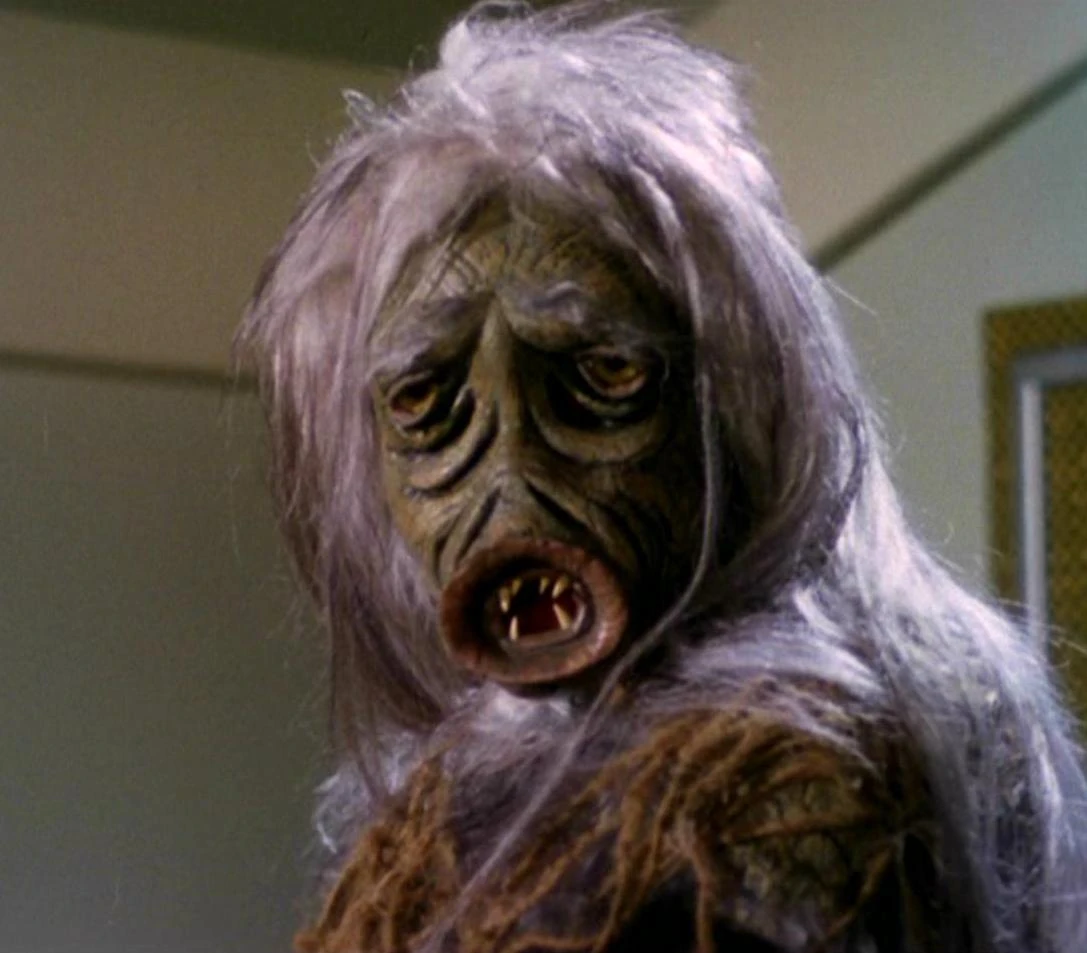

Salt vampires, previously believed to have gone extinct in 2266
- In 2266, it was believed that the so-called salt vampires of planet M-113 have gone extinct, with the death of the last known member following a confrontation with the USS Enterprise. However, more than a century later, members of the species were discovered to have survived the supposed extinction of their kind. (TOS: "The Man Trap"; LD: "Veritas")
- The tribbles were believed to have been completely eradicated by the Klingons by the end of the 23rd century, which included the obliteration of the tribble homeworld of Iota Geminorum IV by a Klingon armada. Tribbles were re-introduced in 2373 when crewmembers of the USS Defiant traveled to the year 2267 and brought back at least one tribble. (DS9: "Trials and Tribble-ations")
- At some point before the 2360s, the Federation believed that the Yridian race went extinct. This disappearance was so total that it even convinced the Borg, who designate the Yridians as Species 6291, that the species was no longer in existence. Despite this, Rudolph Ransom, a Starfleet exobiologist, discovered that there were some still alive and carried out first contact. For this he was awarded the post of captain of the USS Equinox. (VOY: "Equinox")
- The Tarellian species was thought by the Federation to have become extinct in 2356, after their last known ship was destroyed. This assumption was proven wrong with the surfacing of another ship in 2364, though their continued existence remained in question. (TNG: "Haven")
- In 2376, the Vaadwaur were believed to have been destroyed centuries ago until Seven of Nine and the crew of the USS Voyager awoken 600 members of the species from cryostasis. (VOY: "Dragon's Teeth")
Extinction and the Prime Directive
- In 2259 of the alternate reality, after James T. Kirk broke the Prime Directive on Nibiru to save Spock's life, Admiral Christopher Pike chastised him for even intervening and putting his crewmember in danger stopping the Nibiran's extinction in the first place. (Star Trek Into Darkness)
- In 2365, Data violated the Prime Directive by communicating with a young inhabitant of Drema IV, a doomed planet. Despite initially invoking the Prime Directive, Captain Picard changed his mind and saved Drema IV and its inhabitants from extinction. (TNG: "Pen Pals")
- In 2370, Worf's adoptive brother Nikolai Rozhenko violated the Prime Directive by becoming involved with a group of villagers on Boraal II, a doomed planet. After Captain Picard invoked the Prime Directive, Rozhenko secretly saved the group from extinction as Boraal II had become uninhabitable. (TNG: "Homeward")
- In an alternate timeline, the Vau N'Akat blamed the near-extinction of their species in a civil war on first contact with the Federation. Because of the Prime Directive, the Federation had refused to intervene in the war, increasing the hatred of the survivors. (PRO: "Kobayashi", "A Moral Star, Part 2", "Preludes")
Background information
Not all non-extant species were explicitly referred to as "extinct".
Borg assimilation and near-extinction
Species wholly assimilated by the Borg ceased to exist as a separate species, which was essentially equivalent to their extinction. Even species not quite entirely fully assimilated were so decimated that their extinction was either practically inevitable or considered so by remaining members.
For example, two species that the Borg almost entirely assimilated were Species 10026, though Seven tried to save a handful. It is highly likely that the few survivors ended up either dying out or later assimilated. (VOY: "Dark Frontier") Another is Species 116, which was essentially wiped out by the Borg, albeit with a few tens of thousands of (now homeless) survivors. To Arturis they were in essence wiped out as a species and too weak to regain viability. (VOY: "Hope and Fear")
Endangered
Aside from Borg assimilation, at least one Alpha Hirogen believed his race was becoming so nomadic and far-spread that they would soon become extinct. Other Hirogen, along with Captain Kathryn Janeway shared this view, which led them to create "holographic hunting space stations" – notwithstanding the fact that they backfired. (VOY: "The Killing Game", "Flesh and Blood")
The Kobliad were also said to be a dying race. (DS9: "The Passenger")
Following the destruction of Vulcan in 2258 in an alternate reality, Spock noted somberly in his log that he was now a member of an endangered species. (Star Trek)
The JahSepp believed their species was going to be completely killed due to an intruder in their realm. (DIS: "Saints of Imperfection")
The Ba'ul narrowly escaped extinction at the hands of evolved Kelpiens. (DIS: "The Sound of Thunder")
In an alternate timeline, the Vau N'Akat became endangered by the mid-25th century as a result of the Vau N'Akat Civil War. Blaming the Federation, The Order sought to travel back in time and destroy the Federation in order to prevent this from happening. However, only the Diviner and Asencia survived the journey. Armed with this knowledge, the USS Voyager-A and the USS Protostar intervened to help the Uprising overthrow Asencia when civil war did break out, before making peaceful first contact with the Vau N'Akat, thus altering the future and preventing the near-extinction of the species. (PRO: "Kobayashi", "A Moral Star, Part 2", "Preludes", "Ouroboros, Part I", "Ouroboros, Part II")
The Krenim and alternate timeline extinctions
As a result of timeline tinkering, many civilizations were referred to as "extinct" by Annorax and his weapon ship, including the Zahl, the Garenor, the Ram Izad, the Malkoth, and the Alsurans, until his timeship was destroyed, presumably restoring all of history. (VOY: "Year of Hell", "Year of Hell, Part II").