
Argelius, also known as Iota Leonis or 78 Leonis, was an inhabited planetary system in the Argelius sector, Beta Quadrant.
This was the home system of the Argelians.
Components
Stellar system
This was a quaternary star system. It was organized into a pair of binary star systems.
The primary of this system was Iota Leonis A. This was a F-type subgiant and one of the stars in the first binary system. Its companion was Iota Leonis B, a F-type dwarf.
Orbiting this binary system, there was a close binary system consisting of the K-type dwarf Iota Leonis C and its companion.
Planetary system
In this system, there were at least four planets. Located in the system's habitable zone, Argelius II was the homeworld of the Argelians. Another planet in this system was Argelius IV. (TOS: "Wolf in the Fold"; ENT: "Cold Front"; SNW: "Strange New Worlds")
History
When the Venari Ral laid Omega-47 mines around the core of Federation space in 3196, this system was within the enclosed region. (SA: "300th Night")
Stellar cartography
The Argelius system was visible from Earth in the constellation Leo. This system was approximately 79 light years from Sol.
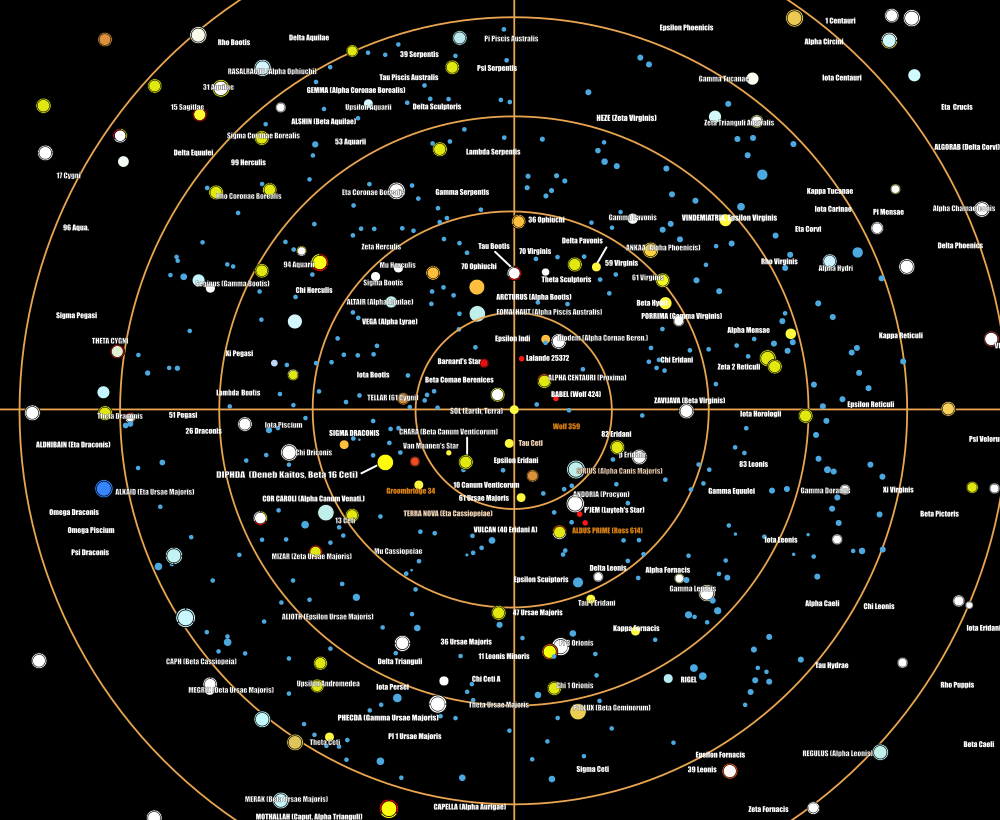

Iota Leonis on an United Earth star chart, 2154
In the 2150s, this system's position was labeled on an United Earth star chart which was d isplayed in several crew and guest quarters aboard the Enterprise. (Star Trek: Enterprise, set decoration)
In 2259, the location of this system was labeled on a stellar cartography chart that was seen on the USS Enterprise's ready room viewscreen. This system's symbol had a blue color, indicating that it was affiliated with the United Federation of Planets. (SNW: "Strange New Worlds", "Spock Amok", "A Quality of Mercy")
On stardate 1292.4, the location of this system was labeled in a chart used during a Section 31 Alpha Team briefing. (Star Trek: Section 31)
The system's location was labeled in a Federation star chart that was in Fleet Admiral Kirsten Clancy's office at Starfleet Headquarters in 2399 and on the bridge of the USS Titan-A in 2401. The Argelius system was in or near to neutral space. (PIC: "Maps and Legends", "The Next Generation", "Disengage")
In 2401, this system's position was labeled on a star chart used by Captain William T. Riker during his attempt at finding the last known location of the SS Eleos XII. (PIC: "The Next Generation")
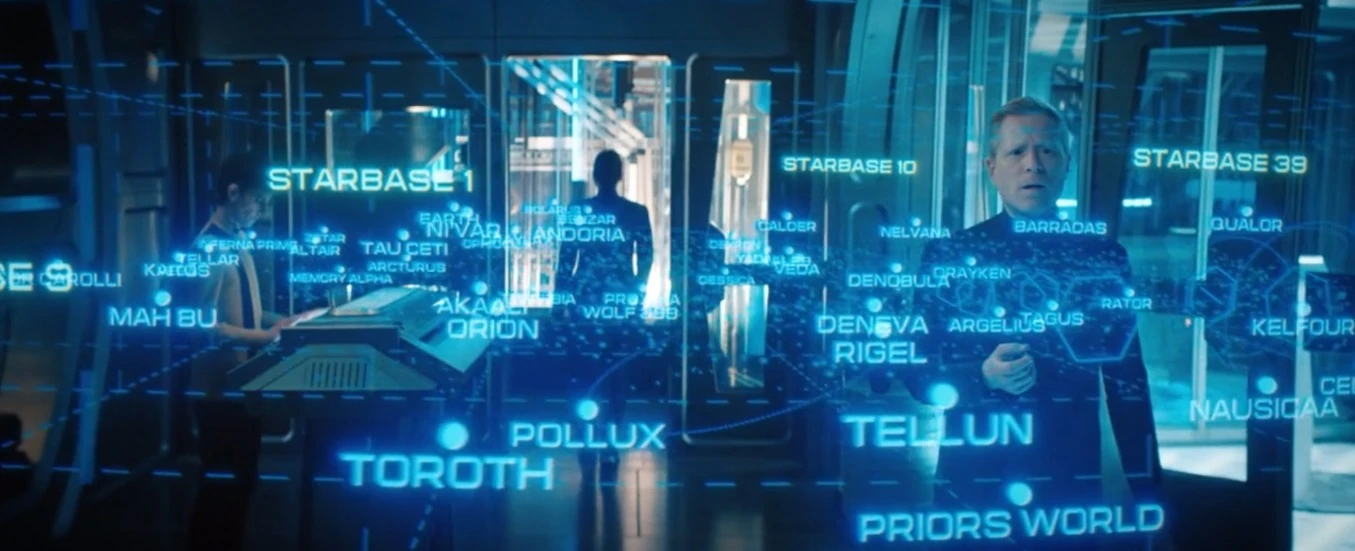

Location of Argelius labeled on a star chart (3190)
In 3190, the location of Argelius was labeled on a star chart used by Commander Paul Stamets for tracking the movement of the Dark Matter Anomaly through the galaxy. (DIS: "The Examples")
In 3196, this system's position was labeled on a Federation star chart which was displayed on the main viewscreen of the USS Athena bridge. Systems affiliated with the Federation, including this one, had blue labels. (SA: "Ko'Zeine")
In 3196, during the Omega-47 crisis, the location of Argelius (Iota Leonis) was depicted on star charts and readouts used across several locations on the USS Athena to locate, monitor, and respond to the Omega-47 mines laid by the Venari Ral. (SA: "300th Night")
Background
This star system was only mentioned in writing.
Information on this system was derived from the episodes, the reference works Star Trek: Star Charts and Stellar Cartography: The Starfleet Reference Library, and real-world sources. The reference works were used extensively in the creation of star charts seen in Star Trek: Discovery, Star Trek: Picard, Star Trek: Strange New Worlds, Star Trek: Prodigy, Star Trek: Lower Decks, and Star Trek: Starfleet Academy. The real-world information added to the article was current as of 2026.
The star chart seen in the series Star Trek: Enterprise made its first appearance in Crewman Daniels quarters in "Cold Front". It was also seen in several other episodes of the series, from 2151 to 2154. (For more information, see Federation star charts#United Earth Alpha/Beta star chart)
In the script for "Relics", Argelius was listed in the pronunciation guide, where the term was pronounced as "ar-GEE-lee-us".
External links
- Ciatella at Memory Beta, the wiki for licensed Star Trek works
- Iota Leonis at Wikipedia
- Subgiant at Wikipedia