Starfleet Command General Orders and Regulations were a series of guidelines used to instruct members of Starfleet on the proper etiquette and policy in a situation that required consultation for a resolution. Part of Federation law, these protocols were the foundation of Starfleet and the responsibility of its officers to uphold and protect, ranging from all manners of duty, such as interstellar diplomacy to punctuation of reports. Violations of protocol could have led to being placed on report, a court martial, demotion of rank, or other reprimands.
These guidelines' fundamental principles were integral for Starfleet officers to help avoid conflicts of interest, (TNG: "Redemption") including one's duty to the truth. (TNG: "The First Duty") Guidelines were useful in many situations, including when flag officers could not be consulted to resolve a situation. (VOY: "Equinox")
Several of the first one-hundred-plus Starfleet Orders were used by the United Earth Starfleet prior to the founding of the Federation. (ENT: "Hatchery")
All these Orders and Regulations cover a lot of possibility, to the point that in 2373, Captain Kathryn Janeway joked with Commander Chakotay about Ensign Hickman imitating her. "Imitating the captain, huh? Surely that violates some kind of Starfleet protocol." (VOY: "Scorpion")
Starfleet Charter Articles
- Article 14, Section 31: The exact language has never been cited, but certain lines in this section permitted the use of "extraordinary measures" in times of dire emergency. (ENT: "Divergence")
Federation Regulations
- Book 7, Section 2386, Paragraph 3434: Related to provide and enforce asylums to refugees "... a core responsibility of its personel is to provide aid to any sentient being in need of assistance, unless it violates the prime directive." (SA: "Vox In Excelso")
- Book 12, Code 2398, Subsection 89: "If engaged in diplomatic relations with species that are not allies, Starfleet officers need not contradict alien morality."
- There exists legal precidents that amends Code 2398, which allows Starfleet to save a known species that is in mortal danger through nonconsensual relocation. However, cases such as Vulcan v Kahconcedes stated that mortal danger is a matter of subjective perception. (SA: "Vox In Excelso")
- Book 19, Section 433, Paragraph 12: Regulation concerning the ability of ranking Federation officials to give direct orders to Starfleet officers. This regulation was referred to but not cited by High Commissioner Ferris in 2267, during a search for the then-missing shuttlecraft Galileo. (TOS: "The Galileo Seven")
Galactic Emergency Procedures
- Title 15 of these procedures allowed ranking Federation officials to assume direct command of Starfleet vessels under certain conditions. (TOS: "The Galileo Seven")
General Orders
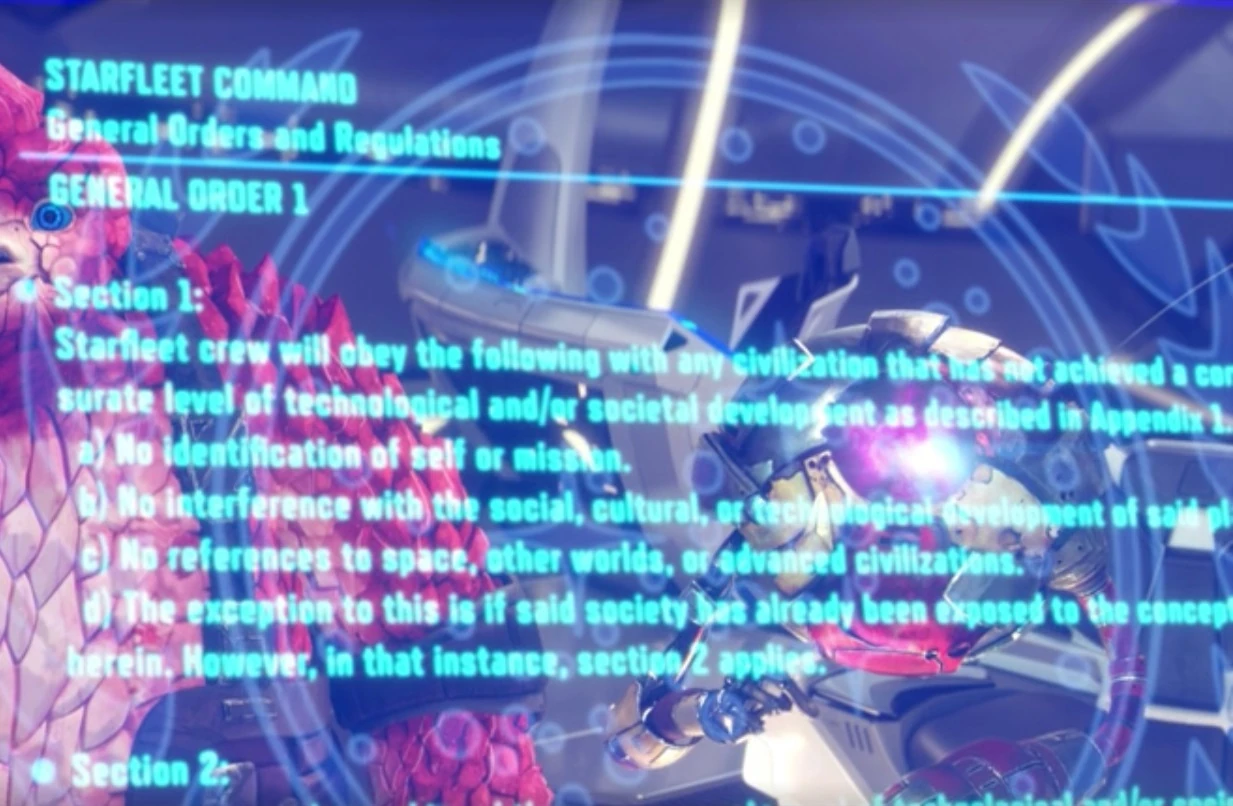

General Order 1, Section 1


General Order 1, Section 2
- General Order 1: "No starship may interfere with the normal development of any alien life or society." (TAS: "The Magicks of Megas-Tu") In 2259, the Federation Council renamed General Order 1 the Prime Directive, a title by which it later became better known. (SNW: "Strange New Worlds"; TNG: "The Drumhead"; PRO: "First Con-tact") It superseded all other laws and directives, with the exception of the Omega Directive. (VOY: "The Omega Directive") Sections 1 and 2 specifically read:
Section 1:
Starfleet crew will obey the following with any civilization that has not achieved a commensurate level of technological and/or societal development as described in Appendix 1.
- No identification of self or mission.
- No interference with the social, cultural, or technological development of said planet.
- No references to space, other worlds, or advanced civilizations.
- The exception to this is if said society has already been exposed to concept, herein. However, in that instance, section 2 applies.
Section 2:
If said species has achieved the commensurate level of technological and/or societal development as described in Appendix 1, or has been exposed to the concepts listed in section 1, no Starfleet crew person will engage with said society or species without first gathering extensive information on the specific traditions, laws, and culture of that species civilization.
Then Starfleet crew will obey the following:
- If engaged with diplomatic relations with said culture, will stay within the confines of culture's restrictions.
- No interference with the social development of said planet.
- General Order 4: Though stated in 2269 (stardate 5928.5) that "Starfleet expressly forbids the death penalty", this general order was stated to be the "only one exception", and as such, mutiny was not considered to be in violation of this order. (TOS: "Turnabout Intruder")
- General Order 5: An order that prohibits Starfleet officers from, for example, transporting out of a dangerous situation if others would be put at risk by doing so. (LD: "Second Contact")
- General Order 6: If all life aboard a Federation starship had perished at the end of twenty-four hours, the ship would self-destruct to protect other beings from the disease on board. (TAS: "Albatross")
- General Order 7: No vessel under any condition, emergency or otherwise, is to visit Talos IV. This was also said to have been "the only death penalty left on our books". (TOS: "The Menagerie, Part I") When broken by Spock in 2267, Commodore José I. Mendez, speaking for Starfleet, issued the following statement: "In view of historic importance of Captain Pike in space exploration, General Order 7 prohibiting contact Talos IV is suspended this occasion. No action contemplated against Spock. Proceed as you think best." (TOS: "The Menagerie, Part II") In 2328, Talos IV was the destination for passengers traveling from Triskelion Orbital Station via commercial transport. Ryan Adams, Wynsdey Adams, Loren Bivens, and Svetlana Reeves-Stevens traveled on the SS Kogin, and Mike Echols traveled on the SS Wisconsin. (TNG-R: "Inheritance", okudagram)
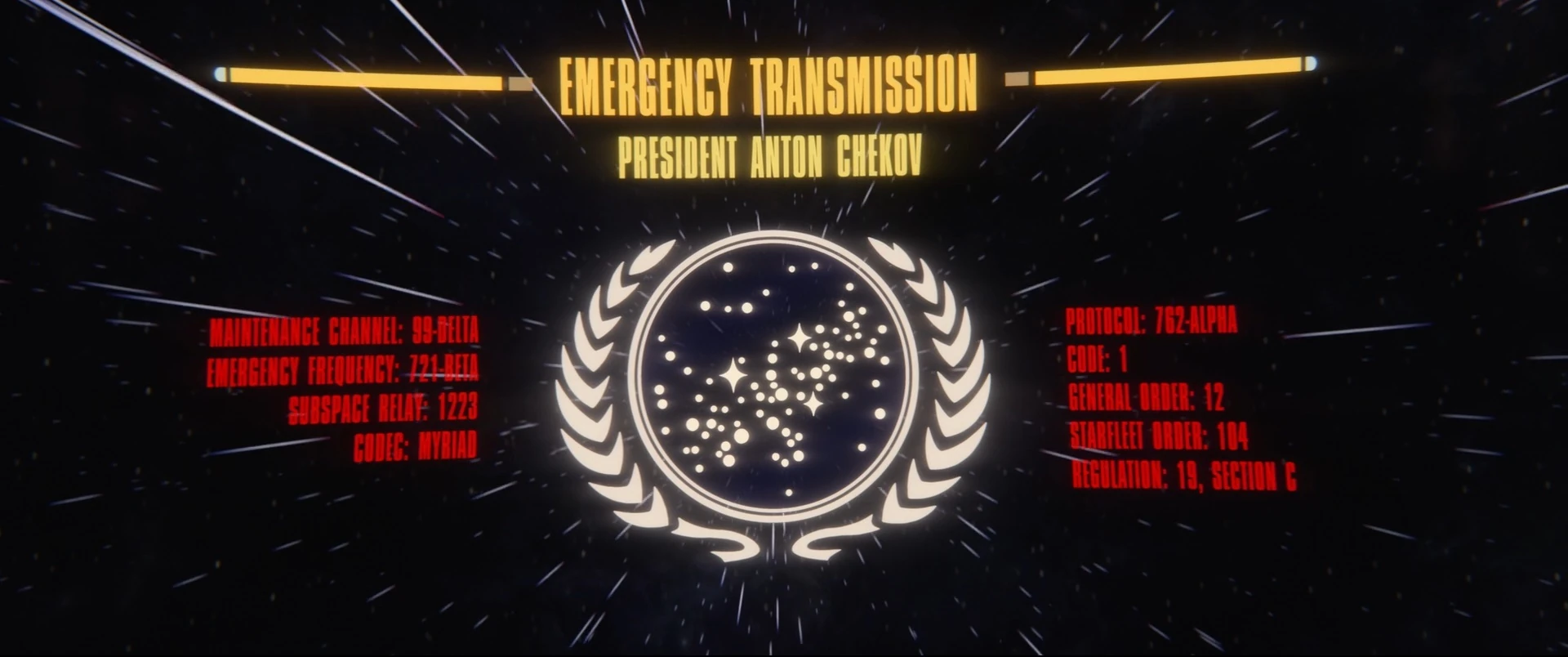

General order 12 in effect (right)
- General Order 12: "On the approach of any vessel, when communications have not been established..." This order began to be cited by Saavik in 2285, but she was interrupted before she could complete her quotation of the order. (Star Trek II: The Wrath of Khan) In 2401, General Order 12 was referenced on screen for Anton Chekov's presidential message. (PIC: "The Last Generation")
- General Order 13: Evacuation order for Starfleet vessels. (Star Trek)
- General Order 15: "No flag officer shall beam into a hazardous area without armed escort." When Saavik cited this order in 2285, Kirk replied, "There's no such regulation!" (Star Trek II: The Wrath of Khan)
- General Order 24: An order to destroy all life on an entire planet. This order has been given by Captain Garth on Antos IV and Captain Kirk on Eminiar VII. On neither occasion was the order actually fulfilled. (TOS: "Whom Gods Destroy", "A Taste of Armageddon")
Starfleet Directives
- Directive 010: "Before engaging alien species in battle, any and all attempts to make first contact and achieve nonmilitary resolution must be made." (VOY: "In the Flesh", ST: "Ask Not")
- Directive 101: Any individual accused of a crime does not have to answer any questions. (VOY: "Meld")
- Tactical Directive 36: "The captain will not engage a hostile force without the protection of a security officer." (VOY: "Unimatrix Zero")
- Prime Directive: Personnel should refrain from interfering with the developement of non-warp capable species. Reference to General Order 1 for details.
- Omega Directive: Authorizes the use of any and all means to destroy an Omega molecule. This directive superseded all other directives, including the Prime Directive. (VOY: "The Omega Directive")
- Temporal Prime Directive: Personnel are strictly forbidden from directly interfering with historical events.
Starfleet labor code
- Section 48, Alpha-7: Requires meal breaks at regular intervals. This was a regulation for at least 122 years, from 2259 to 2381. (SNW: "Those Old Scientists")
Starfleet Orders
- Starfleet Order 2: Starfleet regulation against the taking of intelligent life. (TAS: "One of Our Planets Is Missing")
- Starfleet Order 104: In 2401, Order 104 was referenced on screen for Anton Chekov's presidential message. (PIC: "The Last Generation")
- Section B, Paragraph 1-A – In the absence of a starship's assigned captain, a flag officer had the authority to assume command of the starship should they have deemed it necessary. (TOS: "The Doomsday Machine"; VOY: "Tinker Tenor Doctor Spy")
- Section C – Should it be proven with admissible evidence that the flag officer who had assumed command was medically or psychologically unfit for command, the starship's ranking officer could relieve them on that basis. However, such an action was required to be supported by an appropriate certification of unfitness by the ship's chief medical officer (requiring the CMO to also produce test results to that effect) or other clear evidence, such as an act of attempted suicide (TOS: "The Doomsday Machine"), or other odd behavior. (ENT: "Hatchery"; VOY: "Tinker Tenor Doctor Spy"; PRO: "Supernova, Part 1")
- Starfleet Order 2005: Orders the destruction of a starship by allowing matter and antimatter to mix in an uncontrolled manner. This was a last resort for a captain that allowed them to prevent their ship or crew from falling into enemy hands. (Star Trek: The Motion Picture) Admiral James T. Kirk executed this order (without directly citing it) when he ordered his officers to initiate the Enterprise's self-destruct sequence.
- Starfleet Order 28455: Federation order that dictated the formal relief of a commanding officer by their successor. In the alternate reality, Admiral Richard Barnett told Captain James T. Kirk that, per this order, he had to report to Admiral Christopher Pike to relieve him of command of the Enterprise. (Star Trek)
- Special Order 66715: Federation order that stated, "[Starfleet has] the authority to neutralize security threats to Deep Space 9 by any means necessary." (DS9: "Inquisition")
Starfleet Regulations
- Regulation 3, Paragraph 12: In the event of imminent destruction, a Starfleet captain was authorized to preserve the lives of his crew by any justifiable means. Captain Ransom attempted to use this regulation to convince Captain Janeway that actions he took against a species of nucleogenic lifeforms were justified, but Janeway doubted that the regulation covered mass murder. (VOY: "Equinox")
- Regulation 7, Paragraph 4: An officer must consider themselves under arrest, unless in the presence of the most senior fellow officers presently available, the officers must give satisfactory answer to those charges... (TOS: "The Omega Glory")
- Regulation 15: Regulation that prohibited the transfer of weapons by Starfleet officers to other races without the approval of the Federation Council. (LD: "Second Contact")
- Regulation 17, Article 12: Explicitly prohibits genetically modified individuals from serving in Starfleet. (SNW: "Ad Astra per Aspera")
- Regulation 17.43: In the alternate reality, this regulation related to Starfleet's ethical code of conduct, and was part of the Starfleet Code. Starfleet Academy cadets found cheating were accused to be in violation of the regulation. (Star Trek)
- Regulation 19, Section C: A regulation allowing an officer to take command of a starship. It was active only under at least one of three conditions:
- When an imminent threat was detected
- When the lives of Federation citizens were in danger
- When no other officers of equal or higher rank were present to mitigate the threat. (DIS: "Brother", PIC: "The Last Generation")
- Regulation 25: Regulation that prohibited the transfer of weapons by Starfleet officers to other races without the approval of the Federation Council. (LD: "Second Contact")
- Section B: All personal logs are to remain sealed unless by order of Starfleet Command. (SNW: "Ad Astra per Aspera")
- Regulation 42/15: "Pressure Variances in IRC Tank Storage". Part of the basic operational specifications for impulse engines, written by Montgomery Scott. The tanks could actually handle more pressure than the regulations allowed – in 2369, Geordi La Forge cited it as part of the impulse specifications while he and Scott worked to make the USS Jenolan operational, at which point Scott, realizing that he was thinking of this regulation, assured him that, as its author, he knew the tanks could be more efficient, but that La Forge should "Forget it. I wrote it; a good engineer is always a wee bit conservative... at least on paper." (TNG: "Relics")
- Regulation 46A: If transmissions were being monitored during battle, no uncoded messages were to be transmitted on an open channel. (Star Trek II: The Wrath of Khan; TNG: "Encounter at Farpoint")
- Regulation 76: Prohibited pointing a phaser at a fellow Starfleet officer without a valid reason. (LD: "Second Contact")
- Regulation 157, Section 3, Paragraph 18: Starfleet officers were required to take all necessary precautions to minimize any participation in historical events. (DS9: "Trials and Tribble-ations"; DIS: "Such Sweet Sorrow, Part 2")
- Regulation 191 (Article 14): In a combat situation involving more than one ship, command fell to the vessel with tactical superiority, should there not be a higher ranking officer present. (VOY: "Equinox"; ST: "Ask Not")
- Regulation 208, Paragraph 2: Allowed an active captain to override the orders of other officers. Captain Christopher Pike cited this regulation to Cadet Thira Sidhu during a simulation in which he had supposedly been relieved of duty, and Cadet Sidhu had been ordered to keep him prisoner. Sidhu refused, pointing out that the regulation applied only to an active captain. (ST: "Ask Not")
- Regulation 256.15: Starfleet officers shall display behavior befitting an officer at all times. (DIS: "Far From Home")
- Regulation 286.4: Related to Protected Species. Prohibited disturbing or removal of species covered by regulation before they reached maturity. (SA: "Vitus Reflux")
- Regulation 498: Regulation that prohibited the transfer of weapons by Starfleet officers to other races without the approval of the Federation Council. (LD: "Second Contact")
- Regulation 619: The commanding officer was required to relieve themselves of command if their current mission left them emotionally compromised and unable to make rational decisions. In 2258 of Nero's alternate reality, when, after the destruction of Vulcan, Spock met a young James T. Kirk, marooned by this timeline's Spock, before returning him to the USS Enterprise, he told Kirk to use this regulation in order to take command of the ship. The elder Spock's advice was motivated by knowing that the conservative course his younger self would take would doom Earth to the same fate as Vulcan, while the unorthodox strategy Kirk would follow just might save it. Kirk succeeded in provoking Spock and he resigned command, but acted as Kirk's first officer afterwards, during the Battle of Earth. (Star Trek)
- Regulation 756: Regulation that prohibited the transfer of weapons by Starfleet officers to other races without the approval of the Federation Council. (LD: "Second Contact")
- Regulation 2884.3: Substances unstable in an oxygen atmosphere were required to be handled with care. (TNG: "Night Terrors")
- Regulation 3287.0: Due to its high volatile nature, antimatter was required to be stored in magnetic confinement pods. (TNG: "Night Terrors")
- Regulation 13982: Allowed a Starfleet captain to conscript almost any person into service during a time of war. (DIS: "Choose Your Pain")
- Regulation 614617: Prohibits permanent DNA modification. (SNW: "Ad Astra per Aspera")
- Reserve activation clause: A "little known" and "seldom used" clause in Starfleet regulations which allowed for the recall of a retired or discharged officer in the event of an emergency. (Star Trek: The Motion Picture; ST: "Ask Not")
- Starfleet Rules of Conduct had some power to influence the operation of civilian establishments on Starfleet-administered installations, such as Quark's bar on Deep Space 9. (DS9: "Emissary")
- The Starfleet uniform code governed the proper wearing of the uniform by Starfleet officers.
Starfleet Away Team Guidelines
- Section 12, Paragraph 4: Related to the captain undertaking command of an away mission. During his best man speech at the wedding of William T. Riker and Deanna Troi in 2379, Jean-Luc Picard stated that Commander Data would never let him undertake an away mission; Data reacted to that by reciting this regulation but was told to "shut up" by Picard before he could complete his sentence. (Star Trek Nemesis)
- Regulation 476.9: All away teams were required to report to the bridge at least once every twenty-four hours. (VOY: "Once Upon a Time")
- Medical Emergency on Alien Terrain: "It is recommended to keep an open com-channel at all times." (VOY: "Macrocosm")
- "Specifically forbid the transport of unknown infectious agents onto a starship without establishing containment and eradication protocols." (VOY: "Macrocosm")
- Unnumbered protocol: "Starfleet protocol demands that away teams remain armed and ready to defend themselves until contact is made." (VOY: "Tattoo")
- Unnumbered protocol: Away teams must be composed of more than one crew member. Both Kathryn Janeway and Lieutenant Commander Tuvok cited this protocol to Seven of Nine when conducting an away mission. (VOY: "Hunters")
- Unnumbered regulation: Regulation that stated that the captain and first officer could not be on an away mission at the same time. In the alternate reality, Spock told acting captain James Kirk that he would cite this regulation when Kirk volunteered to beam to the Narada with him but did not do so because he knew Kirk would ignore it. (Star Trek) This regulation was also ignored when both Captain Kathryn Janeway and Commander Chakotay were infected with an unknown virus which inhibited their return to Voyager after an away mission. This resulted in both crew members being isolated on a planet in the Delta Quadrant and Lieutenant Tuvok being left in command of Voyager. (VOY: "Resolutions")
Starfleet Equipment Protocols
- SFRA 543447-87. A photon warhead label mandates the observance of this protocol prior to the servicing or removal of the warhead. (DS9: "Tribunal", label reference)
Starfleet Intelligence Procedures
- Luther Sloan, posing as Deputy Director of Starfleet Intelligence's Department of Internal Affairs, cited standard containment procedures to isolate the senior staff, which included being relieved of duty and confined to quarters. (DS9: "Inquisition")
Starfleet Medical Protocols
- Regulation 121 (Section A): The chief medical officer has the power to relieve an officer or crewman of his or her duties (including one of superior rank) if, in the CMO's professional judgment, the individual is medically unfit, compromised by an alien intelligence, (TNG: "Lonely Among Us") or otherwise exhibits behavior that indicates seriously impaired judgment. A Starfleet officer can face court martial for failing to submit to such a relief. In an alternate timeline generated by the Krenim, Captain Kathryn Janeway was relieved of her duties under this regulation by Voyager's EMH, who had been observing reckless behavior on her part for weeks and attributed it to Traumatic Stress Syndrome. Janeway refused to surrender her duties, as she felt her efforts to bring her crew home were of more importance. Since security personnel had abandoned the ship, the EMH had no means of enforcing the regulation anyway. Janeway's actions later resulted in the erasure of this timeline, so the issue was non-existent. (VOY: "Year of Hell, Part II") In 2375, aboard the Silver Blood Voyager, Neelix became, unofficially, chief medical officer after the loss of The Doctor. He threatened, in a lighthearted manner, to use his "authority" to relieve Janeway of her duties when she insisted on remaining in command although fatigued. (VOY: "Course: Oblivion")
- Unnumbered protocol: A physician must be present when administering arithrazine. A captain, when acting in accordance with the Omega Directive, could override this protocol. (VOY: "The Omega Directive")
See also
Starfleet Safety Protocols
- Safety Directive 3984/A. This regulation prohibited the use of ultritium 283 in class K planetary environments or in cryogenic substrates. This directive was updated on stardate 43094.3. (TNG: "Night Terrors")
- SFRA 2884.3. This regulation listed safety regulations for the use of balter compound 298 and tri-nickolas powder in a class N(2) planetary environment. (TNG: "Night Terrors")
- SFRA 3287.0. This regulation stipulated that antimatter, and its derivative antideuterium, should be stored in magnetic containment pods. (TNG: "Night Terrors")
- SFRA 3842. This regulation was associated with the antimatter injection system startup and operations in the engineering logs of the USS Enterprise-D. (TNG: "Galaxy's Child")
- SFRA 3843. This regulation was associated with both the magnetic containment degauss protocol and antimatter safety procedures in the engineering logs of the USS Enterprise-D. (TNG: "Galaxy's Child")
- SFRA 3848. This regulation established precautions for the use of industrial infusion charge applications in hypergravity and microgravity environments. (TNG: "Night Terrors")
- SFRA 3907A. This regulation was applicable for all uses of Walkerite 342. (TNG: "Night Terrors")
- SFRA 3983. This regulation prohibited the use of ultritium 283 in class K planetary environments or in cryogenic substrates. (TNG: "Night Terrors")
- SFRA 4832.4. This regulation, which required compliance, described the proper handling and use of antideuterium. (TNG: "Night Terrors")
- SFRA 5443. This regulation, which required compliance, legislated the use of the Lichfield suspension. (TNG: "Night Terrors")
- SFRA 8334A. This regulation was applicable for all uses of sternbachium. (TNG: "Night Terrors")
- SFRA 9323.4. This regulation prohibited the use of bio-genovesium in biosynthetic food processing. (TNG: "Night Terrors")
- SFRA 43940. This regulation was applicable for all uses of sternbachium. (TNG: "Night Terrors")
- SFRA 84349. This regulation was applicable to all space vehicles, including the use of propellant for the ullage thruster devices and vernier thruster devices. (TNG: "Night Terrors")
- SFRA 83329.6. This regulation recommended that Grant thermite 893 should be protected from ionizing radiation. (TNG: "Night Terrors")
- Unnumbered protocol. Tuvok once claimed that use of the transporters while at warp was a direct violation of Starfleet safety protocols. He did not cite the protocol by number, though the reason for caution was cited as having to do with the speed differential between two vessels. (VOY: "Maneuvers")
Starfleet Security Protocols
- Protocol 28, Subsection D: "In the event of hostile alien takeover, the EMH is to deactivate and wait for rescue." (VOY: "Message in a Bottle")
- Protocol 49.09: Pertained to the treatment of prisoners on board a starship. In the alternate reality, Spock marooned James T. Kirk on Delta Vega. Kirk believed this act to be a violation of this protocol. (Star Trek) In 3188, Saru cited this protocol to Osyraa regarding the presence of Ryn on board the USS Discovery. (DIS: "The Sanctuary")
- Unnumbered protocol: Luther Sloan, posing as deputy director of the Department of Internal Affairs, mentioned there was a security protocol that prevented others talking to prisoners under his authority without his clearance. (DS9: "Inquisition")
Starfleet Temporal Protocols
Applicable in the event a Starfleet officer stranded in the past:
- No interfering with past events.
- No sharing knowledge of future. (SNW: "Those Old Scientists")
It is unknown if the Protocol is an alternate name for, or part of, the temporal displacement policy and Temporal Prime Directive.
Starfleet Transfer Regulations
According to Leonard McCoy, the captain of a Starfleet vessel had the authority to transfer officers as he pleased, something which could be found in "a hundred volumes of space regulations somewhere." (TOS: "The Conscience of the King") Specific regulations were as follows:
- SFR-02-0933-3440: Transfer of an Officer to Another Starship
- SFR-02-0933-3462F: Transfer Authority of a Starbase-Commanding Admiral (see graphic below)
- SFR-02-0933-3459C: Eligibility of Starfleet Exploratory Corps Personnel to Serve in Other Starfleet Divisions (see graphic below)
- SFR-02-9384-8896: Transfer of Attached Scientific Personnel to Starship Duty
- SFR-02-8431-4933: Authority for Assignment of Deep Space Exploratory Corps Personnel
- SFR-03-3823-3893: Assignment of Starfleet Operational Support Officers
- SFR-03-8532-3892: Emergency Assignment of Scientific and Research Specialists
- SFR-03-4832-3843: Notification Requirements for Reassignment Within Deep Space Corps
- SFR-03-5931-0943: Transfer of Starfleet Diplomatic Corps Personnel to Deep Space Duty
- SFR-04-4833-9834: Eligibility for Exploratory Corps Personnel to Starbase Assignment
- SFR-04-4930-0027: Transfer Policies for Daystrom Institute Faculty Researchers
- SFR-05-3832-9322: Special Environmental Support Provisions for Class-K Native Personnel
- SFR-05-3023-3893: Equal Treatment for Zero-Gravity Native Personnel
- SFR-06-3893-3892: Transfer of Starfleet Tactical Specialists to Starbase Service
- SFR-06-0039-2174: Authority for Assignment of Operational Support Personnel
- SFR-06-8342-9322: Special Authority for Federation Diplomatic Corps


Starfleet Treaty Protocols
- SFPS 34.3.34.6: On stardate 44322, Captain Rudolph Ransom's ship, when in hiding from a Klingon Bird-of-Prey in a T-Tauri type nebula, operated within treaty protocols as set in this regulation. (VOY: "Equinox, Part II")
Starfleet/Federation Codes
- Code 1-Alpha-Zero: Indicated a starship in distress. (TNG: "Relics")
- Code 1: Signaled either a total or imminent disaster, a possible invasion, or indicated that the Federation was either currently or about to be engaged in open warfare with a hostile power. The code required all Starfleet personnel within the affected area to immediately assume tactical alert. It was also colloquially known as "Defense Alert", or a "Priority One Alert". (TOS: "Errand of Mercy", "The Trouble with Tribbles", "The Alternative Factor", PIC: "The Last Generation")
- Code 47: An ultra-secure communications protocol, for captain's eyes only. This code was so secure that all traces of a Code 47 transmission or communication were automatically wiped from all computer records. (TNG: "Conspiracy")
- Code 710: A "quarantine code". No Starfleet- or Federation-registered starship was to approach a system or vessel which was broadcasting Code 710. (TOS: "A Taste of Armageddon")
- Transporter Code 14: A transporter procedure used to destroy an object.
Regulations not specified by name or number
- "All research personnel on alien planets are required to have their health certified by a starship surgeon at one-year intervals." (TOS: "The Man Trap")
- "The ship's surgeon will require a full examination of any crew member that he has doubts about, including the captain." (TOS: "Turnabout Intruder")
- "Nothing shall be beamed aboard until danger of contamination has been eliminated. Beaming down to the surface (of a planet) is permitted, if the captain decides the mission is vital, and reasonably free of danger." (Star Trek III: The Search for Spock; VOY: "Macrocosm")
- "The chief medical officer outranks the captain in health matters." (VOY: "Persistence of Vision")
- A captain cannot order a doctor to violate doctor-patient confidentiality, except in situations of ship security. (VOY: "Fury")
- An officer taking medical leave could select their rehabilitation facility. (DS9: "It's Only a Paper Moon")
- "The transport of a patient is to be performed at the discretion of the attending physician." In 2258 of the alternate reality, Leonard McCoy, citing this, was allowed to bring Cadet James T. Kirk, suspended from duty, along to his posting aboard the Enterprise, as Kirk was quite visibly suffering from the symptoms of a Melvaran mud flea bite. In truth, McCoy himself was responsible for this, having infected Kirk precisely because he would then have the authority to bring his grounded friend aboard the ship. (Star Trek)
Relationships
- During the 22nd century, individuals were not allowed to have sexual relations with colleagues, according to Starfleet regulations. (ENT: "Bounty")
- By the 23rd century, the above rule was either abolished completely, or replaced by protocols regarding fraternizations, which did not forbid romance, but may have required notifying Starfleet of such happening. The reasoning for such protocol was that Starfleet ran on command hierarchy, and fraternizations could lead to complications. (SNW: "Lost in Translation") It is unknown if such protocol continued in later eras.
- "All Starfleet personnel must obtain authorization from their CO as well as clearance from their medical officer before initiating an intimate relationship with an alien species." (VOY: "The Disease")
- Various examples shown after the 23rd century indicate romance and consensual sexual relationships were not forbidden:
- Culber and Stamets were married and shared Quarters during their time on USS Discovery.
- Leonard McCoy told Kirk that "there aren't any regulations against romance". (TOS: "Space Seed")
- Starfleet senior officers officiated various weddings between two crew members on board an active Starfleet ship. (TOS: "Balance of Terror"; SNW: "A Quality of Mercy"; TNG: "Data's Day"; VOY: "Drive")
- In 24th century, Picard mentioned to Deanna Troi that "there are no Starfleet regulations about a captain becoming involved with a fellow officer". (TNG: "Lessons")
- William T. Riker and Troi continued to serve aboard the Enterprise and later the USS Titan, even after being married. (Star Trek Nemesis).
- Non-romantic, consensual sexual relationship/activity was implied to take place often on USS Cerritos, with its holodecks being the most common place for such to take place.
- By the 24th century, some duties may even have recommend the use of married couples, which could cause problems should the assigned ship not have such a couple. (LD: "Parth Ferengi's Heart Place")
Miscellaneous
- A captain was not allowed to leave the ship unaccompanied. (ENT: "First Flight")
- Again, this regulation may have been repealed/amended as there are many recorded instances of captains doing this.
- Removing an individual from a planet against their will violated several regulations, including the Prime Directive. Data reminded William T. Riker of this, who was considering rescuing a group of dissidents of Angel I from execution. They insisted on staying, even if this meant being executed. (TNG: "Angel One")
- "Striking a fellow officer is a court-martial offense." (ENT: "Bound"; TOS: "This Side of Paradise"; VOY: "Parallax")
- 23rd century Starfleet captains had a high degree of authority on board the ship they were assigned to command. In extremes, a captain could invoke their "personal authority as captain" to order their subordinates to override the orders of a senior officer, even if the captain was not actually on board ship at the time. Such an order would almost certainly result in at least an inquiry after the crisis had passed. Captain Kirk used his "personal authority" to overrule the orders of Commodore Matt Decker and to have Spock resume command of the Enterprise during a battle with the planet killer. (TOS: "The Doomsday Machine")
- No Starfleet regulations permitted one's execution without a trial, something Spock reminded James T. Kirk of in 2259 of the alternate reality. The first officer was expressing his concerns about Kirk hunting down and assassinating "John Harrison". He also added that a preemptive strike on Qonos was not permissible either.
- Kirk reminded him that their orders from Admiral Alexander Marcus was not a matter of Starfleet regulation. Spock then reminded him that apart from regulations, the act would be immoral. Kirk then countered that by saying that regulations aside, rescuing Spock from the volcano on Nibiru was moral, yet nobody congratulated him for doing so. (Star Trek Into Darkness)
- As of 2366, there were no regulations prohibiting the unauthorized recreation of Starfleet personnel on the holodeck. (TNG: "Hollow Pursuits")
- Starfleet regulations called for declaring a yellow alert when a starship was targeted by laser weapons. According to Jean-Luc Picard, such regulations were "very old". (TNG: "The Outrageous Okona")
- Protocols on first contact were available to Starfleet personnel, which was once revised by Captain McCoullough. (DS9: "Move Along Home")
- According to Starfleet protocol, "sir" was the proper address when responding to one's commanding officer (or possibly any superior officer), though some female officers, such as Kathryn Janeway, preferred "ma'am". (VOY: "Caretaker") Naval tradition dictated the use of "captain" for a ship's CO, regardless of the CO's rank. (DS9: "Behind the Lines")
- Starfleet rules forbade dealing with outlaws and getting involved in the politics of other cultures. (VOY: "Alliances")
- Starfleet's policy was to deal with new species on a basis of openness and trust until proven otherwise. (VOY: "Alliances")
- Starfleet protocols included guidelines on proper punctuation of reports, such as conn reports. (VOY: "Dreadnought")
- "Encroaching on the territory of an alien species is prohibited." (VOY: "The Swarm")
- A Starfleet officer had the right to ask for an order to which they objected to be placed in writing. (DS9: "In the Pale Moonlight")
- "Ground combat personnel are to rotate off the front lines every ninety days." (DS9: "The Siege of AR-558")
- "Interference in alien conflicts is strictly prohibited." (VOY: "Nightingale")
- Procedures pertaining to official requests for asylum to a Starfleet captain included a hearing. (VOY: "Death Wish")
- Accidents aboard Starfleet vessels were to be followed by an investigation into the cause of the accident. (VOY: "Day of Honor")
- An official/formal letter, written to a senior officer, was required to be replied to by a senior officer. If the letter was to a vessel's captain, they could delegate the task of writing the response to their first officer or chief of security. (VOY: "Tinker Tenor Doctor Spy")
- Ensign Harry Kim referred to privacy protocols being violated by Lieutenant Commander Tuvok while the latter was investigating an attack on Ensign Tabor and read a letter that Harry's cousin, Dennis, had sent from Earth. Tuvok stated that, as chief of security, he had authority to suspend the protocols under special circumstances. (VOY: "Repression")
- Romulan whiskey was not allowed aboard Starfleet facilities. (LD: "Second Contact")
- Protocol allowed a Federation captain to grant political asylum in extreme circumstances. (DIS: "The Examples")
- Federation ships were required to explore new worlds and document their findings. According to Hologram Janeway, failure to do so when presented with the opportunity was a reportable offense. (PRO: "Dream Catcher")
Fictional
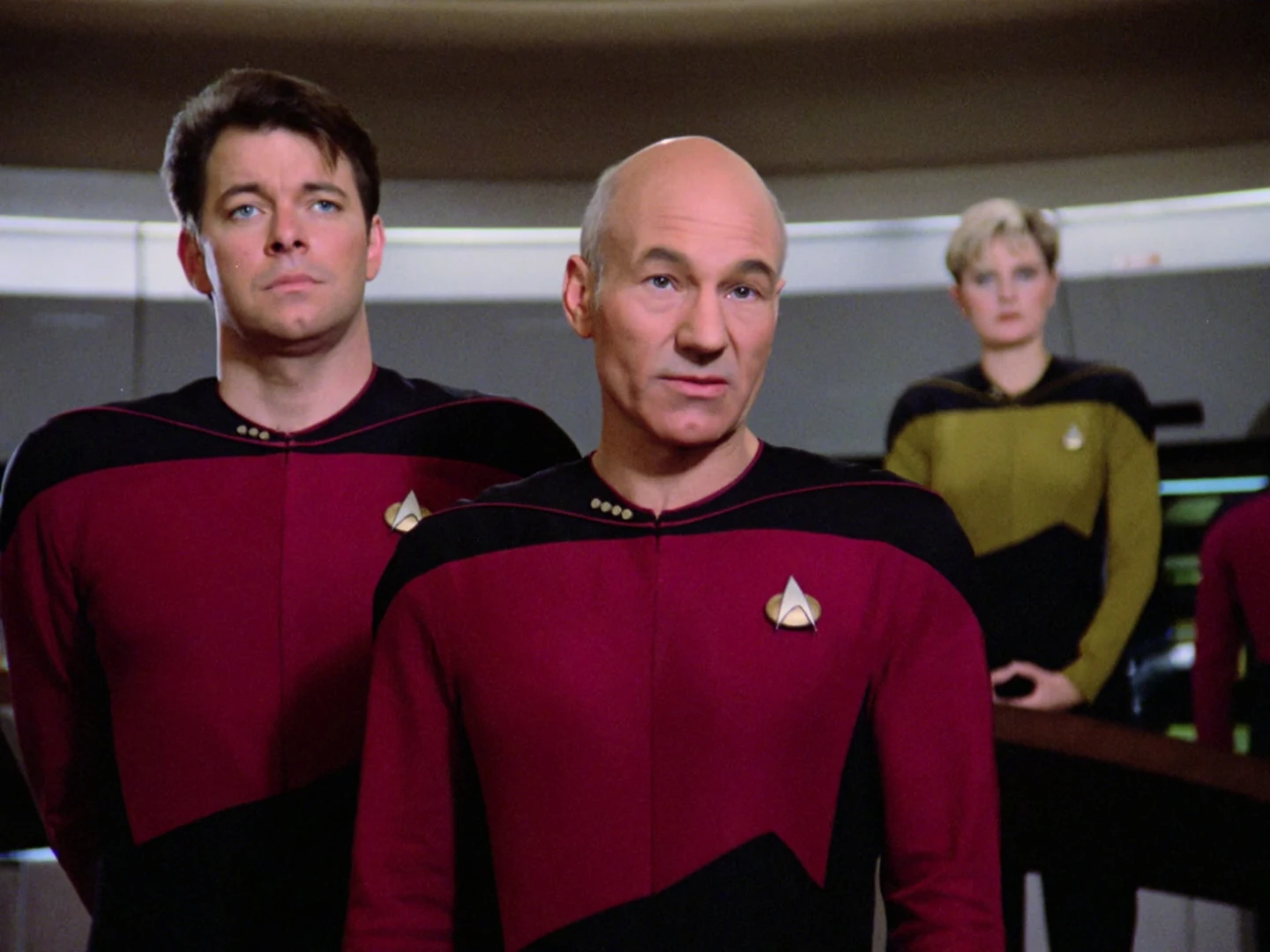

Jean-Luc Picard quoting Starfleet Regulation 6.57 to Radue
- Regulation 6.57: At least two staff officers were to be present during any treaty or contract negotiations. In 2364, Jean-Luc Picard quoted this regulation to Radue of the Aldeans, who had recently kidnapped a group of specially gifted children from the Enterprise, offering scientific knowledge as compensation. Moments later, when Data admitted not to be familiar with the regulation, Picard revealed that it was, in fact, non-existent; it was merely something he had made up on the spot in order to deceive the Aldeans to allow him to bring Beverly Crusher with him to their planet's surface. (TNG: "When The Bough Breaks")
- Tactical Directive 36A: B'Elanna Torres made up Tactical Directive 36A in 2377, claiming that there should also be an engineer with the captain and not just a tactical officer. (VOY: "Unimatrix Zero")
- Directive 927: "Always help those in need." This directive was quoted by Dala as being part of the "Starfleet General Order" when she was posing as Kathryn Janeway, in 2376. (VOY: "Live Fast and Prosper")
Appendices
Background information
As referred to in the revised final draft script of TOS: "Court Martial", "Regulations 7, Subsection D" related to courts martial. It did not allow the defense to call a witness to provide testimony prior to the prosecution resting its case. The regulation was cited by Areel Shaw during Kirk's court martial at Starbase 11.
In the revised final draft script of TNG: "Evolution", "Protocol 'B'" was said to regulate how crew members could access all power components on a starship if they were no longer deemed reliable.
The Star Trek Encyclopedia, 4th ed., vol. 2, p. 180 has a picture of a prop made for Admiral Pike's office in Star Trek Into Darkness. This prop has text for the first three Starfleet General Orders. The prop might or might not have appeared in the film. These general orders were written by Chris Gray and modified by Chris St. John. [1] The text was slightly edited by the individual who made the prop for the film.
- General Order #2 was a prohibition against the use of unnecessary force:
- No Starfleet personnel shall unnecessary use force, either collectively or individually, against members of the United Federation of Planets, their duly authorized representatives, spokespersons, or designated leaders, or members of any sentient member race, for any reason whatsoever.
- General Order #3 was on the rights of the individual:
- The sovereignty of each Federation member being respected in all things, Starfleet personnel shall observe any or all statutes, laws, ordinances, and rules of governance currently in effect within the jurisdiction of a member world.
Violators of such ordinances will be subject to such punishments or corrections as shall be determined by local governmental bodies.
- The sovereignty of each Federation member being respected in all things, Starfleet personnel shall observe any or all statutes, laws, ordinances, and rules of governance currently in effect within the jurisdiction of a member world.
"The only death penalty"
Varying statements about the status of the death penalty in the Federation and General Orders regarding it have been given in the Star Trek canon. Notably, at different times both General Order 4 and General Order 7 were said to be the only death penalty left.
"The Menagerie, Part I", set in 2267, introduced general order 7 as "the only death penalty left on our books". As it was specific to Talos IV, it was presumably instituted after Captain Pike's 2254 mission to the planet. However, in "Turnabout Intruder", set in 2269, Sulu stated "The death penalty is forbidden. There's only one exception", which turned out to be general order 4 (the nature of which remains unspecified).
Further complicating the situation, in DIS: "Si Vis Pacem, Para Bellum", Admiral Katrina Cornwell explained Starfleet's policy on prisoners of war to L'Rell, stating that "the Federation has no death penalty". This episode is set in late 2256 or early 2257, after Pike's visit to Talos IV but before "The Menagerie", thus making it unclear as to when the death penalty for visiting Talos IV was established. In DIS: "If Memory Serves", the planet was said to be off limits, and the Discovery crew faced disciplinary action after visiting it, but no mention was made of General Order 4 or the death penalty.
Regarding the two General Orders each stated to be the only death penalty, if relations with the Talosians had not changed, it could be that one of the two General Orders might have been made to include other planets which might be a threat to the Federation like Talos IV. It is also possible that, in "Turnabout Intruder", Chekov misspoke. In the PC game Star Trek: 25th Anniversary, the USS Enterprise computer states that General Order 4 is sometimes confused with General Order 7 and the death penalty associated with it more generally refers to high treason.
Apocrypha
- Starfleet Catastrophic Response Code, Section A: When all forms of communication failed to establish a link between Starfleet vessels and any Federation outpost, all personnel and ordnance were required to attempt immediate rendezvous at Starfleet Command. (Star Trek: First Frontier)
- General Order 16: All Starfleet ships detecting the energy signature from one of four Malkus Artifacts were under orders to find and confiscate the artifacts. (Star Trek: The Brave and the Bold)
- General Order 34: Starfleet captains must honor, respect, and display extreme tolerance for species-based customs and practices insofar as the safety of the vessel was not threatened by such practices. (Star Trek: New Frontier novel Being Human)
- Regulation 121: An emotionally compromised officer was not fit to serve in the position of captain. (Star Trek novelization)
- Regulation 1186, section 20: The accepting of gifts on an individual basis by an official member of a formal diplomatic representation is strictly forbidden. (Star Trek novel The Unsettling Stars)
- UFP Regulation 342-188564.3, Paragraph 3: A class-3 biohazard alert. All personnel not part of a Biohazard Response Team were to stay away from any site broadcasting such an alert. (Star Trek: 25th Anniversary, Episode 3: "Love's Labor Jeopardized")
- Secret Regulations of Stardate 7500: The exact language was not specified, but the Secret Regulations of Stardate 7500 were outlined as the response to an invasion of the Federation. They were created on stardate 7500, amended stardate 42799, and gave the officer who invoked them the authority to second any Starfleet officers to their command and seniority in command decisions related to the invaders. In 2270, under the authority of Starfleet General Order Three, Commander Riker invoked the secret regulations in response to the threat of an invasion by an alliance of the Borg Collective and a breakaway faction of the Romulan Star Empire. (Star Trek: The Return)
- Starfleet Protocol 547c: Not really known, but seeing as it was cited while trying to shut down force fields leading to the USS Enterprise-C, it is assumed that it was a security protocol. It was cited as an utterance by an annoyed Tasha Yar when she realized there was a group of force fields that had been missed when shutting down security. Frustrated, Richard Castillo griped that the Tholians had most likely never heard of Protocol 547c. (Star Trek Online, "Temporal Ambassador")
- General Order 24, mentioned in TOS: "Whom Gods Destroy" and "A Taste of Armageddon" as allowing for the destruction of all life on a planet, was actually carried out in the first issue of the Gold Key Star Trek comic series "The Planet of No Return", and the novel Reap the Whirlwind in the Star Trek: Vanguard series.
- Starfleet Regulation 320-730-A, Subparagraph 2: Knick-knack shelves were not mandatory for Starfleet captains, but if they did have one, it was required to have at least one (1) "little ship". (Star Trek: Lower Decks, Issue 1)
See also
External link
- Starfleet General Orders and Regulations at Memory Beta, the wiki for licensed Star Trek works