Many projects have been partially developed for Star Trek, beginning in the 1970s. There have also been deleted scenes for completed projects.
Films
- The God Thing (1975)
- Star Trek: Planet of the Titans (1976-1977)
- Star Trek III (1980)
- Star Trek: The First Adventure (1989)
- Star Trek: IMAX (1997)
- Star Trek: The Beginning (2005)
- Star Trek 4 (alternate reality) (2019)
Untitled initial film projects
The notion of a Star Trek film was originally considered amid the making of TOS Season 2, while DeForest Kelley, Gene Roddenberry, and Gregg Peters were having lunch together. "The three of us came up with the idea of doing a motion picture version of the show during the hiatus," remembered Kelley. "That far back, we thought, what a terrific thing that would be. Had we done it, God knows what might have been the result of it. It was much later that 2001 and Star Wars came along. We were all ahead of our time in the thinking, even then [....] We kicked the idea about off and on and then it was kicked out the window; 'Who would ever think of making a motion picture out of a television show?'" Despite that being the verdict which the creative staff reached at the time, the idea of making a Star Trek motion picture persisted for years to come. (Cinefantastique, Vol. 9, No. 2, p. 43)
At the 26th World Science Fiction Convention in 1968 (shortly before the third season of TOS began airing), Gene Roddenberry mentioned the idea of a Star Trek film. "Gene spoke to an adoring crowd," explained Garfield Reeves-Stevens, "and he said that he was talking to Paramount about making a feature film version of Star Trek that would tell the story of how Kirk, Spock and McCoy met at the Academy." ("The Longest Trek: Writing The Motion Picture", Star Trek: The Motion Picture Blu-ray-special feature)
In 1973, Gene Roddenberry again approached Paramount with the idea of a Star Trek film. He wanted Herb Solow (formerly the Desilu executive in charge of production on the first two seasons of Star Trek: The Original Series) to produce the film. Roddenberry also wanted Solow to negotiate with Paramount on his behalf. Roddenberry based the plot idea on the outline "A Question of Cannibalism" in his 1964 series proposal, Star Trek is... (the title was reworked as "The Cattlemen"). Solow thought the script had to be heavily rewritten, because "it did not foreshadow an enjoyable night at the movies." Despite this, Paramount was eager on the project, as its then President Frank Yablans envisioned a high-tech space film potentially grossing US$30 million, years ahead of Star Wars. However, Roddenberry refused to accept the screenwriting fee and equity proposed by the studio, and instead countered with demanding a hitherto near-unprecedented US$100,000 writer's fee and the producer's role, the latter being adamantly opposed by Yablans as he was very aware of Roddenberry's failure as such on the 1971 film Pretty Maids All in a Row – turning out to be one of only two theatrical features Roddenberry was ever to serve as a producer in his life. After several unsuccessful negotiations, Paramount backed away from the project, with Solow being told by two Paramount attorneys that Roddenberry "(...)lost the deal arguing over nickels. Nickels!", and the film was never made. Solow commented that the studio could have made the film without Roddenberry, but they did not want to alienate the fanbase. (Inside Star Trek: The Real Story, pp. 420-421, 430) Nonetheless, Yablans' interest in producing high-tech science fiction was piqued and to this end he facilitated and provided the funding for the establishment of two Paramount visual effects subsidiaries, Douglas Trumbull's Future General Corporation (FGC) in 1975, and Carey Melcher's Magicam, Inc. one year later; both these companies would play a pivotal role in the film that did eventually come to fruition, Star Trek: The Motion Picture. (see: The Motion Picture: Visual effects)
With the popularity of Star Trek conventions, as well as re-runs of Star Trek: The Original Series, a revival of the franchise remained up in the air during the mid-1970s. While no network had approached Gene Roddenberry to support a new Star Trek series, he made clear his preference for how to resume the franchise, stating, "The best way to bring Star Trek back on television now would be to do it as several movies-of-the-week each season. There we would have the time and the budget to make it better than before." (TV Showpeople, June 1975) Around this time, May 1975, Paramount announced they would be producing a Star Trek film for theatrical release, with principal photography slated to begin in the fall of that year. The by Roddenberry written script they had under advisement at that point in time was that of The God Thing, which however was rejected in August. (The Making of Star Trek: The Motion Picture, p. 23; Star Trek Phase II: The Lost Series, p. 16)
It was later revealed, in the premiere issue of Starlog (vol. 1, no. 1, August 1976, pp. 25-26), that plans for the first feature film were already in the works: "The movie (title undecided) is to be written and produced by Gene Roddenberry – as soon as he finishes another movie, Magna I, a 20th Century Fox production about life under the sea, set in the year 2111." It was noted that "a number of story outlines have been prepared and are under consideration."
While Roddenberry's Magna I project was eventually scrapped, little progress was also made with his Star Trek film project, though Roddenberry, now with input from Jon Povill, had started a new story and script outline for a film, tentatively called "Star Trek II", with a new production start that is moved up to 15 July 1976, again moved up to January 1977 at a later point. (The Making of Star Trek: The Motion Picture, p. 25). The second issue of Starlog (vol. 1, no. 2, November 1976) reported that the still "untitled, unwritten, and uncast" Star Trek film had been an on-again, off-again project, which had already missed the original announced filming date of 15 July. It was reported that:
"When Paramount Pictures announced they would be producing a Star Trek movie for theatrical release – nearly a year and a half ago – Gene Roddenberry immediately began work on possible screenplay ideas. His first was one concerning the formative years of the characters – their days at the Space Academy, their first assignments, their coming together to man the Starship Enterprise, and the construction and launching of the UFP Starfleet. This idea never made it to the submittal stage [....] The film's largest problem at this point is that Paramount still has not approved any of the screenplays or outlines that have been written. Both Robert Silverberg and Chris Knopf have written full screenplays; and Harlan Ellison, Dick Simmons, and Theodore Sturgeon have written outlines. All of them have been rejected by Paramount. In an attempt to get the production off the ground, Roddenberry has completed yet another story treatment which will soon be shown to Paramount executives. Aside from the fact that this new story takes place five years after the Enterprise's 'five-year mission to seek out and explore...' no information is available concerning plot. According to Susan Sackett, Roddenberry's secretary (and an accomplished writer herself), Gene is now deciding on just one writer – a skillful and highly experienced screenwriter – who will develop what will be the film's screenplay – just in case Paramount decides not to use Gene's latest treatment."
Because the TOS Enterprise sets had been destroyed, new sets had to be built for the upcoming film, and they needed to be built with enough detail as to withstand the scrutiny of the big screen. Explaining some of the other production considerations for the film at that time, the article continued:
"The film – budgeted at a big $5,000,000 – is now to start shooting in January [1977] [....] [Compared to the television series,] the movie version will show considerable improvement in the effects department – due to the large production budget and a new process called Magicam [....] New Enterprise settings will be built and will be designed in much greater detail than was needed for TV. All of the Star Trek original cast will be back to make the feature film, if all are available and if all will agree to the contracts Paramount offers them. At this point, negotiations are still in progress to secure the services of William Shatner and Leonard Nimoy. Roddenberry told Starlog that he wants to use not only the original actors but the production people as well. 'I'd like to use all of the original production people on the film. People like Fred Phillips with makeup, Matt Jefferies with set design, Bill Theiss with clothes design, and all the others. I thought they were the best when we were first doing Star Trek, and I still do now. I think the story with them is the same as it is with the actors. If available, they'd all like to do the film.' Roddenberry will be producing the Star Trek movie under Executive Producer Jerry Isenberg, a man who has spent many years working in television."
This project turned out to be the equally unrealized Star Trek: Planet of the Titans. All these unproduced film ideas (which also included The Billion Year Voyage) ultimately led to the creation of the Star Trek: Phase II television series, whose intended pilot episode, "In Thy Image", was eventually turned into Star Trek: The Motion Picture.
Star Trek: Prison Planet
Harve Bennett proposed a prequel film entitled Star Trek: Prison Planet, which would feature Khan Noonien Singh's life on Ceti Alpha V in between "Space Seed" and Star Trek II: The Wrath of Khan. The studio decided to prioritize Star Trek III: The Search for Spock instead, leaving Prison Planet in the dust. [1]
Star Trek: The Next Generation - The Movie
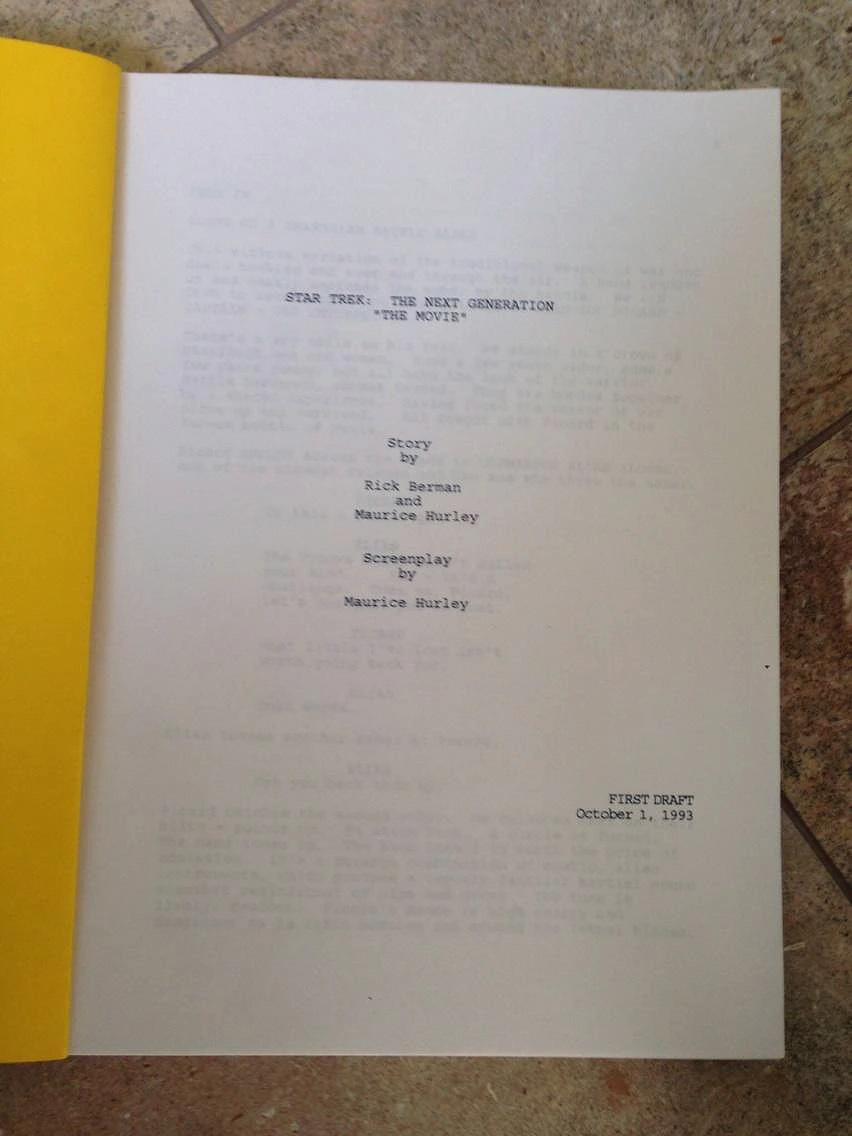

Hurley's TNG movie script
In 1992, Paramount Pictures executive Brandon Tartikoff approached producer Rick Berman in regards to a seventh Star Trek feature film. The installment was decided to be a "passing the baton" story, to bridge The Original Series and The Next Generation. Berman assigned three competetive story assignments to four writers. Michael Piller eventually dropped out of the "competition", while Maurice Hurley and the Ronald D. Moore & Brannon Braga duo both developed their respective story into script form. Eventually, Moore and Braga's script was chosen to be developed further (finally evolving into Star Trek Generations), and Hurley's idea was shelved. [2]
A draft of Hurley's untitled film was written in October 1993. [3] As Hurley later recalled, the script told the tale "of a fold in space, through which an adversary is blown into our universe and who, in trying to get home to save his own species, must basically destroy ours." The Enterprise-D was sent to confront the enemy. Captain Picard meanwhile sensed, however, that something was amiss and that the seemingly random destruction being committed by the alien power must actually have a purpose. "He realizes there's no subtext to the attack [....] These people have no subtext and Picard begins to investigate," explained Hurley. Captain Picard's inquiries led him to the holodeck, where he consulted a hologram of James T. Kirk – the only TOS character in the entire screenplay. The reason Picard called up the image of Kirk was that the latter captain had faced a similar situation in "The Tholian Web". "It's the only other time on record that this has ever happened and the only person who witnessed it was Kirk," said Hurley. "Picard attempts to get a point of view from the Kirk character that is different from what he's getting from pure facts. But that's not enough, so he starts manipulating the image, which produces a couple of bizarre scenes between Picard and Kirk – and they get pretty confrontational at certain moments." Hurley considered it inevitable that, if they were to bring Kirk back, his return would need to be confrontational, since Kirk was an extremely confrontational character, even becoming confrontational with God in Star Trek V: The Final Frontier. "This story was a chance to put these two classic characters, and two really good actors, together and let them bang on each other," Hurley concluded. (Sci-Fi Universe, Vol. 1, issue 1, p. 79)
Rick Berman posted an image of the drafted script on Twitter, in August 2014. [4]
Nemesis follow-up
An eleventh Star Trek film was initially planned during production on the tenth film, Star Trek Nemesis. Nemesis co-writers John Logan and Brent Spiner intended to follow that film with a "crossover" sequel. After Nemesis failed financially, however, this plan was abandoned. [5] Patrick Stewart clarified that the film was intended to be the fifth and final TNG film. He also commented, "It was a very exciting idea for a screenplay. It would have been a real farewell to Next Generation, but it would have involved other historic aspects of Star Trek as well." [6] Spiner himself explained, ""One of the ideas that John Logan and I had about what the next film would have been was a Justice League of Star Trek. Something would bring all the great Star Trek villains together, from Khan to Shinzon, and Picard is the only person who could stop them and he actually has to go through time and pluck out the people he needs to help him. He goes back to the moment before Data blows up and takes him back to get Kirk and Spock, and go even further back and get Scott Bakula's character, Archer. The problem with that more than anything is cost – how do you pay for that?" [7]
The bad reception and dismal performance of Nemesis at the box-office, conclusively put an end to all notions of doing a Next Generation follow-up.
Star Trek: The Avengers
A similar film concept (reported in SFX magazine) was devised by Brannon Braga and likened by him to an Avengers story, because it took a "superhero teamup" approach. (SFX: The A-Z of Star Trek, p. 107; [8]) The story would have collected Starfleet's greatest minds to defeat a terrible threat. ("In Conversation: Rick Berman and Brannon Braga", ENT Season 1 Blu-ray special features; SFX: The A-Z of Star Trek, p. 107; [9])
Braga recalled this concept in a discussion with Rick Berman on 12 December 2012. ("In Conversation: Rick Berman and Brannon Braga", ENT Season 1 Blu-ray special features) "We were gonna get Picard, Data, Odo, the holographic Doctor... all the Star Trek characters on one ship, like a think tank," commented Braga. He went on to say, "It was like Star Trek: The Avengers." ("In Conversation: Rick Berman and Brannon Braga", ENT Season 1 Blu-ray special features; SFX: The A-Z of Star Trek, p. 107; [10]) Braga couldn't recall at what stage they had discussed the film idea, and Berman couldn't remember having spoken about it at all, but they both agreed that it was still "a good idea." Berman also suggested, "You might as well throw Kirk in there as well." ("In Conversation: Rick Berman and Brannon Braga", ENT Season 1 Blu-ray special features)
Alternate reality film
In April 2018, alternate reality Spock actor Zachary Quinto commented that he believed that there were at least three scripts in development for the film, with the Beyond sequel and Quentin Tarantino's pitch being just two of them. [11] In the same month, he reiterated that Paramount wanted to make at least one more Star Trek film, implying that the aforementioned scripts could all be turned into films, but Paramount had to decide on the order. [12] At CinemaCon 2018, Paramount CEO Jim Gianopulos revealed the studio was working on two new Star Trek films. If Quinto had been correct about at least three films being under consideration, then at least one film was cut by this point, and further statements made later confirmed that the two films moving forward at that point were the, later canceled, Beyond sequel and the Tarantino pitch. [13] [14] [15] In 2023, Tarantino re-expressed the will to make only 10 films (counting the two volumes of Kill Bill as one film/production) during his career and he announced that his next, and final film, would be The Movie Critic. [16]
Jaylah and the Wolf
According to Simon Pegg, "[Beyond co-writer] Doug [Jung] and I, we were going to write a spin-off about the character of Jaylah called "Jaylah and the Wolf." Sophia [Boutella], she did such a great job with her, and she was such a great character. We had this idea that Jaylah was going to go Starfleet Academy and she was going to be put into a group of cadets who were like problem cadets, who were called "The Wolf Pack" and they were sent off to a real planet called Wolf 359 and would get into an adventure on this planet. Yeah, for a while we were working on that, but in the end, it just didn't happen." [17]
Live-action television series
1960s
- Assignment: Earth (1967-1968) [18]
- There were some plans for a fourth season of Star Trek: The Original Series, including a second episode featuring Kor, that would have aired 1969-1970.
- During the second season of The Original Series, Gene Roddenberry and Darlene Hartman (writer of unproduced episode "Shol") came up with an idea for a spin-off series entitled Hopeship, which would have been about the voyages of a Federation hospital vessel. The series would have included Doctor Joseph M'Benga (Booker Bradshaw) in the regular cast. Despite the series concept never being realized within the Star Trek universe, Hartman later wrote the idea in the form of a novel in 1994. (These Are the Voyages: TOS Season Two)
- According to Walter Koenig, NBC briefly considered making a spin-off series centered around the adventures of Harry Mudd, as the character proved to be popular, but these plans were quickly abandoned. [19] Mudd actor Roger C. Carmel learned of the idea from Gene Roddenberry, at a going-away party Desilu gave Herb Solow, after TOS was cancelled. Carmel subsequently recalled, "Gene said, 'It's a shame that series thing for you never worked out.' I said, 'What series thing?' He said, 'Oh, didn't you know!? Well, after the successful Harry Mudd episodes [in TOS], NBC wanted to know if I would develop a spin-off series for you starring the Harry Mudd character. A space pirate, intergalactic con-man kind of thing.' 'My God, Gene, I didn't know anything about that! What happened?' He said, 'Well, the artists didn't have enough time to develop it.' And of course, you couldn't blame Gene, he didn't want to let somebody take it off in a direction he didn't approve of. Since he didn't have time to handle it all, the Mudd series project died. But it was a real blow to me, because that was the first time I had heard of it. But what a great chance that would have been for me to star in my own spin-off series." (Starlog, issue #127, p. 33)
- Shortly after the cancellation of TOS, Paramount proposed a spin-off series centered on the character of Spock, featuring him living on Vulcan with other Vulcans. This idea was turned down by Gene Roddenberry, who Paramount had asked to produce the series. (The Making of Star Trek: The Motion Picture, p. 18)
1970s - 2000s
- Star Trek: Phase II (1977)
- Immediately before the creation of Star Trek: The Next Generation, Paramount considered multiple series concepts that were ultimately undeveloped. "There were many ideas that were discussed," stated Rick Berman, "including making it a prequel to the original Star Trek and thoughts of it being set on a starship that was run by cadets in Starfleet Academy. Some suggestions were made by the studio, some by others." (The Fifty-Year Mission: The Next 25 Years, p. 46) One idea which proceeded to written script stage involved the Enterprise being run by a group of cadets. ("Gene Roddenberry - The Creator of Star Trek: The Next Generation", The Official Star Trek: The Next Generation Magazine issue 1, p. 4) Gene Roddenberry observed, "It had a Vulcan captain and a lot of space cadets who seemed to mainly say, 'Gee whiz, Captain.'" This series concept was developed by the father-and-son producing team of Sam and Greg Strangis, the latter of whom explained, "My premise was relatively simple: It was a time when, in the future in the existing Star Trek, the Klingons weren't enemies anymore and were allies. I wanted to create Starfleet Academy on a ship. You'd have a lot of younger players and older, senior leaders, and it was going to be the naval academy on a starship [....] I wanted to create a universe where there was a parallel to the world we were living in at the time. It was jihad in space. You wouldn't call them jihadist by name, but that was what they were. Even before people knew what a jihadist was. That was going to be the ongoing adventure. That was the great story arc. Good guys and bad guys in an eternal battle." Regarding what became of the concept, Greg Strangis added, "I did some preliminary work and shared it with [Paramount Television executive] Lucie Salhany and whoever else was running syndication then, and it was going along swimmingly...." (The Fifty-Year Mission: The Next 25 Years, pp. 44, 45-46) On Friday 12 September 1986, John Pike – the president of Paramount Television Network – sent Roddenberry a copy of the series proposal. Roddenberry responded with five pages of notes, which were generally negative. (Star Trek: The Next Generation - The Continuing Mission, p. 7) "I got a phone call that said, 'You're out, Gene's gonna do it' [....] I knew Gene had seen it. I suspect other people internally had seen it as well," Greg Strangis concluded. (The Fifty-Year Mission: The Next 25 Years, pp. 44-45, 46)
- An idea for a Star Trek sitcom featuring Lwaxana Troi was suggested by Gene Roddenberry as a cable TV project for the Sci-Fi Channel in 1991. However, his death and the delay in setting up the channel shelved that. (Starlog, issue #177, p. 7). Susan Sackett reckoned that Lwaxana actress Majel Barrett-Roddenberry had probably been lobbying for the series herself, as Sackett had heard Majel mention that she was very interested in Lwaxana being granted her own show and appearing weekly. (TV Zone, issue 17, p. 18)
- There were some plans for a fifth season of Star Trek: Enterprise, which would have aired 2005-2006.
- Undeveloped Star Trek episodes
- Babylon 5 creator J. Michael Straczynski and Bryce Zabel (Dark Skies) proposed a reboot of the franchise with the crew of the original series in 2004. [20] Paramount ignored the proposal, though, and were not "even willing to talk about Star Trek." [21]
- Jonathan Frakes developed an idea for a Star Trek series that was rejected by Paramount, who stated that they had previously rejected proposals by William Shatner and Bryan Singer out of concern of "franchise fatigue". Frakes agreed that this was a wise decision. "Not that [I] wouldn't love the Titan, or the Rikers in Space, or any of those shows on the air," he commented. [22]
- Bryan Singer, Christopher McQuarrie, Robert Meyer Burnett, and Geoffrey Thorne planned to pitch their own show entitled Star Trek: Federation, but they chose not to, after development of the film Star Trek was announced. [23]
2010s – 2020s
- Michael Dorn pitched The Worf Chronicles, a spin-off concentrating on the politics and feuds in the Klingon Empire. [24](X)
- Nicholas Meyer was writing a "standalone Star Trek-related trilogy" for CBS All Access, but the conflict between CBS and Viacom put the project on hold. [25]
- In a 2021 profile in The New York Times, Alex Kurtzman mentioned that writer/producer Graham Wagner (known for his work on Portlandia and Silicon Valley) had pitched a series centered on Worf. Kurtzman did not give any details about the content of the pitch, but described it as " incredibly funny, poignant and touching."[26]
- In the documentary What We Left Behind, Ira Steven Behr storyboarded a potential reboot of Star Trek: Deep Space Nine, set twenty to thirty years in the future with Nog as Captain of the USS Defiant, Kira Nerys now a Vedek, and an unknown threat emerging from the Gamma Quadrant which required a new Deep Space Nine crew to locate both Benjamin Sisko as well as Odo, now a leader in the Great Link. Behr had expressed hopes for a DS9 relaunch for many years, however the death of Aron Eisenberg, as well as a general lack of interest from a sponsoring network, never saw the project developed.
- A show taking place after Star Trek: Picard and incorporating the younger characters (Seven of Nine, Raffaela Musiker, Jack Crusher, Sidney La Forge, Alandra La Forge), entitled Star Trek:Legacy, has been proposed.
- A follow-up to Star Trek: Strange New Worlds has been suggested, which would depict the crew of USS Enterprise under Kirk prior to the events of Star Trek: The Original Series, called Star Trek: Year One. [27] [28]
- In 2025, TrekMovie.com reported that Star Trek: Enterprise writer/producer Michael Sussman was considering a Federation President Jonathan Archer series, tentatively called Star Trek: United. [29] Andrew Probert sketched an idea for Archer's presidential ship. [30]
- Star Trek: Prodigy producer Aaron Waltke has another pitch for an animated series. [31].
Animated Star Trek
- Star Trek: Final Frontier (2006)
1970s series
Before the making of Star Trek: The Animated Series was given the go-ahead, one concept for an animated series that was offered to Gene Roddenberry involved the Enterprise crew landing on strange planets and shooting everything on sight that was different or seemed ugly. (The Making of Star Trek: The Motion Picture, p. 18)
1990 animated Star Trek
In 1990, Paramount Pictures attempted to sell an idea for an animated series that combined characters from Star Trek: The Next Generation and Star Trek: The Original Series. None of the networks or syndicators at the time were interested in the series and it was unsold. Rick Berman said such a project would have "diluted the franchise."
Cel art from this series has been seen in various Star Trek conventions over the years, and it has been stated to be well-drawn.
CGI cartoon based on the original series
In the late 1990s, Paramount briefly considered creating a CGI original series cartoon, inspired by the success of Roughnecks: Starship Troopers Chronicles, and art (using motion-capture for the characters) of the unreleased game Star Trek: Secret of Vulcan Fury. [32]
Animated Ferengi series
Around 2000 or 2001, Armin Shimerman and a friend of his devised an idea for an animated series about the teenage years in the lifetimes of the Ferengi Quark and Rom. "We got pretty far with that," stated Shimerman, "but in the end, when we got to the last pitch session with MTV, they said they didn't want a space cartoon show. But everyone was very happy with the ideas that we had come up with." (Star Trek Explorer, Vol. 4, No. 4, p. 11)
Star Trek: The Lions of the Night
Around 2003, Star Trek: The Lions of the Night was a concept, by writer Jimmy Diggs, to produce a film-era, CGI, animated Star Trek adventure. He described the plot the following way; "Captain Sulu takes command of the USS Enterprise-B and must stop a Kzinti invasion of Federation Space." Artist Court Jones created several sketches to depict a new concept of Kzinti that looked more dangerous than they had in TAS: "The Slaver Weapon", as well as a concept of how the Kzinti assault fleet would look.
The material of this animated series was recycled by the writer for an article in Star Trek: Communicator (Star Trek: Communicator issue 149) and later for undeveloped Star Trek: Enterprise season five episode "Kilkenny Cats".
Alternate reality series
After the release of the film Star Trek, Roberto Orci and Alex Kurtzman pitched an animated series to CBS, similar to their series Transformers: Prime for The Hub. [33] However, Orci said the success of the first film did not indicate whether a new show would be viable, explaining, "One movie doesn't make a trend. Two movies starts to indicate that there is a trend and its viable. It will become more real as the year goes on." [34]
Other
Robert Duncan McNeill has expressed interest in turning The Adventures of Captain Proton into a streaming series, Star Trek: Short Treks or even a podcast. [35]
See also
| Undeveloped Star Trek projects | |
|---|---|
| Films: The God Thing • Star Trek: Planet of the Titans • Star Trek III • Star Trek: The First Adventure • Star Trek: IMAX • Star Trek: The Beginning • Star Trek 4 | |
| Series: Assignment: Earth • Star Trek: Phase II • Star Trek: Re-Boot the Universe • Star Trek: Federation • Star Trek: Final Frontier | |
| Episodes: TOS • TAS • TNG • DS9 • VOY • ENT • DIS • ST • SNW | Novels and reference books |