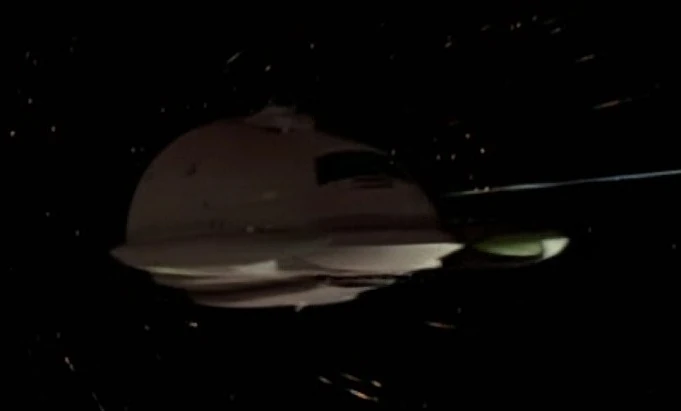

A Ferengi shuttle
In starship classification, a shuttlecraft, shuttle, or glider was a type of auxiliary space vessel typically attached to a starship or a starbase. Most shuttles were short-range transports, possessing only impulse drive or a limited warp capability. Utilization of shuttlecraft was common for most spacefaring civilizations, and along with the transporter, were two of the more common conventional modes of transportation to and from one place to another. (VOY: "Heroes and Demons") Shuttles were generally used for landings when transporters were inoperable, or not yet within the technological capabilities of a species. At times shuttlecraft were used by individuals who preferred not to use transporters or were unable to transport due to health conditions. (TNG: "Encounter at Farpoint", "Darmok", "The Next Phase"; VOY: "The 37's", "Tuvix")


An Apergosian shuttle
Shuttlecraft ranged in size from the larger, longer-range, and more versatile types, such as runabouts, to the small, short-range types commonly known as shuttlepods. Most Starfleet shuttlecraft from the 23rd century onward had warp nacelles, indicating warp capability. (DS9: "Emissary", "Paradise", "The Jem'Hadar"; TNG: "Parallels", "All Good Things..."; VOY: "Drone", "Resolutions"; TOS: "The Galileo Seven", "The Doomsday Machine"; ENT: "Broken Bow", "Shuttlepod One"; Star Trek Into Darkness)
Shortly after the launch of the USS Enterprise a 137 year old Admiral Leonard McCoy came on board to inspect the new ship's medical layouts. Due to his high rank and status within Starfleet, the Enterprise crew agreed to his request to transfer back to the USS Hood via shuttlecraft, with Data piloting the vessel as he didn't want to have his atoms scattered "all over space". Doctor Katherine Pulaski was another individual noted for her reluctance to use transporters. Captain Taggert of the USS Repluse usually accomodated Pulaski's requests to use shuttlecraft over transporters and once told Captain Jean-Luc Picard he would have given her a personal shuttlecraft of her own if she had agreed to stay with the Repulse. When she transferred to the Enterprise, she was ferried over via shuttlecraft. (TNG: "Encounter at Farpoint", "The Child")
In commenting on the musculature of the Pendari Champion, Neelix exclaimed that "he looks like he could pick up a shuttlecraft." (VOY: "Tsunkatse")
After interacting with The Doctor's holonovel, Photons Be Free, B'Elanna Torres wondered what the point of the oversized backpack holoemitter was about, saying that "it was like carrying around a small shuttlecraft." The Doctor explained that it was "a metaphor" representing "a symbol of the burdens that I live with every day. Imagine having to take this everywhere you go. It would be a constant reminder that you're different from everyone else. I wanted the player to feel the weight of it. Literally." (VOY: "Author, Author")
While attending Starfleet Academy, Ensign Nog had heard of instances of cadets commanding a runabout or a shuttle as a training ship, but never a starship, after discovering, in 2374, that the USS Valiant served as a training ship for Red Squad cadets. (DS9: "Valiant")
Shuttle classifications
- Fighter shuttle
- Inspection pod
- Long range shuttle
- Mining shuttle
- Prison shuttle
- Runabout
- Shuttlepod
- Shuttlebus
- Travel pod
Shuttles by species
- Andorian shuttle
- Apergosian shuttle
- Cardassian shuttle
- Denobulan shuttle
- Federation shuttlecraft
- Ferengi shuttle
- Haakonian shuttle
- Iyaaran shuttle
- Kazon shuttle
- Klingon shuttlecraft
- Rakhari shuttlecraft
- Rekag shuttle
- Reman shuttle
- Romulan shuttle
- Son'a shuttle
- Vulcan shuttle
- Xindi shuttle
- Yridian vessels
- Yridian vessel (22nd century)
- Yridian shuttle (24th century)
External links
- Shuttlecraft at Memory Beta, the wiki for licensed Star Trek works
- Shuttlecraft at Wikipedia