
Kahless the Unforgettable (Klingonese: qeylIS) was a legendary mytho-historical Klingon figure. He was the first Warrior King and Emperor of the Klingon Empire, known as the "greatest warrior of them all".
Kahless was the last Klingon to unite all tribes until the Federation-Klingon War of 2256, which was started with that purpose by a Klingon called T'Kuvma, who was concerned that his race had begun to "forget the Unforgettable". (DIS: "The Vulcan Hello")
Time crystals were a symbol of Kahless. (DIS: "Through the Valley of Shadows") Kahless' battle cry, "Today is a good day to die", continued to be a popular Klingon utterance into the 24th century, including in the simpler form "It is a good day to die." (VOY: "Dragon's Teeth"; DS9: "Blood Oath", "The Way of the Warrior")
Quick Answers
Who was the first Warrior King and Emperor of the Klingon Empire?

What was the significance of time crystals to Kahless the Unforgettable?
Who was the last Klingon to unite all tribes before the Federation-Klingon War of 2256?
Who started the Federation-Klingon War of 2256 and why?
History
Sometime in the 9th century, Kahless united the Great Houses defeated his enemies, including Molor and the Fek'Ihri, on the field of battle and founded the mighty Klingon Empire, uniting the Klingon people and giving them the laws of honor. Kahless conquered Qo'noS from Molor which would become the Klingon homeworld. Upon his death, Kahless promised he would return one day and lead the Empire again. After his death, it was said that Kahless awaited all Klingons in Sto-vo-kor: the life which lies beyond this life. His teachings of honor and tradition formed the basis of modern Klingon philosophy and culture. As of 2374, Kahless was still revered as a near-divine figure by the Klingons. (VOY: "Day of Honor"; SA: "Vox In Excelso")
Although Kahless was not high-born, those who descended from him and his wife, the Lady Lukara, were said to reside within the Klingon Imperial Court. Those members of the Court, including Dahar master Kor, were considered "of the blood," and were regarded throughout the Empire to have been born to rule by the divine will of Kahless. (DS9: "Tacking Into the Wind", "Once More Unto the Breach")
In 2256, the zealot T'Kuvma proclaimed that the Great Houses of the Klingon Empire would "stand as one under Kahless, reborn in me, T'Kuvma." (DIS: "Battle at the Binary Stars")
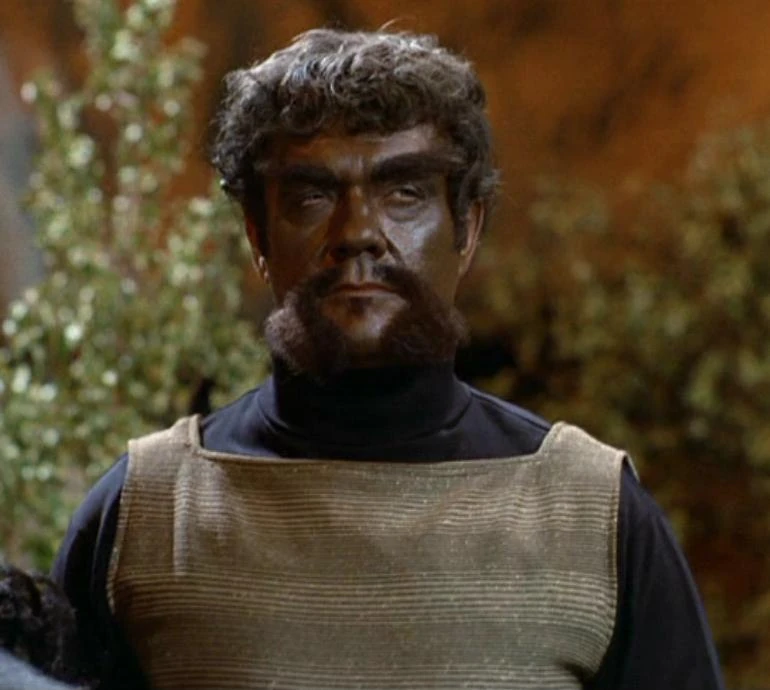

Excalbian's recreation of Kahless
In 2269, an image of Kahless was created by the Excalbians in a plot devised to better understand the concepts of "good" and "evil". The image was considerably flawed from the original Kahless, with such notable discrepancies as being infected with the Klingon augment virus and wearing a 23rd century Imperial Klingon Fleet uniform. The Excalbian version of Kahless appeared and acted quite differently from the original, since the image had been created from reading the minds of Humans who, at that point in Starfleet history, saw Kahless as a ruthless tyrant, and had had far more contact with Augment Klingons (or their descendants) than with standard Klingons. The Excalbian version of Kahless also had a talent for mimicking voices. (TOS: "The Savage Curtain")
Legacy
The stories of Kahless were the stories of the Klingon people. Passed down from generation to generation, these stories reminded the Klingons about who they were and where they had come from. Klingons studied these stories for all of their lives; Worf said he found new truths in them on each reading. (TNG: "Birthright, Part II") Many of these stories were held within the sacred texts, a few exclusively. Nevertheless, they remained an integral part of Klingon lore.
The following stories are portions and excerpts of song and lore surrounding the life of Kahless:
- Long ago, a storm was heading for the city of Quin'lat. Everyone took protection within the walls except one man who remained outside. Kahless went to him and asked what he was doing. "I am not afraid," the man said. "I will not hide my face behind stone and mortar. I will stand before the wind and make it respect me." Kahless honored his choice and went back inside. The next day, the storm came, and the man was killed. Kahless replied, "The wind does not respect a fool". (TNG: "Rightful Heir")
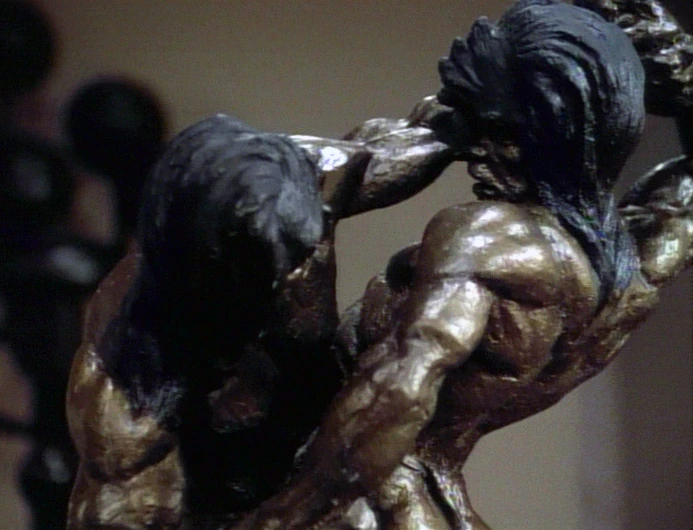

Kahless and Morath fight
- …Kahless was determined to teach his brother a lesson for having told a lie, because it made him look like a coward, but Morath refused to fight his brother, and instead ran away. Kahless pursued him across valleys and over mountains, all the way to the edge of the sea. And there on the shore, they fought for twelve days and twelve nights because Morath had broken his word and brought shame and dishonor to his family. (TNG: "New Ground", "Firstborn")


Kor and Worf find the Sword of Kahless
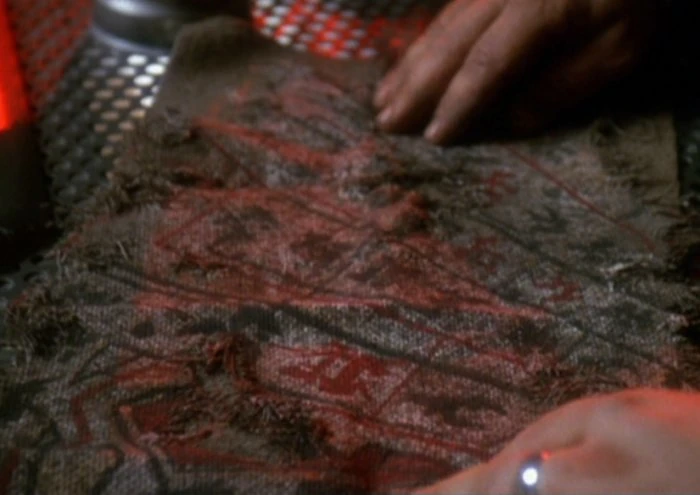

The Shroud of the Sword
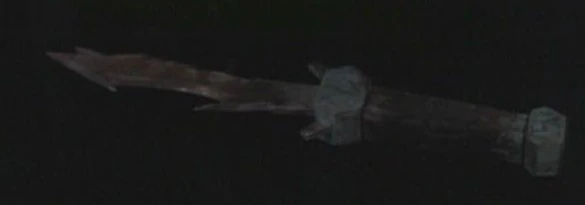

The Knife of Kirom stained with the blood of Kahless
- …Kahless held his father's lifeless body in his arms. He could not believe what his brother had done. Then, his brother threw their father's sword into the sea, saying that, if he could not possess it, neither would Kahless. That was the last time the brothers would speak. Kahless looked into the ocean and wept, for the sword was all he had left of his father and the sea filled with his tears and flooded beyond the shore. (TNG: "Birthright, Part II")
- Kahless single-handedly fought off an entire army at Three Turn Bridge. (DS9: "Let He Who Is Without Sin...")
- …The tyrant Molor was so strong that no one could stand against him. Kahless would rather die than live under Molor's tyranny… (TNG: "Firstborn")
- Kahless went into the mountains, all the way to the Kri'stak Volcano. He cut off a lock of his hair and thrust it into the river of molten rock, which poured from the summit. The hair began to burn, but then he plunged it into the Lake of Lusor and twisted it into a sword. (TNG: "Rightful Heir")
From the "drinking song":
- …and sticky-continuous and surrounded-continuous (by) blood, and the River Skral ran crimson red. On the day above all days. When Kahless slew evil Molor dead…! And after he used it to kill the tyrant Molor he gave it a name: bat'leth, "the sword of honor". (TNG: "Rightful Heir"; DS9: "The Way of the Warrior")
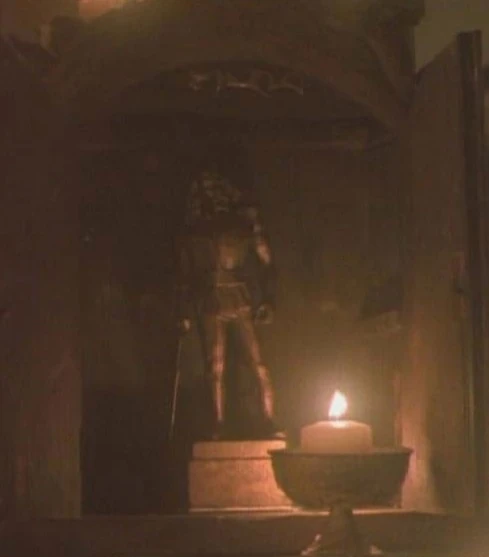

A small shrine with a statue of Kahless
The story of the sword was known only by the Klingon High Clerics, because it was never written down in the sacred texts. This was so that, if Kahless was ever to return, they could be sure it was him. (TNG: "Rightful Heir") When the Shroud of the Sword of Kahless was discovered, it was determined that the Sword of Kahless dated back at least 1,400 years. (DS9: "The Sword of Kahless")
- With the Sword, Kahless slew Molor, conquered the Fek'Ihri, and forged the first Empire. Kahless also used the Sword to skin the Serpent of Xol, to harvest his father's field, and to carve a statue for his beloved Lukara. (DS9: "The Sword of Kahless")
Molor's defeat was celebrated annually with the observance of the Kot'baval Festival. (TNG: "Firstborn")
- A thousand years ago, at the dawn of the Empire, five hundred warriors stormed the Great Hall at Qam-Chee. The city garrison fled before them. Only the Emperor Kahless and the Lady Lukara stood their ground. It was here that they began the greatest romance in Klingon history. (DS9: "Looking for par'Mach in All the Wrong Places")
- Kahless and Lukara were nearly killed, moments after they were married, by Molor's troops. (DS9: "You Are Cordially Invited")
The wielding of Ma'Stakas, used to re-enact Kahless' and Lukara's battle at Qam-Chee, at the conclusion of a Klingon wedding was a continued tradition in Klingon culture.
Another story that mentions Kahless entering the afterlife said that he was there to rescue his brother from the Barge of the Dead and deliver him to Sto-Vo-Kor. According to the Eleventh Tome of Klavek, Kahless returned from the dead still bearing a wound from the afterlife. (VOY: "Barge of the Dead")
The Story of the Promise was Kahless' swan song, "When Kahless united the people and gave them the laws of honor, he saw that his work was done. So one night he gathered his belongings and went to the edge of the city to say goodbye. The people wept, as they did not want him to go. And Kahless said, "You are Klingons. You need no one but yourselves. I will go now, to Sto-Vo-Kor. But I promise one day I will return." Then Kahless pointed to a star in the sky and said, "Look for me there, on that point of light."
The story of "The Promise" indicated that Kahless was to reappear in the lava caves on the planet of Boreth. The Followers of Kahless, or Guardians, waited there for his return. To Klingons, there was no more sacred place. For over 1,500 years, Klingons came to Boreth to ask questions. According to the clerics, the only way a Klingon warrior could find the answers they sought was to "Open your heart to Kahless, ask him your questions, let him speak to you with your mind unclouded by doubt or hesitation. Only then can you find what you are looking for." (TNG: "Rightful Heir")
After witnessing Worf's prowess in battle against the Jem'Hadar, General Martok praised his fellow Klingon, noting that Worf "truly [had] the spirit of Kahless within [him]". (DS9: "By Inferno's Light")
Caleb Mir told Jay-Den Kraag that he had heard the story of how Kahless had conquered Qo'noS, the Klingon homeworld, from Molor and how "they ate entrails stew to taste their victory, and how Kahless' warriors laid their weapons at his feet to honor him." The SuvwI' tlhIq continues to commemorate the event. Jay-Den revealed that his parents had sung Jay-Den and his brother Thar to sleep with that myth and it gave them comfort in the refugee camps. After finally understanding the myth, Jay-Den suggested to Starfleet that, instead of giving Faan Alpha to Klingons as their homeworld (which they refused as charity), "fight" the Klingons and allow the Klingons "conquer" the planet, as Kahless had done with Qo'noS. (SA: "Vox In Excelso")
Artifacts
- Beacon of Kahless
- Emperor's Crown
- Fornication Helmet
- Grail of Kahless
- Knife of Kirom
- Shroud of Kahless
- Sword of Kahless
See also
- Order of Kahless
- Spirit of Kahless
- Star of Kahless
Quotations
- "Destroying an empire to win a war is no victory. And ending a battle to save an empire is no defeat." (DS9: "The Way of the Warrior")
- "There is no victory without combat." (ENT: "Divergence")
- "Great men do not seek power; they have power thrust upon them." (DS9: "Tacking Into the Wind")
- "Today is a good day to die." (VOY: "Dragon's Teeth")
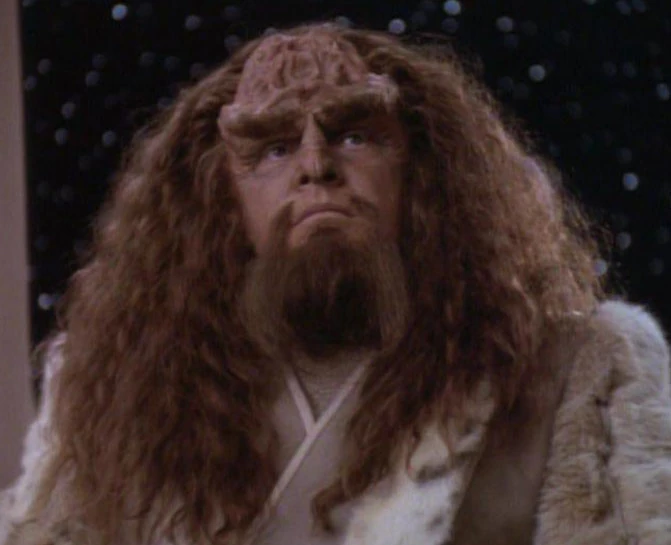
The Rightful Heir
.jpg)
A clone of Kahless
See: Kahless (clone)
Leaders of the Klingon Empire | |
|---|---|
| Emperors |
|
| Chancellors | |
Appendices
Further references
Background information
The "real" Kahless never appeared on Star Trek, outside a painting of his depiction as portrayed by Kevin Conway, who also appeared in "Rightful Heir" as Kahless' clone. The original depiction, and introduction of Kahless, appeared as an Excalbian recreation in "The Savage Curtain", who was portrayed by Robert Herron.
The name "Kahless" has been pronounced in various ways throughout Star Trek, such as the commonly used "Kay-less" and "Kaw-less" by Worf in "New Ground". The Okrandian Klingon language spelling of his name was qeylIS. (The Klingon Dictionary 2nd ed., p. 58)
Among the inspirations for Kahless as portrayed in TNG were King Arthur, Jesus Christ, and Viking lore. (AOL chat, 1998)
The original script for "Birthright, Part II" included a number of additional tales about Kahless that were not included in the final version of the episode (some of these unaired tales were later contradicted by other episodes):
- …Kahless held his father's lifeless body in his arms. He could not believe what his brother had done. Then, his brother threw their father's sword into the sea, saying that, if he could not possess it, neither would Kahless. That was the last time the brothers would speak. Kahless looked into the ocean and wept, for the sword was all he had left of his father and the sea filled with his tears and flooded beyond the shore. The people begged Kahless to stop his weeping, and he did and walked into the water to find the lost sword. He searched and searched the murky ocean bottom, holding his breath for three days and three nights when he would eventually find his father's sword.
- Kahless later invented the forms of what would become the Mok'bara when he went to the Underworld in search of his father. Kahless showed him the forms, and his father was able to remember his body and return to the world of the living.
- Kahless was condemned to die by the tyrant Molor, who was angered that Kahless had incited the people against him. The night before his execution, Kahless asked that he be allowed to go out into the night and say farewell to the moon and the stars, for he knew that, in the Netherworld, he would not see them again. Kahless gave his word that he would come back, and Molor let him go. Kahless had given his word and Molor understood what that meant. The next day at dawn, Kahless returned and was put to death (this story is contradicted by "The Promise").
In the first draft script of DS9: "When It Rains...", Kahless was said to have stood before his warriors, cut his own hand with a knife so that blood dripped out of his palm, and instructed those present, "Do this… in memory of me."
Kahless' lifetime
The exact time period in which Kahless lived has repeatedly been described with differing numbers. In "Looking for par'Mach in All the Wrong Places", taking place in 2373, Worf enthusiastically mentions Kahless' battle against Molor's troops to have happened "a thousand years ago." This would appear to be somewhat of a contradiction, as TNG: "Rightful Heir" states that the monks on Boreth have been awaiting Kahless' return for fifteen centuries, i.e. five hundred years longer. Either Worf "rounded" the number of years in his enthusiasm, or Molor and Kahless were at least five hundred years old, which, while the maximum life span for Klingons has never been clearly defined, seems to be without precedent. Another solution would be that Worf counted in Klingon years, as DS9: "Soldiers of the Empire" established 2373 to correspond to the Year of Kahless 999. This would also be in accord with the Sword of Kahless being dated to an age of 1,400 years in "The Sword of Kahless". Furthermore, a scene cut from "Rightful Heir" had Data specify Kahless' death as 1,547 years prior, which would place it in 822 AD.
Apocrypha
The novel Kahless showed a different take on the legend. The novel asserted that Kahless, son of Kanjis was a soldier within Molor's army who refused to burn down a village and who was forced to slay Molor's eldest son. This turned Kahless and his band into outlaws, but their goal was not to topple Molor but to simply hide. Rumors spread, however, that they planned to overthrow Molor's tyrannical empire. After the death of his love, a woman known as Kellein, Kahless despaired and fled the group, but was followed by his loyal friend Morath, son of Ondagh, who wrestled with Kahless for six days and nights. After this wrestling match, Kahless yielded to Morath and dedicated his life to destroying Molor. The novel also mentioned the Mok'bara; in the novel, Kahless had never heard of the practice. The book also suggested that the blood used to create the clone of Kahless was not Kahless' blood but rather Morath's.
The comic book Star Trek: Klingons also uses the name Kahless, son of Kanjis but is otherwise much more true to the legend of Kahless as a messianic figure. The story begins with Kahless slaying his brother Morath and continues with Kahless defeating the armies of the three warlords of Three Turn Bridge and freeing the people from their tyranny. In this story, Molor had a spaceship and was worshiped by some Klingons as a deity.
In the FASA role-playing game, Kahless lived during a time when Klingons had already invented warp drive and died fighting against the Romulans. His full name was Kahless epetai-Riskadh.
In the DC Comics line, a descendant of Kahless, Kahless IV, served as emperor during the movie era. This conflicted not only the details of "Rightful Heir", but also a statement that the Klingons had not had an emperor in three hundred years.
In Star Trek Online, the clone of Kahless seen in TNG and DS9 appeared prominently in early missions available to Klingon players, and fought alongside them battling Fek'Ihri forces intent on conquering the Klingon Empire. He later was killed in single combat against an Iconian named T'Ket during The Iconian War.
In the miniseries Star Trek: Prey, a group of con artists fake the public execution of the Kahless clone with the goal of studying him so that they can attempt to fake the return of the true Kahless, but Kahless is able to outsmart them and escape captivity, and the plan is brought to a halt when the gang betrays each other before they can put it into practice.
External link
- Kahless the Unforgettable at Memory Beta, the wiki for licensed Star Trek works