
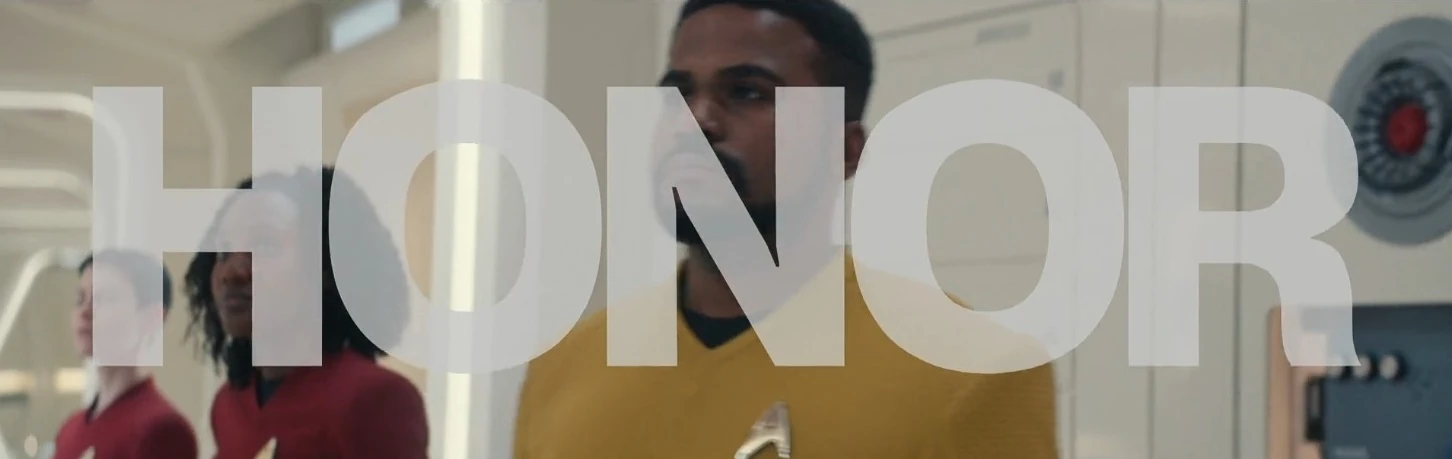

"You use that word, but you have no idea what it means."
"Maybe not, but you do."
The definition of honor varied widely between cultures, as did the importance placed upon it. Honor was normally synonymous with dignity and referred to the upholding of one's values. The Klingons were notorious for the emphasis they placed on honor.
This may have been a more abstract way of viewing honor. But, as notions of honor were often very subjective, putting emphasis on clear objects (i.e., victory) made the Klingons able to deduce the honorable conduct (i.e., means used to achieve victory).
The Tosk had a high belief in their honor, preventing them from breaking their oath of silence and accept a possibility such as political asylum. (DS9: "Captive Pursuit")
Although Vulcans suppressed emotions, they nevertheless had a sense of honor. (ENT: "The Andorian Incident") In 2152, T'Pol, explaining to Captain Jonathan Archer why she was sent by the Vulcan High Command to capture a criminal who escaped her during her time as an agent with the Ministry of Security, stating that they considered it a matter of honor. Archer found this to be a very Vulcan attitude. (ENT: "The Seventh")
In 2364, Ligonian custom made it clear that a visiting leader became an honored guest. (TNG: "Code of Honor")
The Breen had a sense of honor to the point that Primarch Ruhn breaking a tergun, a sacred oath, not to destroy the Eternal Gallery and Archive would have other Breen coming after him for Ruhn's dishonor. (DIS: "Labyrinths")
Klingon honor
Honor was one of the most important components of Klingon philosophy, as their social order depended on an inviolable honor-shame dynamic. However, it was significantly different from most other cultures' definition of the word. For example, Worf once said, "Nothing is more honorable than victory." From this point of view, using a cloaked ship to ambush enemies could be considered honorable if it achieved victory. (DS9: "The Way of the Warrior"; DIS: "The Vulcan Hello")
The notion of honor seemed to be highly relative and open to debate. Each and every Klingon could possibly have his own interpretation of what consisted of an honorable means to achieve an end. Even more, some decisions were paradoxical because two different views of honor were in contradiction. For instance, Worf indicated that it was necessary to challenge Gowron's leadership (because he was presumably acting in a dishonorable way), while General Martok was convinced that it was dishonorable to challenge the leader of the Klingon Empire in the middle of a war. (DS9: "Tacking Into the Wind") In another case, while Doctor Antaak's deception in claiming to have stabilized Augment DNA, allowing the creation of Klingon Augments, when he and Phlox had merely cured the augment virus might be seen by some as dishonorable, Antaak himself believed that, given the millions of lives this cure would save, his near-certain execution, if caught, would be as honorable a death as a doctor could have. (ENT: "Divergence") Hence, dishonor was sometimes a concept which compelled Klingons to action.
Despite honor being a huge part of Klingon culture and society, there have been known cases of Klingons acting dishonorably. D'Ghor sought to take over the House of Kozak but did so by attacking the House's financial assets, as he did not wish to destroy it through openly challenging it; Grilka was openly disgusted by the very idea of this, and Gowron later discommended him for his actions. (DS9: "The House of Quark") While explaining the hierarchy on Klingon ships, Jadzia Dax mentioned that cowardice was among the conditions under which a subordinate could challenge a superior; Miles O'Brien was surprised at the very idea of Klingons showing cowardice, though Dax stated, "It's been known to happen." (DS9: "Soldiers of the Empire") Captain Dorg's actions in manipulating the Pakleds into war with the Federation in order to destabilize it were so dishonorable that his first officers Togg and Ma'ah challenged him, with the latter killing Dorg and taking control of his ship. Dorg was shown to be a Klingon extremist who cared more about the power of the Klingon Empire than honor. (LD: "wej Duj")
Dorg's brother Bargh, the leader of the Klingon Oversight Council proved to be dishonorable as well, stabbing Ma'ah in the back after being defeated in single combat by him. Afterwards, the Klingon High Council assigned Dorg and Bargh's sister Relga to patrol a worthless corner of the Empire, presumably in response to her dishonorable brothers' actions. Relga later faked a message from Admiral Alonzo Freeman to trick Captain Carol Freeman of the USS Cerritos in order to get revenge on Ma'ah and his brother Malor. After the deception was exposed, Lieutenant junior grade Beckett Mariner commented "damn. That is so dishonorable." Following Relga's death, her dishonorable actions led to Ma'ah being given command of her fleet. (LD: "A Farewell To Farms", "The New Next Generation")
Out of all races the Klingons had encountered, the Romulans were widely considered by them to be the most dishonorable; Worf especially hated them and considered them dishonorable due to an attack they had committed on Khitomer and the death of his father. However, he later admitted that they were capable of fighting with honor, when they assisted the USS Enterprise-E in defeating Shinzon's ship, the Scimitar. (TNG: "The Neutral Zone"; Star Trek Nemesis) Klingon opinion on the Federation was widely variable and changed with time, though they were deeply impressed by the sacrifice made by the crew of the USS Enterprise-C, which was destroyed when attempting to defend a Klingon outpost at Narendra III. (TNG: "Yesterday's Enterprise") When tensions reached a high in 2372, Gowron claimed that the Federation did not care for honor, though his opinion changed the following year when Benjamin Sisko's team infiltrated Ty'Gokor to assassinate a Changeling at very high personal risk, leading to a ceasefire between the two sides. (DS9: "The Way of the Warrior", "Apocalypse Rising")
Other races considered dishonorable, by at least some Klingons, include the Breen, (DS9: "'Til Death Do Us Part") the Ferengi, (DS9: "The House of Quark") and the Jem'Hadar. (DS9: "Soldiers of the Empire") On the other hand, the Jem'Hadar did understand the concept of honor, with some even respecting it. The Vorta, however, considered it barbaric. (DS9: "By Inferno's Light") In contrast, the Klingon soldier Leskit claimed to respect the Cardassians as he felt they fought for their people and followed a code, "just like we do." (DS9: "Soldiers of the Empire")
Klingon honor can involve saving face through rituals and traditions, and does not always have to end in battle and bloodshed. For example, when Jay-Den Kraag expressed the desire to join Starfleet, his father purposely missed a shot during a hunt before abandoning Jay-Den, which is noted by Klingon-Hybrid Lura Thok, as Klingon even in anger would not miss a shot, but instead is the only way a traditionalist Klingon knew how to concede victory, thus free his son to follow his own path.
After The Burn devastated Klingon Empire, Klingon dug further into their traditions, seeing that is all they have left. In 3195, Klingon honor prevented them from accepting Starfleet help when they found the Klingons a new homeworld, Faan Alpha, following the destruction of Qo'noS in the Burn. Klingon warlord Obel Wochak risked dishonor from his own people just for meeting with Captain Nahla Ake on the topic. On the suggestion of Klingon cadet Jay-Den Kraag, Starfleet satisfied Klingon honor on the matter by staging a battle with Obel's forces -- both sides deliberately missing or only causing minor damage -- so that the Klingons could claim Faan Alpha as the spoils of war. (SA: "Vox In Excelso")
As Klingon honor is shown to be reputation and standing based, it is closer to "Face" and "Izzat" in real world, both of which were traditionally translated as "Honor". An example of a staged act being used to save face can be seen in an example provided by Lu Xun in his article "說「面子」", where Qing officials merely accept foreigner's coercions but sent them away from side doors to save face. The same article also noted whether one gain faces or loses face depends on situations and the person's own standing. Furthermore, under Face-based system, subterfuge, scheming and manipulation is accepted or even celebrated if executed successfully, but will results in lost of Face if exposed before fruition or ended in failure. Calling out other's unscrupulousness despite one's own lack of face can even be a way to salvage face. As per Four Occupation, merchants have low reputations, which is mirrored in Klingons seeing Ferengi as dishonorable.
The seemingly paradoxical aspect regarding Martok killing of Gowron can be resolved by changing from "honor" to "face" - Gowron’s mismanagement of the war would be perceived as face-losing internally and externally. However, per "faces", there was always an obligation to give face to your superior and allies. Thus, keeping status quo retained faces, while if Martok moved against Gowron, but had no support or failed in his attempt, Martok would lose face, and having such act known outside is also face-losing.