Temperature is a measurement of the quantity of heat in an object or an environment, usually as measured on a thermometric scale.
Damage from a too high temperature on an object was called thermal damage. (ENT: "Regeneration")
Sub-commander T'Pol once said, that she prefered cold temperatures instead of the Human odor. (ENT: "The Andorian Incident")
Earth scales
Celsius
- Main article: Celsius
The degree Celsius (°C) was named after Earth astronomer Anders Celsius, and was designed so that the freezing and boiling points of water would be 0 °C and 100 °C respectively at 1 Earth atm.
The replicators aboard a Federation starship like the USS Enterprise-D were calibrated to the Celsius scale. (TNG: "The Defector")
Fahrenheit
- Main article: Fahrenheit
The degree Fahrenheit (°F) was named after Earth physicist Gabriel Fahrenheit, and was designed so that the freezing and boiling points of water would be 32 °F and 212 °F respectively at 1 Earth atm.
Sensors aboard 23rd century Federation starships could be calibrated to read in degrees Fahrenheit. However, like the mile, this antiquated means of measurement was used only on rare occasions. (Star Trek: The Original Series)
Kelvin
- Main article: Kelvin. You might also be looking for the alien species from the Andromeda Galaxy known as the Kelvans.
The Kelvin (K) was named after Earth physicist and engineer Lord Kelvin. The scale was designed so that 0 K would be absolute zero, with the magnitude of each unit equal to one degree Celsius. As a result, water freezes at 273.15 K and boils at 373.15 K
Other scales
Onkian
- Main article: Onkian
An Onkian was a thermometric scale used within the Romulan Star Empire. Twelve onkians were equivalent to a temperature above the freezing point of water. Admiral Alidar Jarok, after requesting political asylum on the USS Enterprise-D, ordered water with a temperature of twelve onkians from the replicator in his guest quarters. (TNG: "The Defector")
Absolute zero
Absolute zero is the term used for zero heat energy, the lower limit of possible temperatures.
Comparative list of temperatures
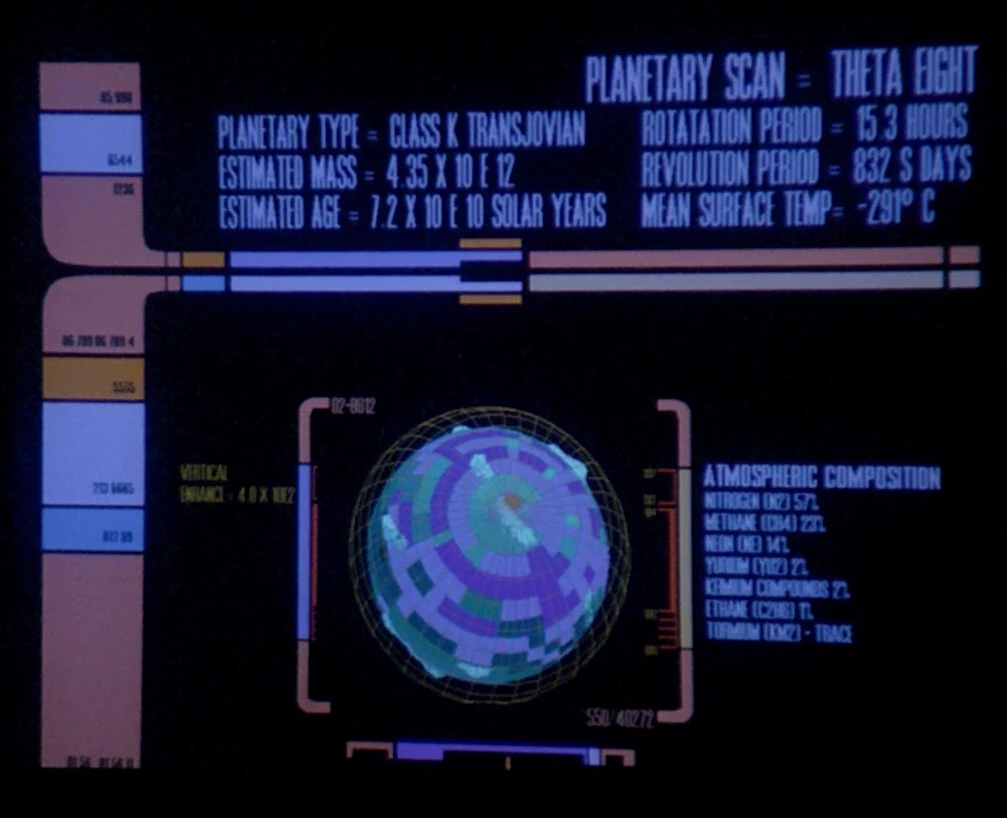

An impossible temperature of −291 °C
- ( 0 K, −273.15 °C, −459.67 °F ) – When the USS Enterprise first scanned the insectoid starship it encountered in 2269, it appeared to have a temperature of exactly absolute zero, a theoretical impossibility. Later, it was discovered that the insectoid starship's energy accumulating wands, which collected many types of energy, were causing the sensors to return false data. The heat was being absorbed by the wands, leaving none to be detected. (TAS: "Beyond the Farthest Star")
- ( 20 K, −253 °C, −424 °F ) – The geologically unstable "mad planet", where the Soul of the Skorr was believed to be located, containing constant earthquakes, gravitic shifts, tidal waves, and a temperature that varied from 20 Kelvin to 204 °C above. (TAS: "The Jihad")
- ( 94 K, −179 °C, −291 °F ) – In "The Royale", Geordi La Forge stated that the planet Theta VIII had a surface temperature of −291°.
- ( 253 K, −20 °C, −4 °F ) – The Argala habitat zone, found on board a Nyrian biosphere vessel, had an ambient temperature of −20 °Celsius. (VOY: "Displaced")
- ( 290 K, 17 °C, 63 °F ) – The morphogenic matrix of a Changeling was most malleable at 17 °Celsius. (DS9: "The Begotten")
- ( 294 K, 21 °C, 70 °F ) – Uhura noted the weather forecast at Mount Rushmore as being sunny skies with a temperature of 70 degrees (Fahrenheit). (Star Trek V: The Final Frontier)
- The external temperature of a Federation shuttlecraft, utilizing metaphasic shielding, could tolerate radiation levels that approached ten thousand rads and temperatures of 1.9 million Kelvin, while maintaining an internal cabin temperature of 21 °C. (TNG: "Suspicions")
- ( 295 K, 22 °C, 72 °F ) – Zefram Cochrane maintained a constant temperature of 72 degrees (Fahrenheit) in his dwelling on Gamma Canaris N. To Nancy Hedford, who was suffering from Sakuro's Disease, this temperature felt "terribly hot." (TOS: "Metamorphosis")
- ( 295.4 K, 22.2 °C, 72 °F ) – Initial scans made by the USS Grissom on Sector 1 of the Genesis Planet indicated that it was a forested region with a temperature of 22.2 °Celsius. (Star Trek III: The Search for Spock)
- ( 297 K, 24 °C, 75 °F ) – The surface temperature of the Companion's homeworld was reported by Doctor Leonard McCoy to be 75 degrees Fahrenheit. (TOS: "Metamorphosis")
- A weather report, heard on the Henry Starling's radio in 1967 noted that the temperature in downtown Barstow, California was 75 degrees (Fahrenheit). (VOY: "Future's End")
- ( 298 K, 24 °C, 76 °F ) – The Federation and Bourget habitat zones, found on board a Nyrian biosphere vessel, both had an ambient temperature of 76°. (VOY: "Displaced")
- ( 305 K, 32 °C, 90 °F ) – When the Federation took over Deep Space 9, the station's average temperature was at 32 °Celsius, indicating the temperature preference of Cardassians. (DS9: "Emissary")
- ( 310.1 K, 36.9 °C, 98.5 °F ) – While scanning the surface of a planet, Spock's sensor readings discovered a Human being, later determined to be named Lazarus, with a body temperature of 98.5 °Fahrenheit. (TOS: "The Alternative Factor")
- ( 312.3 K, 39.1 °C, 102.4 °F ) – The internal climate aboard a Borg cube was kept at a constant temperature of 39.1 °Celsius. (Star Trek: First Contact)
- ( 312.6 K, 39.4 °C, 102.9 °F ) – Initial scans made by the USS Grissom on Sector 2 of the Genesis Planet indicated that it had a desert terrain, with minimal vegetation and a temperature of 39.4 °Celsius. (Star Trek IV: The Voyage Home)
- ( 319 K, 46 °C, 115 °F ) – The Zooabud and Tanatuva habitat zones, found on board a Nyrian biosphere vessel, both had an ambient temperature of 46 °Celsius. (VOY: "Displaced")
- ( 323 K, 50 °C, 122 °F ) – The summers in the Rinax marshlands were the hottest in the sector surrounding the Talaxian system. Conditions of these marshlands included temperatures of 50 °Celsius, with a 90% humidity, and some of the most vicious lavaflies on Rinax. (VOY: "Macrocosm")
- ( 328 K, 55 °C, 131 °F ) – Lambda Paz, a moon of Pentarus III, was classified as barely class M with a desert-like surface and an average temperature of 55 °Celsius. (TNG: "The Host")
- The ore processing section of Terok Nor, while processing dilithium ore, would reach temperatures of 55 °Celsius. (DS9: "Civil Defense")
- ( 333 K, 60 °C, 140 °F ) – Benjamin Sisko preferred his coffee served at 60 °Celsius. (DS9: "Call to Arms")
- ( 353 K, 80 °C, 176 °F ) – Aunt Adele's cure for the common cold was ginger tea with honey, served at 80 °Celsius. (TNG: "Ensign Ro")
- ( 360 K, 87 °C, 188 °F ) – In order to free the bio-neural gel packs aboard the USS Voyager from a viral infection caused by schplict, the interior of the ship was heated to 360 Kelvin to simulate a fever. (VOY: "Learning Curve")
- ( 423 K, 150 °C, 302 °F ) – The Legarans preferred to inhabit in a pool of thick swirling ooze, which was carefully maintained at the constant of 150 °Celsius. (TNG: "Sarek")
- ( 473 K, 200 °C, 392 °F ) – The temperature at the lunar prison on Meldrar I reached 200° in the shade. (DS9: "Necessary Evil")
- ( 477 K, 204 °C, 399 °F ) – A geologically unstable planet, where the Soul of the Skorr was believed to be located, experienced constant earthquakes, gravitic shifts, tidal waves, and a temperature that varied from 20 Kelvin to 204 °C above. (TAS: "The Jihad")
- ( 500.00 K, 226.85 °C, 440.33 °F ) – A dish devised by Gideon Seyetik, using an Andorian boiler, was cooked at exactly 500 Kelvin. (DS9: "Second Sight")
- ( 500 K, 227 °C, 440 °F ) – The surface of a Y-class planet was categorized by a surface on which the temperature exceeds 500 Kelvin, with an extremely turbulent, toxic atmosphere with thermionic radiation. (VOY: "Demon")
Extreme heat
At very high temperatures, the difference between Kelvin and Celsius becomes inconsequential, as 273 degrees becomes less than the measurement and/or rounding error.
- ( 60×103 K, °C, 108×103 °F ) – While conducting an experiment on the star Praxillus, in order to revitalize the Kaelon sun, the results of their initial experiment yielded seventeen hundred percent rise in gamma radiation levels, while the stars' density was measured at eleven hundred grams per cubic centimeter, with a temperature approaching 60 thousand degrees Kelvin. (TNG: "Half a Life")
- ( 1.9×10⁶ K, °C, 3.4×10⁶ °F ) – The external temperature of a Federation shuttlecraft, utilizing metaphasic shielding, can tolerate radiation levels that approach ten thousand rads and temperatures of 1.9 million Kelvin, while maintaining an internal cabin temperature of 21 °C. (TNG: "Suspicions")
- ( 260×106 K, °C, 468×106 °F ) – In order to stabilize the core of a star, the temperature has to reach 220 million degrees Kelvin. The core density of a star becomes unstable at 260 million degrees Kelvin. (TNG: "Half a Life")
Fluctuation in temperature
Although not explicitly stated in terms of "degrees of what", the following temperature fluctuation references are most likely made in Celsius.
- Pentharan spheral forecasts were predicting a drop in temperature of 10 to 12 degrees within the first ten days after impact of an type 3 asteroid on the planet. (TNG: "A Matter Of Time")
- While inflicted with the morphogenic virus, the Female Changeling noted that she wanted the temperature in the rooms of the Dominion Headquarters on Cardassia Prime lowered by 15 degrees. She noted that she didn't "share the Cardassians' love of heat;" nor apparently did Weyoun. (DS9: "Treachery, Faith and the Great River")
- Once the wind died down on the planet where Dukat and Sisko were stranded in 2374, Dukat noted that the temperature increased by 20 degrees – much to the liking of his Cardassian physiology. (DS9: "Waltz")
- The surface of the planet Dozaria was about 50 degrees too hot for the Breen, considering their homeworld was a frozen wasteland. (DS9: "Indiscretion")
See also
- Body temperature
- Boiling point
- Melting point
- Surface temperature
- Temperature control louver
- Temperature control shield
- Thermalization