Syndication is the occurrence of third-party national, local and/or foreign television stations[1] purchasing broadcast rights of individual television shows outside the context of the original broadcasting network for whom said television shows had been produced to air in the first place. Depending on the contracts signed, broadcast rights can be for one-time-only airings or for multiple airings. While it is the production company that usually negotiates the syndication, it is commonplace that the original broadcaster as co-owner of the respective television show it paid for, also retains a cut from the syndication revenues, either indefinitely (which is the case for NBC in regard to Star Trek: The Original Series) or for a pre-negotiated period of time, again depending on the contracts signed.
The phenomenon was quickly expanded to include television broadcast rights for theatrical motion pictures as well. The only difference was that there were usually no original broadcasters in play with whom syndication revenues had to be shared, with the exception of the so-called directly for television made "TV films", of which the latter-day Kurtzman-era produced Star Trek: Section 31 is the prime example where Star Trek is concerned.
Some stations carry network programming at peak hours, such as prime-time and weekends, and air syndicated series at other times. Others thrive solely on syndicated shows. Star Trek: The Next Generation and Star Trek: Deep Space Nine were both syndicated, and actually the first Star Trek shows to be released directly through syndication, instead of premiering on one of the three national broadcasters, constituting an innovative industry novelty at the time when The Next Generation was launched. (William Shatner Presents: Chaos on the Bridge)
Early Star Trek syndication
| Earliest known trade journal Star Trek studio syndication advertisements | |
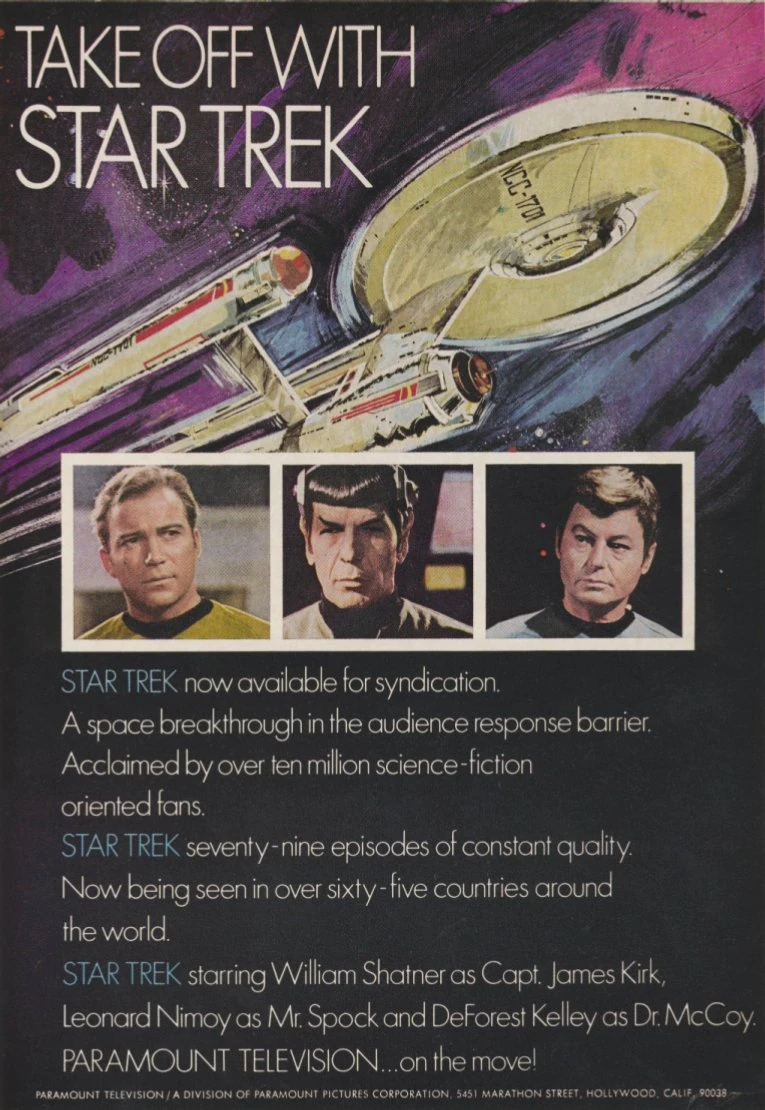
|
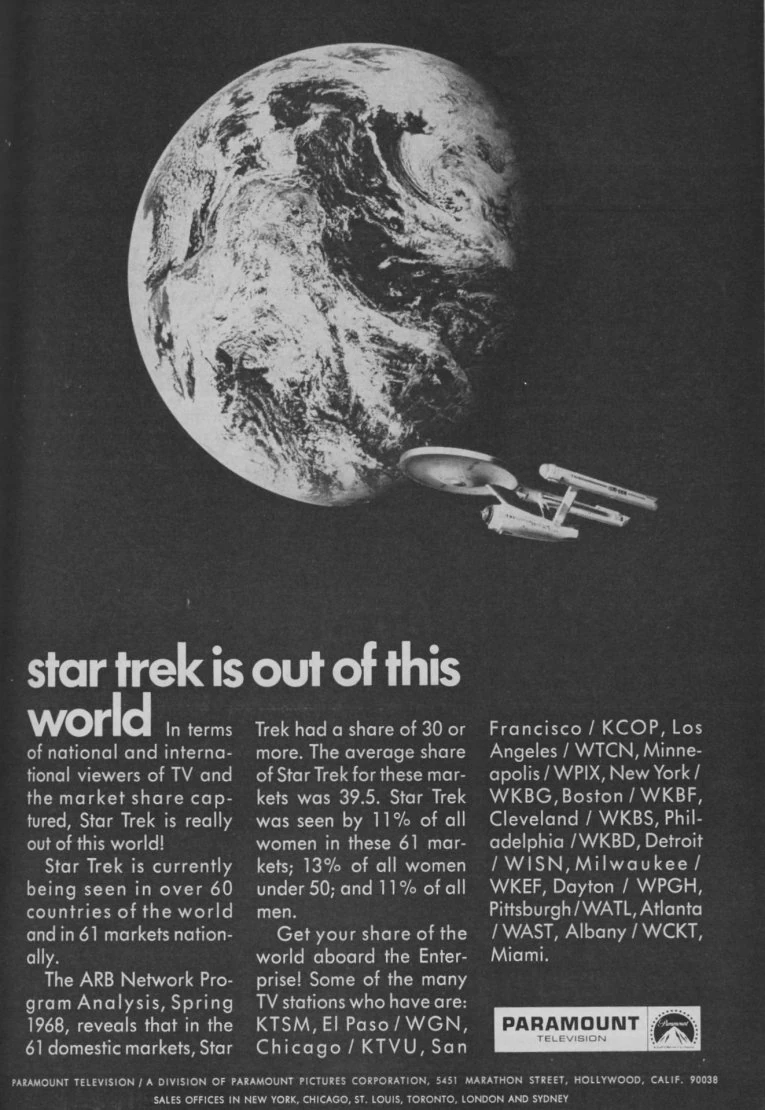
|

|
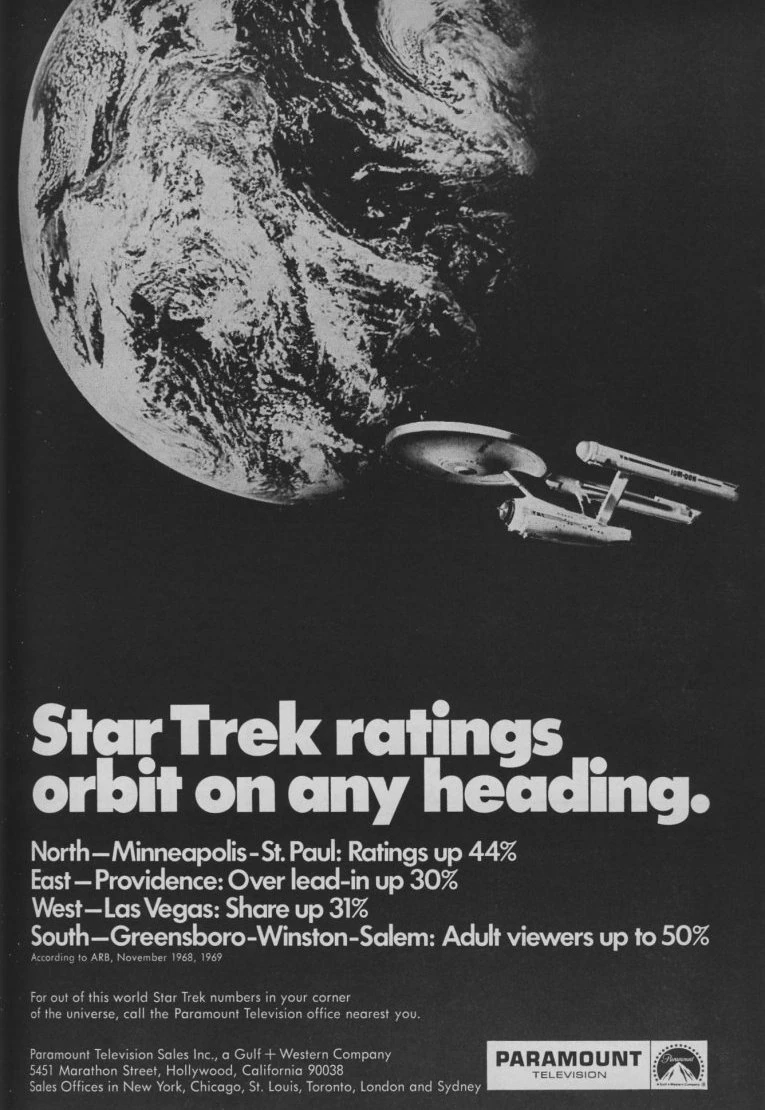
|
Star Trek: The Original Series was aired on NBC, one of the three traditional national broadcasters, where it was cancelled after only three seasons, following the overturning of the earlier cancellation after the famed letter-writing campaign led by Bjo Trimble that saved the series for a third season. When original production company Desilu Studios was sold on 27 July 1967, its new owner Paramount Pictures did not want the Star Trek property because, "(...)it was losing too much money each week and didn't have enough episodes to syndicate successfully. That was a wise business decision at the time," as former Desilu, but now Paramount executive Herb Solow had put it, and a widely held belief by the three broadcasters at the time. Nonetheless, Desilu owner Lucille Ball insisted on selling her company as an intact entity – excepting her own hugely popular Here's Lucy show – which forced a reluctant Paramount to also accept the legal and financial liabilities for the unwanted property. (NBC: America's Network, p. 218)
Despite Paramount's reservations though, the show was already sold in syndication for the first time while the third season was still being aired on NBC, and which coincidentally and ironically added just enough episodes for a syndication to become potentially viable, as then believed. [1] Herb Solow has identified Kaiser Broadcasting, operating a small chain of local television stations along the West and East Coast, as the first-time buyer, which immediately started to broadcast Star Trek on a daily basis directly after the last episode had aired on NBC. Much to the delight of owner Henry J. Kaiser, a steep rise in viewership and ratings – and thus television advertisement revenues – was observed, the ratings later identified in Star Trek lore as the reason why the Original Series had been cancelled by NBC in the first place. Incidentally, Kaiser had four years later hoped for a repeat performance of the twin sibling franchise Mission: Impossible, which had sufficient episodes to syndicate after its full seven-season run, but much to his dismay Mission: Impossible actually bombed in syndication, having to wait for three decades for its resurgence as a franchise. (Inside Star Trek: The Real Story, 1997, pp. 417-418)
Apparently, Solow proceeded from the most common understanding of syndication when he made the observation in his book, namely after-the-fact broadcast rights sales (meaning, after the original broadcaster had completed the initial run on television and also referred to as "second-run syndication"), but had overlooked the fact that the series had already been sold to two foreign broadcasters previously; Canadian broadcaster CTV started to air the Original Series on 6 September 1966 (in effect beating NBC to the punch by two days and therefore constituting the actual world premiere of Star Trek), whereas Japanese broadcaster Nippon Television Network Corporation started to air the series on 27 April 1969, over a month before the series ended its original NBC run on 3 June. For all intents and purposes, these constituted the actual first two airings in ("International") syndication – as well as the only known instances of the Original Series being aired beyond NBC while it was still in production.
The phenomenon experienced by Kaiser Broadcasting was not lost on other (local) television stations, and were queuing up to buy Star Trek for their own stations as well. Thus the spectacular resurgence of Star Trek in syndication started, when the show experienced a strong revival in the 1970s after it became aired locally across America, including on local "UHF" channels in addition to being shown (again) on major networks.
In syndication, Star Trek was often aired late at night (after 9 or 10PM) or on weekends. Due to the different time allotments for syndicated programs, nearly all Star Trek episodes were cut of certain scenes to allow for running in their syndicated forms. This led to a popularity in "uncut" episodes which were available on VHS tapes (and later DVDs) or shown in their entirety as part of special programing, such as the 20th anniversary of Star Trek in 1987. Quickly expanding to other foreign markets as well, the Original Series became continuously aired on television for the better part of the next four decades – if not in the USA, then somewhere else in the world, in the process making Star Trek the world-wide phenomenon it eventually became. According to a feature-length article, published in Playboy magazine, the Original Series was by the time Star Trek: The Motion Picture premiered, aired domestically 308 times a week on 134 US stations, whereas it had been translated in 47 languages (dubbed and subtitled) and sold in syndication to 131 international markets. (Playboy, January 1980, p.142)
The importance of syndication for Star Trek – a failed television show as universally believed by the industry, only to be relegated to oblivion as a minor footnote in television history, if even that – can not be overstated enough, as it essentially brought Star Trek back from the grave as the first of its kind, providing the cornerstone on which everything Star Trek that came after, aka "The [Star Trek] Franchise", was built. And it is this in particular, even more so than Trimble's third season saving letter campaign, that media scholars have recognized Star Trek for making television history, instead of becoming a footnote of it – a fate that actually befell younger franchise sibling Mannix. (Star Trek and American Television, Chapter 1)
Syndicated Star Trek programing continued well into the 1990s and early 2000s; however, some later showings presented the episodes in their entire form, without cuts, or cut the episodes in different ways. This was most evident on the Sci-Fi Channel, which began showing its Sci-Fi Channel Star Trek Special Edition in the late 1990s, which either cut additional scenes from those in syndication or showed the episodes in their entire form.
Early syndicating of Star Trek has not been limited to the Original and, later on, Star Trek: The Animated Series alone, the latter actually commissioned because of the success the original enjoyed in syndication, and thus becoming the first franchise building block added on the cornerstone provided by syndication. When the Star Trek films franchise was created with The Motion Picture, broadcast rights for three airings were already sold while it was still in production in the autumn of 1978 to broadcaster ABC (one of the other two national broadcasters) for US$15 million – or $10 million, according to performer Walter Koenig – before the film had even premiered a year later. (Starlog, issue 32, p. 58) Syndicating the subsequent films to broadcasters worldwide has become a Star Trek syndication staple as well. Incidentally, when first-time aired on 20 February 1983, a re-edited with twelve minutes extended longer version was shown, later known as the "Special Longer Version". Only released on VHS, VHD and LaserDisc as such, these have become collector items onto their own, as this version has seen no other home video formats afterwards – until September 2022 that is, when it became released in the 4K Ultra HD Blu-ray format as part of the Star Trek: The Motion Picture - The Director's Edition Complete Adventure set. ABC repeated this for the first-time television airing of the follow-up Star Trek II: The Wrath of Khan on 24 February 1985. [2] This time around however, the aberrant version of the film was not immediately released on a home video format afterwards, but has seen later and wider releases as the 2002 Star Trek II: The Wrath of Khan (The Director's Edition) DVD and the 2016 Star Trek II: The Wrath of Khan (Director's Cut) Blu-ray, though some clippings included in the aired version were not included on the home video releases, and vice versa.
With the rise of digital streaming (see below), syndicated Star Trek episodes, saved on such media formats as VHS, have become a rarity and are even sought out for their uniqueness as collector's items.
Later Star Trek syndication
The producers of Star Trek: The Next Generation originally sought a lower-pressure environment than syndication through traditional means, when President Paramount Network Television CEO John S. Pike approached the three national networks in his 1986 search for an outlet for the new show, but failed to engender network interest for it, including the at the time by Brandon Tartikoff headed NBC, which had originally aired the Original and Animated Series. For the briefest of times it appeared that the new Star Trek television series had died before it even had been born, when Pike was approached by his colleague, Paramount Domestic Television President Lucie Salhany. Salhany convinced Pike to produce the new series for direct syndication, an entirely novel idea at the time, assuring him she could sell a full season of twenty-six episodes. Taking her cue from the syndication history of the Original Series, Salhany reasoned that even if the new series did not turn in a profit in first syndication run, also referred to as "First-Run Syndication", the studio should still take its losses on this occasion, as subsequent runs would, not to mention the future revenues from associated sales, such as merchandise, home video formats, foreign sales, and the like. Even more novel was Salhany's idea to offer the first syndication run of The Next Generation for free, in exchange for control over the seven-minute advertisement blocks. In order to manage financial risk, the studio green-lit a half season run of thirteen episodes packaged with Original Series episodes (which were to be paid for by networks). These were proposed to see if interest in the new series would materialize, especially from the side of advertisers, to continue production if it did. (William Shatner Presents: Chaos on the Bridge; Star Trek: The Next Generation - The Continuing Mission, pp. 5-7, 11).
In service of this goal, Paramount Television head Mel Harris, Pike's and Salhany's superior and the studio executive who had initiated the development of The Next Generation in the first place, stepped in and spoke in early August 1987 via satellite with the initial 170 television stations (covering 94 percent of American television households), that would premiere The Next Generation in first-run syndication. In a slick presentation, featuring footage and production scenes from the yet unfinished pilot, "Encounter at Farpoint", praising the business opportunities the new series entailed to commercial ends – to wit, television adds revenues – for those savvy enough to grasp. ([3]; Star Trek: The Next Generation Companion, 3rd ed., p. 22) Subsequent events proved Salhany's hunch correct, with The Next Generation going on to arguably become the most successful outing in the television franchise. In having done so, Star Trek had again made television history.
Brandon Tartikoff incidentally, made good on his error in judgement later on when he, now as Paramount head, became responsible for the inception of both the Next Generation Star Trek films and Deep Space Nine, which he, somewhat ironically, ordained to premiere in syndication as well. (Star Trek: The Next Generation - The Continuing Mission, pp. 154-157)
The next two Star Trek series, Star Trek: Voyager and Star Trek: Enterprise, did not premiere in syndication. When Star Trek owner Paramount launched its own network, UPN in 1995, Voyager was the flagship series. UPN was intended as a de facto fifth national broadcaster, after NBC, ABC, CBS and the relative newcomer Fox Television, which was founded around the time when Pike was making his rounds for The Next Generation, and as newcomer had actually shown interest, but under conditions that were hugely disadvantageous for Paramount under the old system. (Star Trek: The Next Generation - The Continuing Mission, p. 6) Voyager ended in 2001 and was immediately replaced with Enterprise, which was cancelled after only four seasons as UPN attempted to change its image. Like the original Trek, Enterprise was nearly cancelled a year earlier than it was, but was spared and moved to Friday night instead, where its ratings fell, leading to cancellation. In 2007, Sci-Fi acquired the first-time rights to re-air Enterprise in syndication, starting on 8 January 2007 alongside its own series many felt was in large part responsible for its demise, Ronald D. Moore's Battlestar Galactica.
From September 2006-September 2009, Star Trek Remastered was broadcast in syndication. Concurrently, Star Trek: The Next Generation was broadcast in syndication on weekdays, in essence repeating its original syndication run when it was packaged with the old version of the Original Series. [4](X)
Footnote
- ↑ Meaning that broadcasters owned by the conglomerate that had actually produced the show in question, but which are airing the production nonetheless, are not considered part of the syndication phenomenon – even if they are required to pay broadcast rights to said conglomerate. In Star Trek's case this concerned conglomerate-owned broadcasters like Nickelodeon, UPN or Paramount Network which had aired several Star Trek productions since their acquirement/establishment by Paramount Pictures from 1990 onward.