
Crisis Point II script
A script or screenplay was a set of written directions for a movie or television program, including dialogue, actions, and setting.
Within the Amelia Moon series holoprogram, Lee Woods was writing a western screenplay set in the Dakotas. (SNW: "A Space Adventure Hour")
When Beckett Mariner was altering Brad Boimler's holodeck program with Leonardo da Vinci, she put in her own parameters for a holoprogram that played out like a scripted movie, although it was actually completely unscripted. The movie was called Crisis Point: The Rise of Vindicta. (LD: "Crisis Point")
Brad Boimler later meticulously scripted his own holo-novel, Crisis Point II: Paradoxus, a sequel to Mariner's movie. (LD: "Crisis Point 2: Paradoxus")
Star Trek scripts
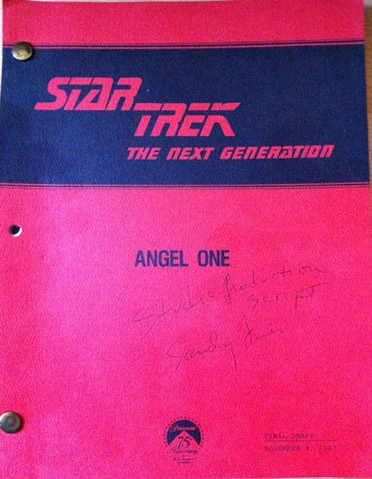
A script is a written version of a film (also known as a screenplay) or television episode (also known as a teleplay), used in the creation of that filmed product. Many Star Trek scripts have been written, some using a working title. Scripts have been used in the creation of all the Star Trek TV series and films.
Scripts typically proceed from a story outline. Scripts are then revised through a series of drafts, each draft given a new color for revision pages. A first draft script initially has completely white pages, though the first draft's colored change pages are later collated with these. Changes to pages, as regards both dialogue and stage directions, are indicated using asterisks on the right side of the page. For the Star Trek TV episodes, most scripts cycled through three or fewer drafts before a final draft was created. Often on Star Trek: Voyager and Star Trek: Enterprise, the first draft didn't encompass the entire episode, with one or more acts still to be written and added. For ENT, an archive copy was created and saved in post-production. A writer's draft script is the last (or pending) version from a freelance writer's own hands who is not on the relevant writing staff, and the story hasn't yet been subjected to the whole room to break.
In the end credits of TOS: "The Squire of Gothos", the word "script" was misspelled "SPIPT".
In four episodes of Star Trek: The Next Generation, scripts can be seen in the background of episodes:
- "Suddenly Human": in sickbay
- "Violations": lying on the steps during a dream sequence
- "Ethics": on the floor of the cargo bay
- "Cost Of Living": on the bed in the guest quarters [1]

.png "Wortham unit (script).png (48 KB)")


Official releases
Some Star Trek scripts have been released to the public in the form of books or computer programs.
- Reference books:
- CD-ROMs: