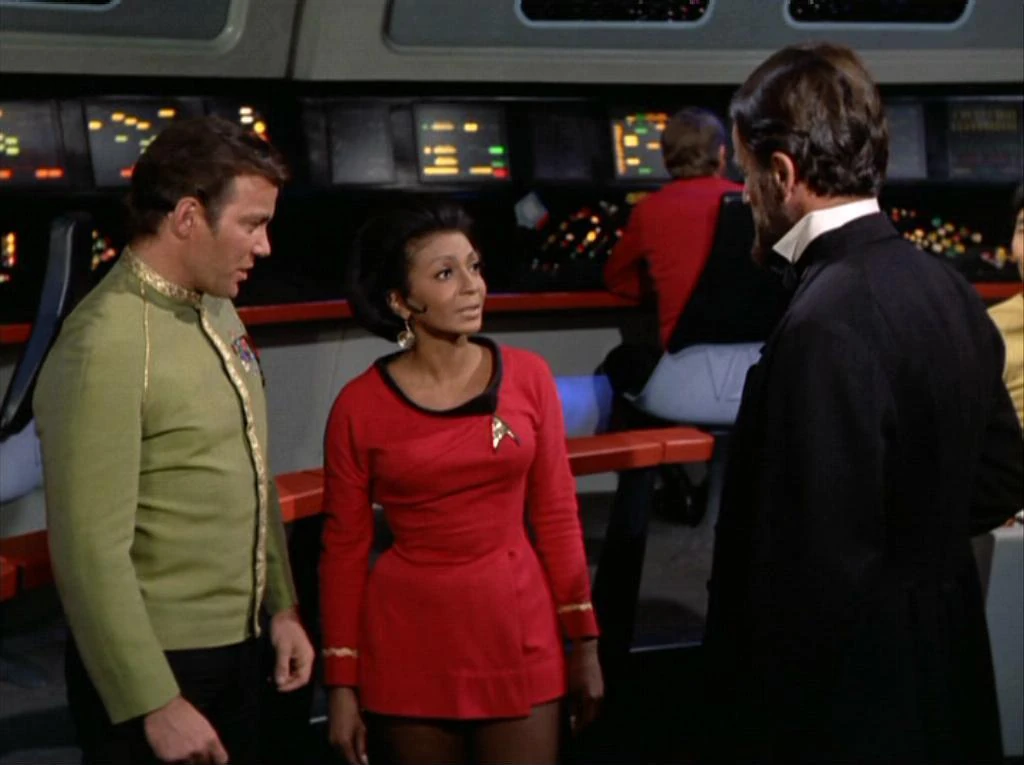

Uhura explains to Lincoln that mankind no longer fears words
Negro, colored, and n***** were terms used for people of African ancestry or appearance (such as having dark skin or being black) throughout the English-speaking world until the mid-20th century.
One notable Negro newspaper was the Amsterdam News. (DS9: "Far Beyond the Stars")
In an alternate timeline 1944, while walking with Alicia Travers, Jonathan Archer was asked by a German if he liked Negroes. He was then told, "When we send her back to Africa, you can go along. You can run through the jungles together."
Alicia explained that her neighborhood used to be a nice one, even for coloreds.
The Germans outlawed colored music such as that of Billie Holiday, but those opposed to them played it in secret.
According to Sal, coloreds were among the resistance. (ENT: "Storm Front")
During Benjamin Sisko's vision of 1950s America, Benny Russell and other people of color were often referred to as Negroes. Herbert Rossoff once joked about the dangers of a Negro with a typewriter (an author).
According to Douglas Pabst, books by Negro authors such as Native Son were "literature for liberals and intellectuals", but the average reader wouldn't spend money on such works. He explained to Russell that Incredible Tales of Scientific Wonder wouldn't publish his Sisko stories because the hero was a Negro captain in charge of a space station, which writers wouldn't accept. Russell then asked if Martians were.
According to Pabst, Russell's fellow contributor Albert Macklin preferred robots to either Negroes or white people.
Later, Jimmy suggested that people of color would never get into space except as shoeshiners, because "as far as they're concerned, we'll always be n*****s."
During a brainstorming session, Macklin suggested Russell make the story of Deep Space 9 a dream, on which Kay Eaton elaborated, saying it could be "someone, er, someone without a lot of hope. A shoeshine boy, a convict, someone dreaming of a better future", after which Pabst concluded she meant the dreamer would be a Negro. Darlene Kursky agreed he would have to be if he was dreaming about a Negro captain.
Willie Hawkins didn't move to better living quarters when he became a famous baseball player because if he did, he'd be "just another coloured boy who can hit a curve ball" instead of being a celebrity in his own neighborhood. (DS9: "Far Beyond the Stars")
The Excalbian recreation of Abraham Lincoln referred to Nyota Uhura as "a charming Negress" before realizing that his words were poorly chosen. He corrected himself by stating that in his time, "some used that term as a description of property." Uhura, however, asked why she should object to that term, explaining that Human philosophy of the 23rd century taught mankind not to fear words and to be delighted with who they were. (TOS: "The Savage Curtain")