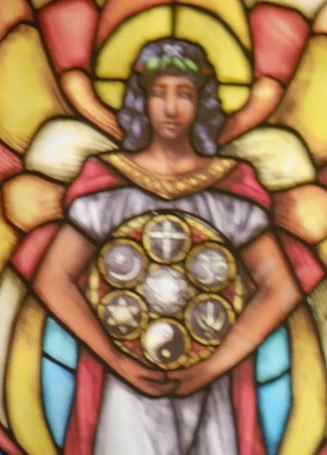

A stained glass window depicting iconography of various Human religions
Human religion refers to any system of associated beliefs held by a Human about one or more supernatural deities, often involving rituals and codes of ethics. While many such belief structures developed naturally, others were influenced by extraterrestrial influences over time. Despite the formation of numerous religions on Earth during recorded history, no single religion predominated the entire Human culture.
During his time on Earth, Doctor Phlox made a point of studying Earth religions. (ENT: "Cold Front")
In the 23rd century, some Federation starships included a nondenominational chapel where weddings and funerals could be held. (TOS: "Balance of Terror", "The Tholian Web")
Both mono- and polytheistic beliefs and traditions existed in the 23rd century. Lara, a 23rd century Human, used the expression: "In the name of the seven Gods!" (TAS: "The Jihad") Earlier, however, Captain James T. Kirk stated that "mankind has no need for Gods. We find the one quite adequate." (TOS: "Who Mourns for Adonais?")
In 2381, when Doctor T'Ana described the god-like superpowers with which strange energy could endow a person, Captain Carol Freeman made note of Humanity's "complicated relationship with organized religion." (LD: "Strange Energies")
Human religions
- Buddhism
- Christianity
- Greek gods
- Hinduism
- Islam
- Judaism
- Kukulkan
- Native American religions
- Polytheism
- Sikhism
Appendices
Background information
Religion in Star Trek
Gene Roddenberry himself is said to have rejected the idea of religion lasting into Humanity's future. Ronald D. Moore commented regarding the fate of specific religions in Trek history: "Gene felt very strongly that all of our contemporary Earth religions would be gone by the 23rd century, and while few of us around here actually share that opinion, we feel that we should leave this part of the Trek universe alone." (AOL chat, 1997) "It was a core tenet of Gene's Trek." (AOL chat, 1997)
Brannon Braga said that "In Gene Roddenberry's imagining of the future [...] religion is completely gone. Not a single Human being on Earth believes in any of the nonsense that has plagued our civilization for thousands of years. This was an important part of Roddenberry's mythology. He, himself, was a secular humanist and made it well-known to writers of Star Trek and Star Trek: The Next Generation that religion and superstition and mystical thinking were not to be part of his universe. On Roddenberry's future Earth, everyone is an atheist. And that world is the better for it." [1](X)
Michael Chabon commented: "It's not just Jews who are absent; it's any kind of explicitly religious characters. I can't think of any explicitly Christian or Hindu or Muslim characters in "Star Trek." We get Vulcan religion, Klingon religion and other [alien] religions, especially the Bajorans [on Deep Space Nine], sometimes discussions of godlike beings, but I don't think the absence of Jews is significant in itself". [2]
Still, the series has never officially stated that religion is totally dead among Humanity or that any religion has died out more that it has taken a back seat to scientific belief. For example, Kirk seems to declare himself (or at least some Humans) as monotheist by saying "Mankind has no need for gods. We find the one quite adequate." (TOS: "Who Mourns for Adonais?") And Kasidy Yates mentioned that her mother would want her daughter to be married by a minister. (DS9: "Penumbra") When Captain Picard was in the Nexus, he found himself with a family celebrating Christmas, despite Picard's open disagreement with religious belief (however, Christmas is often a completely secular holiday) and earlier stated his belief there was some kind of an afterlife. (Star Trek Generations; TNG: "Where Silence Has Lease") Though perhaps a personal view, Dr. Leonard McCoy referenced the biblical story of Genesis as nothing more than mythology when discussing the Genesis Device: "According to myth, the Earth was created in six days. Now, watch out! Here comes Genesis! We'll do it for you in six minutes!" However, the various post-TNG series seem to imply that most Humans, like Captain Picard, have embraced a form of "secular Humanism." In the TNG episode "Who Watches The Watchers", Picard fears that Human interference has "set back" a preindustrial race to an age of religious belief. And with the notable exception of Star Trek: Deep Space Nine, religion is generally portrayed as the result of ignorance, fraud by alien influences, or both. (Even in Deep Space Nine, the Bajoran religion is still displayed as the result of alien influence, albeit in a benevolent fashion.) In some ways the original series acknowledged Human religion in Starfleet more directly, as weddings and funerals took place in a designated ship's chapel. In The Next Generation, Voyager, and Star Trek II: The Wrath of Khan, such ceremonies took place in mess halls, recreation areas like Ten Forward, and/or photon torpedo launch bays.
In DS9: "The Ship" and "The Sound of Her Voice", wakes were featured.
Some subtle religious themes have taken place in the early Star Trek films. For example, Montgomery Scott plays the Christian hymn "Amazing Grace" on his bagpipes during the funeral for Spock in the concluding scenes of Star Trek II: The Wrath of Khan.
In the Star Trek: Enterprise episode "Cold Front", Dr. Phlox says he has taken Holy Mass in Saint Peter's Square in Rome and visited a Buddhist monastery in Tibet. This indicates that several faiths are still alive and practiced.
Star Trek as religion
- The 1999 book Star Trek and Sacred Ground, particularly the essay "Star Trek Fandom as a Religious Phenomenon", discussed how themes in Star Trek "relate to a philosophy of life that fans will commit themselves to," describing "Star Trek as folk religion." Conventions are compared to "religious pilgrimages." [3] [4]
- In the animated comedy Futurama, in the episode "Where No Fan Has Gone Before", Star Trek eventually became a formal religion and threatened the existing power structure. In the West Wing episode "Arctic Radar", Josh Lyman suggested establishing a "Star Trek holiday." A 2006 course at Lake Tahoe Community College examined the "Anthropology of Star Trek", and asked "Is Star Trek a religion?" [5](X) Gregory Smith, an orchestra conductor, remarked in a 2006 studio trailer for Star Trek: Remastered, "We're being very truthful and faithful to the original notes because it's... it's sacred; hallowed ground, this theme." [6]
- There is real-world precedent for science fiction fandom wanting religious recognition, notably the Jedi census phenomenon. Since January 2005, Wiktionary has listed Star Trek as an example along with one definition of religion, "Anything that involves the association of people in a manner resembling a religious institution or cult." [7]
- James Kahn, discussing his work on "The Masterpiece Society", said that "Science fiction fulfills many of the same needs for wonder and awe that religion used to fill, but within the context of a more intellectualized, scientific framework. Science fiction has become the religion of our age." (The Official Star Trek: The Next Generation Magazine issue 28)
- Speaking at a 2006 conference on atheism, Brannon Braga suggested Star Trek as an "atheistic mythology." [8](X)
- A couple who were inspired to join the military as a result of watching Star Trek and Star Trek: The Next Generation said that they turn to episodes such as "Tapestry" and "The First Duty" "like some people turn to the Bible." [9]
Apocrypha
- The comic book story "A Small Matter of Faith" focuses on a Starfleet chaplain.
- Guises of the Mind, a TNG novel, has as one of its chief characters a telepathic Catholic nun, as well as a visit to a monotheistic member-world of the Federation. In this book, Catholicism, at least, is still very alive, and the mission continues on among the stars even to non-Federation planets. Also, Picard recounts visiting a chapel in France, so perhaps they are still preserved as cultural monuments. Jews, Hindus, Buddhists, and Christians are named as crewmen on the ship, and Data himself considers the study of religion. Characters such as La Forge and Picard seem to accept the existence of some kind of higher power but do not go further.
- Creative Couplings, Book 1 and Book 2, a storyline in the Star Trek: Starfleet Corps of Engineers series, featured a wedding between a Jew and a Klingon. [10]
- The Future Begins mentions a chaplain by whom a revived Montgomery Scott feels scrutinized.
- Star Trek: 25th Anniversary, a PC game by Interplay, contains a colony of religious separatists. The scenario, entitled "Demon World", brought the Enterprise to their colony to investigate reported "demon" attacks on the settlers. The demons soon turn out to be a hoax. The player controlling Kirk has the option of responding to the colonists' beliefs with either courteous but non-specific responses, or sarcastic disdain for their beliefs.